
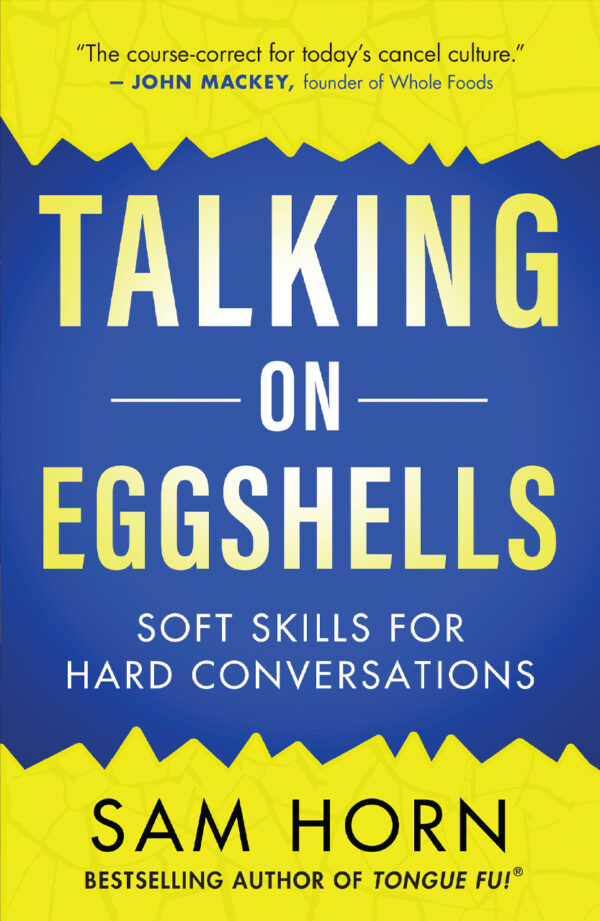
Talking on Eggshells by Sam Horn
Review Editor
admin
Some books arrive at precisely the right cultural moment. Talking on Eggshells: Soft Skills for Hard Conversations by Sam Horn landed in June 2023 into a world that had spent several years sharpening its capacity for division and dulling its capacity for dialogue. Horn, a communication strategist with decades of keynote and coaching experience, offers something genuinely useful: a field guide for the moments when we know we need to say something important but cannot find the words, or when we say the wrong thing entirely and watch the conversation collapse around us.
This is not a book about being nice. It is a book about being effective. Horn draws a careful and important distinction between the two, and that distinction gives the entire project its spine. Politeness without substance produces evasion. Confrontation without skill produces damage. Horn’s goal is the space between those two failure modes, and she navigates toward it with real precision.
Core Argument
Horn’s central premise is that most of us were never taught how to handle difficult conversations. We learned through trial and error, picking up bad habits along the way, and we reach adulthood carrying a collection of reflexive responses that often make things worse. We go silent when we should speak. We overexplain when we should listen. We escalate when we need to de-escalate. The book’s core argument is that these patterns are not personality traits fixed at birth. They are habits, and habits can change.
What makes this argument land is that Horn does not moralize about it. She does not tell readers they are broken or need to be fixed. She treats communication skill the same way a coach treats a golf swing: you have a current technique, the current technique has identifiable flaws, and here are specific adjustments that will produce better results. The tone throughout is encouraging without being saccharine, practical without being cold.
Horn’s broader point, woven through every chapter, is that the quality of our communication directly determines the quality of our relationships, our careers, and our wellbeing. That is not a new idea, but she supports it with enough concrete evidence and vivid illustration to make it feel freshly true.
Key Frameworks
Horn has been teaching what she calls “Tongue Fu” for years, and several of the book’s frameworks draw on that methodology. The most immediately useful is her “W.A.I.T.” prompt: before speaking, ask yourself “Why Am I Talking?” That single question, applied honestly, stops a surprising number of counterproductive responses before they escape into the room.
She also introduces the concept of “verbal judo,” the practice of redirecting conversational energy rather than meeting it head-on. When someone comes at you with aggression, matching the aggression doubles it. Horn shows, through specific scripted examples, how to sidestep rather than block, how to acknowledge without conceding, and how to keep the conversation moving toward resolution instead of just toward a winner.
Another strong framework is her treatment of what she calls “word choice architecture.” The difference between “You always do this” and “When this happens, I feel” is familiar to anyone who has encountered conflict resolution literature, but Horn takes the idea further. She dissects the specific words that trigger defensiveness (accusatory pronouns, absolutes, minimizing phrases) and provides word-for-word replacements. This is not dumbed down. It is a genuine workshop in precision language.
Her chapters on digital communication deserve particular attention. Horn wrote this book in full awareness that most difficult conversations now begin in text, where tone is invisible and misreading is easy. Her guidance on when to escalate from text to voice to in-person, and how to do so without signaling alarm, is among the most timely material in the book.
Practical Application
One of the book’s genuine strengths is its organizational structure. Each chapter addresses a recognizable scenario: the colleague who takes credit for your work, the family member who reliably derails holiday gatherings, the boss who delivers feedback as personal attack, the customer whose frustration has crossed into hostility. Horn does not present abstract principles and leave the reader to reverse-engineer application. She puts you in the scene first, lets you feel the familiar discomfort, and then walks you out of it with specific language.
The scripted exchanges throughout the book are a particular asset. Some self-help books shy away from scripts, worried they will make readers sound robotic. Horn argues the opposite: having rehearsed language available for high-stress moments means your nervous system is not starting from scratch when cortisol is already elevated. The scripts are not meant to be memorized verbatim. They are meant to be internalized as templates, and Horn is clear about that distinction.
Readers who work in customer-facing roles, management, healthcare, education, or any field requiring sustained human contact will find this immediately applicable. But the book earns its broader reach by addressing the personal alongside the professional. The chapters on family communication and on conversations with people we love who are struggling with addiction, grief, or mental health challenges are handled with genuine care and practical wisdom.
Style and Voice
Horn writes the way a skilled trainer talks: directly, warmly, without filler. Her sentences are short enough to move fast and long enough to carry weight. She uses anecdote well, grounding abstract points in specific moments from her own experience and from the many professionals she has coached. The stories feel real because they are told with the kind of specific detail that cannot be manufactured.
The book is organized for dipping as much as for cover-to-cover reading. Each chapter is self-contained enough that a reader facing a specific upcoming conversation can go straight to the relevant section and find usable material. The summaries and pull-quotes Horn provides at key intervals make it easy to return to passages that mattered most on first reading.
There is humor here too, deployed carefully. Horn knows that books about difficult conversations can become relentlessly heavy, and she lifts the tone at regular intervals without trivializing the subject. That balance is harder to achieve than it looks, and she gets it right consistently.
Verdict
Talking on Eggshells is one of the best practical communication books published in recent years, and it earns that standing by refusing to be merely inspirational. Sam Horn gives readers a real toolkit, built from real scenarios, with real language attached to each tool. It does not promise to eliminate conflict from your life. It promises to change your relationship with conflict, and it delivers on that promise through a combination of rigorous thinking and genuine warmth. The 2023 Meridian Award for Business Communication confirms what readers have been discovering on their own: this is a book worth keeping within arm’s reach.
Frequently Asked Questions about Talking on Eggshells
What is Talking on Eggshells about?
Talking on Eggshells: Soft Skills for Hard Conversations by Sam Horn is a practical guide to navigating difficult conversations in professional and personal settings. Horn provides frameworks, scripted language, and real-world scenarios to help readers stay composed, communicate clearly, and resolve conflict without escalation or evasion.
Who is Sam Horn, and what makes her qualified to write this book?
Sam Horn is a communication strategist, keynote speaker, and coach with more than three decades of experience helping professionals and organizations communicate more effectively. She is the originator of the “Tongue Fu” methodology and has worked with clients ranging from Fortune 500 executives to healthcare workers and educators. Her previous books include Tongue Fu! and Got Your Attention?
Is this book primarily for business or personal use?
Both. While Horn draws heavily on workplace scenarios, every framework in the book applies equally to personal relationships. She dedicates substantial chapters to family dynamics, friendships under strain, and conversations with loved ones facing serious challenges. The skills she teaches transfer across every context where human communication happens.
Does the book provide specific scripts, or just general advice?
Specific scripts throughout. This is one of the book’s distinguishing features. Horn provides word-for-word language for dozens of recognizable scenarios, along with explanations of why certain phrases work and others backfire. The scripts are framed as templates to internalize rather than lines to memorize verbatim.
How does Horn handle digital communication in the book?
Horn devotes meaningful attention to text, email, and social media communication, recognizing that many difficult conversations now begin or unfold entirely in digital channels. She covers when to de-escalate from digital to voice or in-person, how to write messages that reduce the likelihood of misreading, and how to handle the particular pressures of online hostility.
What is the “W.A.I.T.” framework Horn introduces?
W.A.I.T. stands for “Why Am I Talking?” It is a self-interruption prompt that Horn recommends using before speaking in any charged situation. The question forces a brief pause to assess whether what you are about to say will move the conversation toward resolution or away from it. Horn describes it as one of the simplest and most immediately effective tools in the book.
Is this a good book for managers and team leaders?
Yes, strongly so. Horn addresses workplace dynamics throughout, including how to deliver corrective feedback, how to handle a team member who is struggling, how to respond to a colleague who is being undermining, and how to manage a difficult client or customer relationship. The book has been recommended by senior leaders at Johnson and Johnson, Genius Network, and Duct Tape Marketing, among others.
How does Talking on Eggshells differ from other communication books?
Most communication books sit closer to one of two poles: the purely inspirational (you can do it) or the purely academic (here is the theory). Horn works in the practical middle. She grounds her frameworks in neuroscience and communication research, but the delivery is scenario-driven and the takeaways are immediately applicable. The density of usable tools per page is unusually high for the genre.
Book Details
- Title
- Talking on Eggshells by Sam Horn
- WritersReview Rating
- 5.0 / 5