
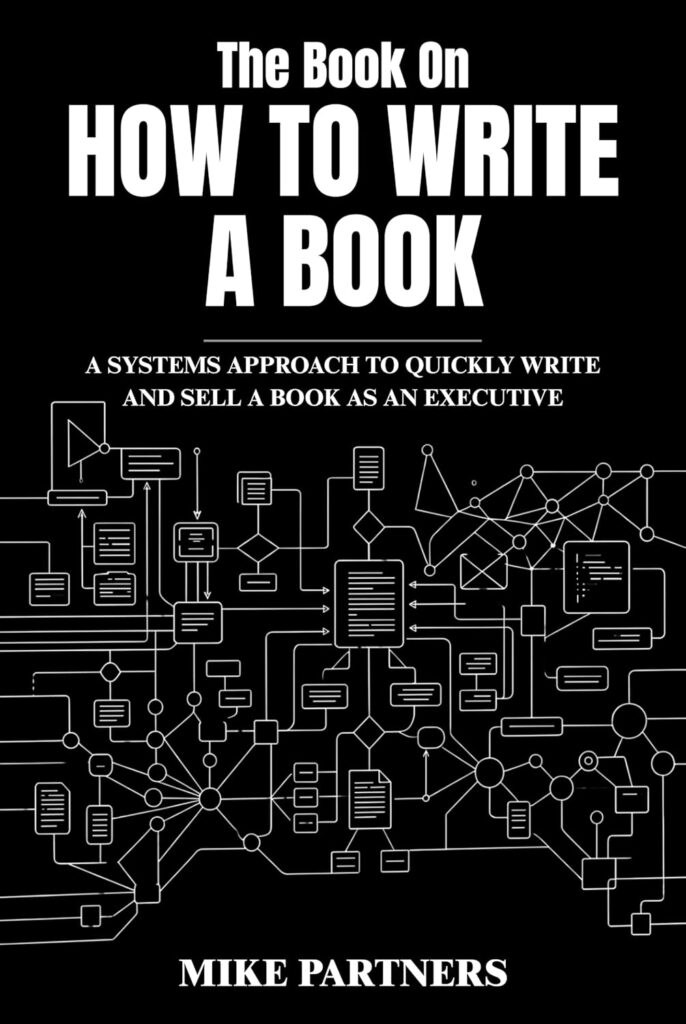
The Book on How to Write a Book
Legacy Printing Inc. · 2024 · 250 pages
ISBN: 9798950846021
Review Editor
Daniel Okafor
Most books about writing a book are, in a quiet way, dishonest. They describe the finished experience of a finished person: how it felt when the words finally came, how the structure eventually emerged, how the struggle was eventually worth it. They document a process in retrospect, which means they document the clean version, the one that already knows how it turns out. Mike Partners takes the opposite approach. The Book on How to Write a Book begins with the assumption that you will not write a book unless you have an engineered system that removes every decision point where you might stall, and that the system has to be built in the right sequence, because sequence is where most people actually fail. The result is one of the more practically specific and psychologically honest books about the executive book-writing process available.
The organizing insight is counterintuitive enough to be genuinely useful: do not start by writing. Start by building the outside of the book first. Write the back cover before you write a word of the manuscript. Write the last chapter before you write the middle. Map every chapter before you fill in any of them. The sequence inverts what most people attempt, and the inversion is not arbitrary. When you write the back cover first, you are defining the promise your book makes to the reader before you have any content to rationalize into that promise. The back cover becomes the brief. Every chapter you write afterward either serves the brief or it doesn’t, and you know which immediately. Partners calls this building from the outside in, and the logic holds across every step of the thirteen-step system the book delivers.
Partners writes as someone who has run the system, watched clients run it, and observed exactly where people stall. That proximity to failure is one of the book’s real assets. He names the specific chapter range where most first-time executive authors stop — between chapter four and chapter eight, when the early chapters are weakest and feel like evidence that the book will never be good — and explains why that experience is structurally predictable rather than personal. He reframes the first draft as a “zero draft,” explicitly not a finished piece of writing but thinking made visible, and then explains exactly what to do with it. The practical reframes are not motivational. They are operational. There is a difference.
Argument and Structure
The Book on How to Write a Book is organized in seven parts across eighteen chapters, each chapter ending with a specific, named deliverable. By the time you finish Part 1, you have four real outputs: a draft back cover, a draft cover brief, a completed last chapter, and a completed first chapter. Not notes. Not intentions. Outputs. This structure-as-commitment is not accidental. Partners is engineering forward momentum by ensuring that every chapter of the book about writing a book produces something that makes the next chapter of your book more inevitable. The sequencing is the system.
The early chapters establish the business case for the book before establishing the writing process. The authority asset argument — that a published book changes how you are introduced, what speaking fees you can command, and what kind of consulting conversations you can initiate — is made specifically, with dollar figures, with named examples. Patrick Lencioni’s single book generating a decade of consulting, workshops, and certification programs is not presented as an inspiration. It is presented as a documented outcome of a system that Partners is about to give you. The framing matters: the reader understands from page one that the book is an investment with specific returns, not a creative project competing with everything else on the calendar.
Parts 3 through 5 contain the operational core: the skeleton method, the layer method, and the chapter engine. The skeleton method is the most original contribution. Partners defines four chapter types — teaching, story, diagnostic, and challenge — and provides a complete example skeleton for each, naming not just the structure but the specific content that goes in each section. The skeleton for a chapter called “Why Your Best Hire Will Also Be Your Biggest Problem” runs 180 words and contains no prose — only the intention for each section, the concept being taught, and what the reader will have completed by the close. Anyone can read that skeleton and know exactly what the chapter needs to be. That is the design goal and the system delivers it.
Key Concepts
The back-cover-first methodology is the book’s central and most defensible innovation. The back cover is not marketing copy added at the end of the process; it is the brief for the entire project. Its hook identifies the specific reader. Its promise states what the book delivers. Its bullets describe outcomes, not topics. Partners is specific about this distinction: “Create your morning routine” is a topic. “Build a 90-minute morning structure that adds three hours of effective capacity to your day without extending it” is an outcome. The back cover written around outcomes tells the reader exactly what they are purchasing, and it tells the author exactly what they are writing. When they diverge, the manuscript loses direction. When they align, every chapter writes itself against a fixed target.
The podcast pre-sell strategy is the book’s second major contribution, and it is underrated relative to how central it is to the system. Partners recommends recording twelve to fifteen podcast episodes on the core ideas of your book while the manuscript is being written, using those episodes to build an email list, and using the email list to generate pre-orders. The recordings serve double duty: they build an audience before the book exists, and they generate transcript content that can be shaped into chapters. By launch day, you do not have a new book looking for readers. You have readers who have been waiting for a finished product they already understand. That is a structurally different launch. The system was designed around this outcome from the beginning.
The Chapter 15 section on what makes a book exceptional — the one unforgettable idea, the reader as hero, vulnerability on the page, and the quotable line — is the most intellectually substantive part of the book. The argument that the reader must be the protagonist of the book, not the author, is made with precision. The author’s experience is the source material. The reader’s transformation is the subject. Every time the authorial “I” dominates a chapter, the reader recedes into the role of observer. Observers do not recommend books. Partners gives a specific diagnostic: read three random chapters and count the paragraphs centered on the author’s experience versus the reader’s next action. Any balance above roughly 30 percent author to 70 percent reader is worth examining. That kind of specific, testable guidance is what separates this book from the writing advice that stays at the level of principle.
Influence and Voice
Partners writes in a stripped, declarative style that suits the material without calling attention to itself. The sentences are short. The paragraphs are organized around single points. The prose does not strain for effect because effect is not the goal. The goal is forward motion, and the style enforces it. When he describes the four categories of editorial problems — structural, framing, voice, and mechanical — and explains that mixing the passes is how authors spend three hours editing one chapter and never finish the manuscript, he is not being stylistically impressive. He is being operationally useful, which is the appropriate ambition for a book of this kind.
The book’s most effective moments are the ones where Partners describes a failure mode from the inside: the author who evaluates a chapter draft against the standard of a finished book and concludes they cannot produce something worth reading; the first-time book writer who reads chapters four through eight and mistakes a predictable dip in first-draft quality for evidence of permanent inadequacy; the executive who resists vulnerability on the page because they believe expertise requires the performance of always having known the answer. In each case, Partners names the specific wrong thought, explains why it is structurally predictable, and tells you exactly what to do instead. This is more useful than encouragement and more honest than inspiration.
Verdict
The Book on How to Write a Book does something most writing books do not: it respects the reader’s time enough to be completely specific. There are no vague encouragements to “find your voice” or “trust the process” without explaining what the process actually is. Every step produces a named deliverable. Every deliverable serves the next step. The system is designed so that each completed piece of work makes the next piece of work more tractable, and the book earns its promise that following the sequence produces a manuscript where improvising the sequence does not.
The ideal reader is an executive or senior professional who has been meaning to write a book for years, has the material, knows the audience, and has never found a system concrete enough to follow from intention to completion. For that reader, this book is unusually well matched to the actual problem. It does not give you inspiration. It gives you a sequence, a set of deliverables, and an explanation of why the sequence produces the outcome. That is what the problem requires, and the book delivers it with precision and an unusually honest accounting of where the system demands something difficult from you.
Frequently Asked Questions about The Book on How to Write a Book
What is The Book on How to Write a Book by Mike Partners about?
The Book on How to Write a Book is a 13-step system for executives and business professionals who want to write and publish a book without clearing their schedule or treating the project as a long-term creative endeavor. The system inverts the conventional writing sequence: it begins with the back cover, then the last chapter, then the first chapter, and builds the middle of the book from a complete map. The book covers everything from initial positioning through manuscript production, editing, and a day-by-day launch strategy, with a specific deliverable produced at the end of each chapter.
Who is The Book on How to Write a Book written for?
The book is specifically written for executives, senior professionals, consultants, and entrepreneurs who have subject matter expertise and an audience to serve but have not been able to complete a manuscript through conventional methods. It is most useful for people who have started a book multiple times and stalled, who have the ideas but cannot find a system specific enough to follow, or who understand intellectually that a book would build their authority and business but have not found a process that fits their actual working life. It is not written for novelists or literary writers. The frameworks are designed specifically for non-fiction authority books.
What is the back-cover-first methodology?
The back-cover-first methodology is the book’s central innovation. Instead of writing the manuscript and then figuring out how to market it, Partners instructs the author to write the back cover before writing a single chapter of the manuscript. The back cover functions as the brief: it defines the hook (who the book is for), the promise (what the reader gets), and the outcome bullets (specific results, not topics). Every chapter written afterward is evaluated against the back cover brief. If a chapter serves the promise, write it. If it does not, cut it or revise it until it does. The back cover turns a creative project into a deliverable with a specification, which is the frame that allows executives to treat writing a book like any other business project they actually complete.
What is the podcast pre-sell strategy described in the book?
The podcast pre-sell strategy involves recording twelve to fifteen podcast episodes on the core ideas of your book while the manuscript is being written. Each episode covers one concept from the book and points listeners toward a pre-order page or email list. The episodes build an audience before the book exists, generate email subscribers who become pre-order customers, and produce transcript content that can be shaped into chapters. By launch day, the author has a warm audience who has been listening for months and is ready to purchase, rather than a finished product with no existing readership. The strategy treats the writing process as simultaneous with the audience-building process, which changes the economics of the entire project.
How does the chapter skeleton method work?
The chapter skeleton is a 100-to-200-word document for each chapter that names the opening, the core concept or framework, and the closing exercise or application — without writing any of the actual prose. The skeleton points to the story the chapter will use without telling it. It names the framework without explaining it. It identifies the exercise without writing the instructions. Anyone who reads a chapter skeleton knows exactly what the chapter needs to be. The skeleton can be recorded as a podcast episode, handed to an editor, or used as a script for a dictation session. Its purpose is to separate the work of designing a chapter from the work of producing one, which allows both to be done more effectively.
What does the book say about editing a manuscript?
The book recommends editing in four specific passes in a specific order: structure first, then openings and closes, then voice, then mechanics. The structural pass catches wrong sequencing, missing deliveries, and chapters that belong elsewhere. The opening and close pass catches framing problems — places where the book promised something it did not deliver. The voice pass catches inconsistency in tone and prose register. The mechanical pass catches typos, grammar errors, and sentences that work but could be tightened. The book is explicit that mixing passes is how authors spend hours editing one chapter and never finish the manuscript. It also strongly recommends hiring a professional editor — specifying a budget range of $2,000 to $6,000 — as a non-optional investment rather than a luxury.
What is the Layer Method for writing chapters?
The Layer Method is an approach to drafting that separates different kinds of content into sequential passes rather than trying to write a complete, polished chapter in a single session. Layer one is the structural skeleton in prose: the core argument, the framework, the exercise. Layer two adds the stories and specific examples that support the framework. Layer three adds depth — the counterintuitive element, the challenge to the reader’s assumptions, the harder question the chapter needs to ask. Layer four is the polish pass, where the prose is tightened and the voice is made consistent. Each layer is faster and more focused than trying to write all of it at once, and the result is a chapter that is more complete at each stage than a single-pass draft typically achieves.
How long does it take to write a book using this system?
Partners does not give a single fixed timeline, because the honest answer depends on the author’s available time and the length of the book. What the system is designed to do is compress the elapsed calendar time by eliminating the stall points where most executive authors lose weeks or months: the undefined direction, the paralysis of a blank page, the endless revision of early chapters before the middle is written, and the lack of a launch plan that turns publication into a quiet release rather than a coordinated event. Authors who follow the full system, including the podcast pre-sell strategy, typically find that the manuscript itself takes two to four months of part-time work. The podcast content and audience-building run in parallel with the writing and extend the project to six to nine months total, at the end of which there is both a finished manuscript and an audience ready to buy it.
Book Details
- Title
- The Book on How to Write a Book
- Author
- Mike Partners
- Genre
- Business
- Publisher
- Legacy Printing Inc.
- Year Published
- 2024
- Pages
- 250
- ISBN
- 9798950846021
- WritersReview Rating
- 4.8 / 5