
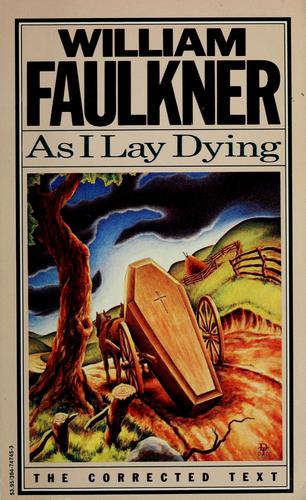
William Faulkner wrote As I Lay Dying in six weeks while working night shifts at a power plant, composing it in the spaces between work and sleep. Published in 1930, it tells the story of the Bundren family’s journey across Mississippi to bury their matriarch Addie in her hometown of Jefferson. The journey is deliberately difficult, and the difficulty is both literal (a flooded river, a barn fire, rotting heat) and metaphorical. The novel’s fifty-nine sections, voiced by fifteen different narrators, constitute one of the most formally ambitious works in American fiction and one of the most darkly funny.
What Happens in As I Lay Dying
Addie Bundren is dying when the novel opens. Her husband Anse, her sons Cash, Darl, Jewel, and Vardaman, and her daughter Dewey Dell will carry her coffin to Jefferson in a horse-drawn wagon, a journey that should take a few days and that takes more than a week due to disasters both natural and human. A flood makes the river crossing catastrophic; a barn fire, apparently set by Darl, destroys the coffin and the animals; the July heat does what July heat does to an unrefrigerated body.
Each family member narrates one or more sections, revealing what that person wants, fears, and understands about the journey. Anse wants new teeth and intends to acquire a new wife in Jefferson. Cash, a carpenter of painstaking precision, has built the coffin according to specifications he considers correct and has broken his leg in the river crossing. Jewel, who is not Anse’s biological son, loves his horse with a ferocity that transfers all the feeling he cannot otherwise express. Vardaman, the youngest, is trying to understand what death means to a child. Dewey Dell is pregnant and has come to Jefferson hoping to find someone who will help her end the pregnancy. Darl, the most perceptive and most verbal of the Bundrens, sees everything and cannot act on what he sees in ways the others can accept.
Addie Bundren’s Section
Addie speaks once, from the dead, in a section placed roughly in the novel’s middle. Her monologue is a tour de force: bitter, precise, and illuminating of everything that has happened and will happen. She describes her marriage to Anse as a swindle, her understanding of words as false containers for the things they name, and her belief that the only truth is in the body – in blood and pain rather than in language. This section retroactively transforms everything the reader has understood about the family.
Faulkner places the dead woman’s voice at the center of a novel about the journey to honor her, and the irony is devastating: what the family is doing for Addie is not what Addie would have wanted.
The Multiple Voices
The novel’s fifteen narrators are not equals. Cash’s sections are lists: numbered justifications for the angle at which he built the coffin. Vardaman’s sections achieve a child’s associative reasoning in a form that can make readers laugh and break their hearts simultaneously (“My mother is a fish” is one of the most discussed sentences in American literature). Darl’s sections are the most formally ornate, his language a measure of his distance from the pragmatic world his family inhabits.
The formal variety does not produce incoherence; Faulkner controls his fifteen voices without ever confusing one with another.
The Dark Comedy
The novel is genuinely funny. Anse’s self-pity is a comic creation; his ability to extract labor and sacrifice from everyone around him while contributing nothing himself and believing genuinely in his own virtue is one of literature’s great comic portraits. The escalating disasters of the journey have a comic momentum that does not cancel their seriousness. Faulkner understood that tragedy and comedy are not mutually exclusive; the Bundrens’ journey is both simultaneously.
Who This Book Is For
Readers who want Faulkner without the sustained formal difficulty of The Sound and the Fury, who are interested in Southern American life and death, or who want a novel that is structurally innovative without being impenetrable will find As I Lay Dying an extraordinary experience. It is the better entry point to Faulkner and a masterpiece in its own right.
Frequently Asked Questions
- What does “My mother is a fish” mean?
- Vardaman, the youngest Bundren, is trying to understand his mother’s death. He has just caught a fish and watched it be transformed from living animal to pieces of flesh. He associates this transformation with what has happened to his mother. The sentence is both comic and deeply sad.
- Why does Darl set the barn on fire?
- Darl has the clearest view of what the journey means and what it costs. His act of arson is an attempt to end the degradation of the journey and give Addie an end more dignified than what Anse’s quest for new teeth and a new wife will produce.
- Is As I Lay Dying easier to read than The Sound and the Fury?
- Most readers find it more accessible. The multiple narrators are more clearly demarcated, and the chronology is linear. The Vardaman and Darl sections are the most formally challenging.
- What does Anse Bundren want?
- Anse wants new teeth, which he has been denied for years. He obtains them, and a new wife, by the novel’s end. His priorities throughout the journey are entirely oriented toward this personal agenda, not toward honoring Addie.
- Is the novel set in a specific time period?
- It is set in 1920s Mississippi. The landscape, the poverty, the family’s isolation, and the specific hardships of their journey are characteristic of rural Depression-era Southern life.
- What happens to Dewey Dell’s pregnancy?
- Dewey Dell is tricked by a drugstore clerk in Jefferson who provides her with a fake remedy in exchange for sex. Her situation ends where it began, with no resolution.
- What happens to Darl at the novel’s end?
- The family commits him to a state asylum. Darl’s response – laughing and referring to himself in the third person – is the most disturbing and most discussed ending to a character in Faulkner’s fiction.
- Is Addie Bundren a sympathetic character?
- Her single section reveals a woman who has been profoundly disappointed by life and who has responded with a combination of stoicism and quiet cruelty. She is not sympathetic in a conventional sense, but she is fully realized and her perspective transforms the novel’s moral landscape.
Book Details
- Title
- As I Lay Dying
- Author
- William Faulkner
- Genre
- Literary Fiction
- Publisher
- Vintage Books
- ISBN
- 9780394747453
- WritersReview Rating
- 5.0 / 5