
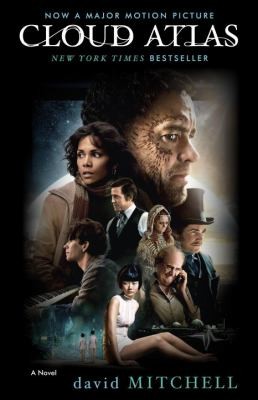
Cloud Atlas
Random House · 2004 · 509 pages
ISBN: 9780812984415
Review Editor
Eleanor Marsh
Cloud Atlas comprises six nested stories spanning roughly five centuries, from a mid-19th century Pacific voyage to a post-collapse Hawaii. Each narrative is interrupted at its midpoint and resumed in reverse order: the novel opens a story, opens another, opens another, keeps opening, reaches the center, then unfolds back out. The stories include a Victorian notary’s journal from the Pacific, letters from a young British composer in 1930s Belgium, a thriller set in 1970s California, a darkly comic contemporary story about a British publisher, a dystopian thriller set in near-future corporate Korea, and an oral narrative from post-apocalyptic Hawaii. Across all six, a character bears a comet-shaped birthmark.
Character Arcs
Each story has its own protagonist, and Mitchell gives each a distinct voice and register — a Victorian journal reads nothing like a Korean corporate state document, and Mitchell sustains both convincingly across 500 pages. The most affecting arcs belong to Luisa Rey, the California journalist who pursues a nuclear cover-up at genuine personal cost, and Sonmi-451, the fabricant (a clone worker) in near-future Korea whose politicization and eventual execution become the founding mythology of the Hawaiian civilization that forms the novel’s center. The comet birthmark connecting these characters is Mitchell’s suggestion of metempsychosis — a soul reincarnating across bodies and centuries — though he doesn’t insist on the metaphysics, leaving it open to structural interpretation.
Pacing
The structure is daring and largely earns its ambition. Each story is interrupted at a moment of tension; the effect is that you read forward through accumulating suspense, then discharge it on the way back out. Some stories are more absorbing than others. The publisher comedy — Timothy Cavendish’s farcical imprisonment in a care home — is genuinely funny in ways that initially feel like relief but that can overstay their welcome. The Hawaiian sections are the most demanding (Mitchell invents a degraded future English called Valleyspeak) but reward the effort with the novel’s most emotionally direct material. Readers who struggle with the structural interruptions in the first half will find the second half far more satisfying.
Thematic Depth
The novel’s recurring concern is predacity — whether human civilizations always organize themselves around the exploitation of some group by another. Each of the six stories features someone weaker being consumed by someone stronger: indigenous people, workers, clones, the elderly, the colonized. Mitchell refuses to resolve this pattern into optimism or pessimism. The stories don’t build toward progress or toward apocalypse but toward something more honest: the pattern persists, and so does resistance to it. The structural choice to interrupt each story mid-sentence and resume it later suggests that history rhymes rather than progresses — the same conflicts played out in different costumes across different centuries.
Style and Voice
Mitchell’s feat of ventriloquism is the novel’s greatest technical achievement. The six distinct prose styles are not mere affectations — they shape how each story’s world feels from the inside. The Victorian journal is slightly stilted and grandiose in the way 19th-century travel writing tends to be. The 1970s California thriller uses the clipped propulsion of genre fiction. Sonmi-451’s interview transcript has the formal precision of state bureaucracy. These voices do double duty as both character and worldbuilding, which is why the novel’s ambition feels justified even when some sections drag.
Verdict
Cloud Atlas is genuinely ambitious, and Mitchell largely justifies that ambition. It is not a comfortable read — it demands patience through slower sections and sustained concentration to track its connections — but it rewards that investment with a structure that works on you across hundreds of pages. The novel is strongest when it engages with how exploitation persists across history; it is weakest when structural cleverness overshadows the human material underneath. A book that achieves most of what it sets out to do, which is more than most novels can claim.
Rating: 4.2 out of 5
Book Details
- Title
- Cloud Atlas
- Author
- David Mitchell
- Genre
- Literary Fiction
- Publisher
- Random House
- Year Published
- 2004
- Pages
- 509
- ISBN
- 9780812984415
- WritersReview Rating
- 4.2 / 5