
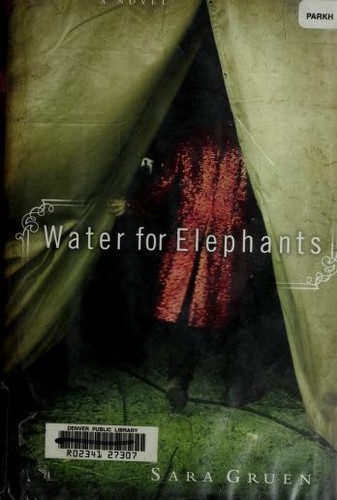
Water for Elephants
Algonquin Books · 2006 · 335 pages
ISBN: 9781565124998
Review Editor
Eleanor Marsh
Jacob Jankowski tells his story from two vantage points. In one, he is 23 years old: a Cornell veterinary student whose parents die in a car accident the week before his final exams, leaving him broke, adrift, and with no plan except the one that appears when he stumbles onto a moving circus train. In the other, he is 93, living in a nursing home and reliving those months with increasing vividness as a circus sets up across the road. On the Benzini Brothers Most Spectacular Show on Earth, Jacob falls into the orbit of Marlena, an equestrian performer, and August, her volatile, charming, possibly psychopathic husband who runs the animal operation. At the center of their triangle is Rosie, an elephant who understands Polish and is becoming the fulcrum of more than one person’s fate.
Character Arcs
Jacob is appealing but slightly underwritten — his principal quality is decency, which makes him a reliable moral anchor in a world of casual cruelty, but decency alone doesn’t generate much dramatic tension. Marlena is similarly idealized and rarely exists fully outside her relationship to the men around her. August is the novel’s most alive character precisely because he operates in multiple registers at once: charming and menacing, perceptive and oblivious, capable of extraordinary warmth and sudden cruelty. The novel is most honest when it acknowledges that even sympathetic characters find August compelling before they find him frightening. The nursing home Jacob deserves a stronger novel of his own — his fury at being managed, his grief for the people he’s outlived, and his need to tell this particular story give those sections a depth and wry humor that the 1930s sections sometimes lack.
Pacing
Gruen handles the Depression-era circus world with genuine authority. The research feels worn-in rather than inserted, and the setting — its hierarchies, its performers and roustabouts, the constant work of rigging and tearing down and moving — comes alive in specific, convincing detail. The central love triangle is less compelling than the world it inhabits, and the novel’s climax, which pivots on a fairly conventional twist, feels like it belongs to a less interesting story than what came before it. The book moves — it’s 330 pages that read shorter — and the alternating timeline gives Gruen a useful structural rhythm, even when the material in one frame is stronger than the other.
Thematic Depth
The novel is partly about how circus culture requires everyone to perform their identities continuously — the showmanship, the maintained fiction that everything is spectacular, the gap between what the audience sees and what sustains it backstage. Jacob’s entry into this world mirrors his entry into adulthood under crisis: he was about to inherit his father’s practice and instead inherits nothing, and the circus requires him to make himself up from scratch. The treatment of animals — Rosie in particular — is not merely a plot mechanism. August’s cruelty to Rosie is depicted in specific, disturbing terms, and Jacob’s growing horror at what happens to animals in the circus economy is one of the book’s genuine ethical threads.
Style and Voice
Gruen writes readable, efficient prose that gets out of its own way. The Depression-era setting is evoked through specific detail rather than heavy atmospheric prose, which serves the story well. The voice distinction between young Jacob and old Jacob is convincing: the younger sections have an urgency and naivety the older sections don’t need, while the nursing home chapters have a rueful, wry quality that comes from someone who has seen enough to know what matters and what doesn’t. The book is genuinely fun to read, which is a quality that serious literary criticism tends to undervalue but readers do not.
Verdict
Water for Elephants is better than its beach-read reputation suggests, but also not quite the novel it could have been. Gruen’s circus world is genuinely vivid, August is a compelling and unsettling creation, and the older Jacob sections carry real emotional weight. The love story at the center is the weakest element — Marlena barely exists as a character, and the romance has an inevitability that drains it of tension. A satisfying read that doesn’t fully cash in on its best ideas, but one that earns its affection for the world it creates.
Rating: 3.9 out of 5
Book Details
- Title
- Water for Elephants
- Author
- Sara Gruen
- Genre
- Literary Fiction
- Publisher
- Algonquin Books
- Year Published
- 2006
- Pages
- 335
- ISBN
- 9781565124998
- WritersReview Rating
- 3.9 / 5