
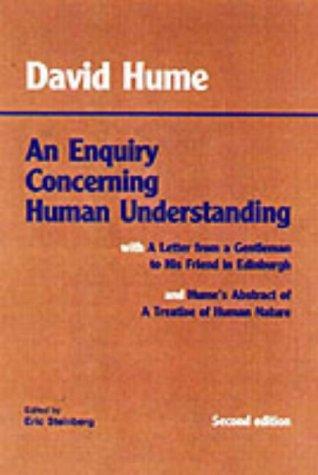
An Enquiry Concerning Human Understanding
Oxford University Press · 1748 · 192 pages
ISBN: 9780199549177
Review Editor
Owen Strand
Summary
David Hume published An Enquiry Concerning Human Understanding in 1748, presenting a revised and more polished version of the epistemological arguments he had first attempted in his youthful Treatise of Human Nature. Hume himself considered the Enquiry his definitive statement on the subject, and he was right. Where the Treatise was sprawling and sometimes obscure, the Enquiry is taut, lucid, and precise. It remains one of the most important works in the Western philosophical tradition and one of the most readable.
The book opens by distinguishing two types of philosophy: the easy and obvious moral philosophy concerned with practical virtue, and the accurate and abstruse philosophy that examines human understanding itself. Hume aligns himself with the latter tradition, but with a crucial difference. He does not want philosophy to become so technical that it loses touch with human life. His goal is to examine the mind scientifically, to map its operations and limits, and in doing so to clear away the obscurantism and metaphysical speculation that has cluttered European thought since antiquity.
The Enquiry’s central project is an investigation into the origins of our ideas and the nature of our knowledge claims. Hume argues that all meaningful thought traces back to sensory experience, that what we call ideas are faint copies of impressions received through the senses. This apparently simple claim has devastating consequences for traditional metaphysics. If no impression corresponds to a concept, that concept is empty. Hume deploys this criterion relentlessly, using it to undermine claims about the soul, about the nature of God, and most dramatically, about causation itself. The result is a philosophy that is empiricist in method and deeply skeptical in conclusion, yet written with a clarity and even a certain wry pleasure in its own implications.
Character Arcs and Development
There are no characters in a philosophical treatise, but Hume’s Enquiry has something better: ideas that develop, transform, and collide with mounting force. The intellectual drama centers on the concept of causation, and what Hume does with it in Section IV is one of the great moments in the history of philosophy.
Hume begins gently, offering straightforward observations about how human minds form ideas. Then, in Section IV, he springs his trap. We believe that every event has a cause, that the future will resemble the past, that fire will continue to burn. But what justifies these beliefs? Not logic: there is no contradiction in imagining that the sun will not rise tomorrow, or that bread will fail to nourish. Deductive reasoning cannot establish causal necessity. What about experience, then? Experience can only tell us what has happened, never what must happen. The inference from observed regularities to necessary connections is itself a habit of mind, not a rational deduction. This is the problem of induction, and Hume states it with a precision that has never been bettered.
The billiard ball example becomes one of philosophy’s most enduring thought experiments. We watch one ball strike another and the second ball move. We see constant conjunction, not necessary connection. The power by which the first ball moves the second, the hidden force that metaphysicians have always invoked, is simply nowhere to be found in experience. Causation, on Hume’s account, is a projection of mental habit onto the world. The mind, observing repeated conjunctions, develops a felt expectation, and then mistakes that internal feeling for an external necessity.
Section X, on miracles, extends the empiricist logic into theology. The argument is elegant and still controversial. A miracle by definition violates natural law. Our evidence for natural laws consists in the accumulated testimony of human experience. No testimony, however reliable, can outweigh the uniform experience of nature, because the improbability of a miracle always exceeds the improbability that witnesses erred or deceived. It is always more reasonable to doubt the testimony than to accept the miracle. The argument caused Hume serious trouble in his own lifetime and remains a genuine flashpoint today.
Pacing
The Enquiry moves with remarkable efficiency for a philosophical text. Hume’s twelve sections are short, focused, and largely self-contained. A reader can work through the core argument in a single long sitting and feel they have followed a genuine intellectual journey from beginning to conclusion.
The pacing is not uniformly perfect. Section IX, on the reason of animals, reads slightly as a digression, interesting but less essential than what surrounds it. Hume wants to show that if animals learn from experience without pure reason, then human beings, who learn the same way, cannot appeal to reason to distinguish their cognitive processes. The point is philosophically important, but the section interrupts the momentum built from the causation arguments.
Otherwise the progression is excellent. Each section builds on what precedes it, and the culminating Section XII, which steps back to consider the overall character of Hume’s skeptical philosophy, provides genuine intellectual satisfaction. Hume’s distinction between excessive skepticism, which he rejects as unlivable, and mitigated skepticism, which he endorses, closes the book on a note that is cautious, wise, and oddly reassuring. The Enquiry is one of the rare philosophical texts that earns its ending.
Deeper Thematic Exploration
The Enquiry’s deepest theme is the relationship between what we can know and what we cannot avoid believing. Hume is a genuine skeptic about the rational foundations of many of our most basic beliefs: causation, induction, the external world. But he is not a skeptic who recommends that we stop believing these things. We cannot stop. The belief in causation is not a conclusion we reach; it is a disposition we have. Custom and habit, not reason, govern the fundamental operations of the mind.
This creates what might be called Hume’s productive tension. The philosopher sitting in his study can demonstrate, rigorously, that there is no rational basis for believing that the future will resemble the past. Then he walks out of his study and acts, exactly as everyone else does, on the assumption that it will. Philosophy reveals the limits of reason without providing any alternative. We are left with nature, habit, and the fortunate fact that our instincts are generally reliable enough.
The section on free will and necessity, Section VIII, deploys the same method to dissolve an ancient quarrel. The debate between freedom and determinism, Hume argues, has persisted because both sides have mistaken verbal disputes for substantive ones. Necessity in human action means nothing more than regular patterns of behavior that allow us to make predictions, the same regularity we observe in the physical world. Liberty means nothing more than acting according to one’s own motives rather than external compulsion. Defined this way, liberty and necessity are not only compatible but mutually required. This compatibilist resolution remains enormously influential in contemporary philosophy of action.
Throughout, Hume insists on a strict empiricist standard: when any term is used, ask what impression gave rise to this idea; when any claim is made, ask what possible experience could confirm or disconfirm it. This verificationist criterion, which anticipates the logical positivism of the twentieth century, is used to clear the field of metaphysical debris. The Enquiry ends with its most famous passage, suggesting that any volume not containing abstract reasoning concerning quantity or number, or experimental reasoning concerning matters of fact, should be committed to the flames. It is one of the great philosophical provocations, all the more striking for being expressed in perfectly measured prose.
Style and Voice
Hume’s prose is a remarkable achievement: philosophically precise without being dry, intellectually demanding without being obscure, and occasionally lit by moments of sardonic wit that make it genuinely pleasurable to read. The sentences are long by contemporary standards, built from balanced clauses in the eighteenth-century manner, but Hume controls his syntax with complete confidence. He never buries the reader in subordinate clauses or retreats behind technical jargon when plain language will serve.
His examples are concrete and often vivid: the billiard balls, Caesar’s assassination, Xerxes crossing the Hellespont. Philosophy, for Hume, must remain in contact with the observable world, and his prose style enforces this requirement at every turn. There is also a quality of controlled irony running beneath the surface. Hume takes genuine pleasure in what he is doing, in the spectacle of reason examining its own foundations and finding them to be something other than reason.
The famous passage about consigning metaphysical volumes to the flames is not really angry; it is almost amused. The same quality appears in the miracles argument, where the logical trap is sprung with what feels like quiet satisfaction. Hume is a philosopher who enjoys his work. For modern readers, the prose may initially feel slightly formal. The conventions of eighteenth-century English are not entirely transparent to twenty-first-century eyes. But the difficulty is minor, and the reward is access to one of the finest examples of philosophical writing in the English language.
Verdict
An Enquiry Concerning Human Understanding is an essential book, and not just historically. Hume’s arguments remain alive, still contested, still generating new philosophical work nearly three centuries after they were written. The problem of induction has never been resolved. The compatibilist account of free will remains a live position in contemporary debate. The verificationist criterion for meaningfulness shaped the whole trajectory of twentieth-century analytic philosophy.
The Enquiry earns its place on any serious reader’s shelf, and not as a monument to be admired from a distance. It is short enough to read, clear enough to follow, and provocative enough to disturb. That last quality is perhaps the most important one. Hume does not invite comfortable agreement. He shows you, with patient precision, that many things you thought you knew are not known in the way you assumed. What remains, once the metaphysical illusions are cleared away, is a philosophy rooted in human nature, experience, and the honest acknowledgment of uncertainty.
Rating: 4.3 out of 5. Essential reading for anyone interested in epistemology, the philosophy of science, or the history of ideas. Readers who prefer philosophy with definitive answers rather than rigorous questions may find it unsettling, which is precisely the point.
Frequently Asked Questions
What is An Enquiry Concerning Human Understanding about?
It is a philosophical investigation into the nature and limits of human knowledge. Hume examines how the mind forms ideas, what counts as genuine knowledge, and why many traditional metaphysical claims turn out to be unfounded. The book’s central topics are causation, induction, miracles, free will, and the proper scope of human reason.
Is An Enquiry Concerning Human Understanding hard to read?
It is more accessible than most philosophy of its era. Hume writes in polished eighteenth-century English, with concrete examples and a clean argumentative structure. Readers unfamiliar with philosophy may need to read slowly and may benefit from a modern edition with explanatory notes, but no specialized training is required to follow the arguments.
What is Hume’s main argument about causation?
Hume argues that we never directly observe necessary connection between cause and effect. We see constant conjunction, one event regularly following another, and our minds develop a habitual expectation. Causation, on this account, is a feature of how we perceive the world, not something we can observe in the world itself. The underlying power connecting cause to effect is nowhere to be found in experience.
What is the problem of induction and how does Hume state it?
The problem is that no logical argument can justify inferring future events from past observations. Hume points out that the assumption that the future will resemble the past cannot be proven by logic, since there is no contradiction in denying it, and cannot be justified by experience without circular reasoning. We infer that fire will burn because it always has, but that inference relies on the very assumption it is supposed to justify.
What does Hume argue about miracles?
Hume argues that testimony for a miracle can never rationally outweigh the evidence from uniform human experience for the laws of nature. Since a miracle is by definition a violation of natural law, accepting one requires that testimony be more credible than the entire accumulated weight of human experience. Hume contends that this condition is never met, making rational belief in miracles unjustifiable.
How does Hume approach free will?
Hume argues that the apparent conflict between free will and determinism dissolves once the terms are clearly defined. Human behavior shows regular, predictable patterns, which he calls necessity, while free action simply means acting from one’s own motives rather than external constraint, which he calls liberty. On this compatibilist view, liberty and necessity are not only consistent but mutually required for moral responsibility to make sense.
How does the Enquiry relate to Hume’s other works?
The Enquiry is a revised and condensed version of the epistemological sections of Hume’s earlier A Treatise of Human Nature (1739-40). Hume considered the Enquiry his definitive treatment and repudiated the Treatise in his autobiography, calling it a work that fell dead-born from the press. Most scholars today read both texts, but the Enquiry is the better starting point for new readers.
Why does the Enquiry still matter today?
Hume’s arguments set the agenda for much of subsequent epistemology, philosophy of science, and analytic philosophy. The problem of induction, the analysis of causation, and the compatibilist account of free will all remain active research areas. His empiricist criterion for meaningful claims directly influenced logical positivism, and his skepticism about metaphysics continues to shape debates about the limits of what science and reason can establish.
Book Details
- Title
- An Enquiry Concerning Human Understanding
- Author
- David Hume
- Genre
- Philosophy
- Publisher
- Oxford University Press
- Year Published
- 1748
- Pages
- 192
- ISBN
- 9780199549177
- WritersReview Rating
- 4.3 / 5