
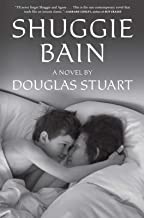
Shuggie Bain
Grove Press · 2020 · 448 pages
ISBN: 9780802148506
🏆 Booker Prize (2020)
Sue Kaufman Prize for First Fiction (2021)
British Book Awards - Debut Book of the Year (2021)
British Book Awards - Overall Book of the Year (2021)
National Book Award for Fiction - Finalist (2020)
Kirkus Prize - Finalist (2020)
Center for Fiction First Novel Prize - Shortlisted (2020)
Review Editor
admin
Shuggie Bain, the debut novel by Douglas Stuart, published in 2020 by Grove Press, plunges readers into 1980s Glasgow during the Thatcher years. The story follows Hugh “Shuggie” Bain, a young boy growing up in the housing schemes of the city’s East End, as he navigates poverty, his mother Agnes’s devastating alcoholism, and his own dawning sense of difference. Stuart, who grew up in Glasgow and lost his own mother to addiction, draws on deeply personal material here, but the novel never feels like memoir dressed in fiction’s clothes. It is too precisely structured, too deliberate in its choices, too aware of its own emotional architecture for that. This is a novel about love that cannot save, about a child who keeps believing it can, and about the Scotland that Thatcherism hollowed out and left behind.
Agnes Bain, Shuggie’s mother, is the gravitational center of the book. A woman of ferocious pride and vanity, she married above her station, then watched that marriage collapse. By the time the novel opens, she has been relocated with her children to Pithead, a bleak mining town outside Glasgow, where she knows no one and where her alcoholism accelerates. Shuggie, her youngest, is the only one of her three children who stays. His older siblings, Catherine and Leek, escape as soon as they can, leaving Shuggie alone with a mother who loves him completely and fails him just as completely.
Stuart sets this story against the backdrop of a specific economic catastrophe. The mines have closed. The jobs have vanished. The housing schemes are crumbling. But he never lets the political context overwhelm the intimate story at its center. Glasgow here is not a symbol; it is a place where people live, drink, fight, and occasionally find small moments of grace.
Character Arcs and Development
Agnes Bain is one of the most fully realized characters in recent literary fiction. Stuart refuses to flatten her into either a victim or a villain. She is vain, applying her makeup with care even when she can barely stand. She is funny, sharp-tongued, capable of lighting up a room when sober. She is also destructive, dragging Shuggie through cycles of hope and relapse that leave him perpetually off-balance. What makes Agnes so painful to read is that Stuart never lets you forget the person she could have been. Her aspirations, her desire for dignity, her love for her children, all of it coexists with the addiction that is consuming her. She does not decline in a straight line. She rallies, she finds work, she gets sober for weeks at a time, and each rally makes the next collapse more devastating.
Shuggie himself is drawn with aching precision. He is fastidious, gentle, sensitive to beauty in ways that mark him as different in the hypermasculine world of the schemes. Other children call him “no right,” and the adults around him see it too. Stuart handles Shuggie’s emerging sexuality with remarkable subtlety. The novel never names what Shuggie is; it simply shows a boy who does not fit, who knows he does not fit, and who keeps trying to earn love by being useful. His devotion to Agnes is both his most admirable quality and his most self-destructive one. He mothers his mother, cleaning up after her binges, lying to social workers, walking her home from pubs. The emotional cost of this caregiving accumulates across the novel until it becomes almost unbearable.
The secondary characters are sharply observed rather than deeply developed, which is the right choice for a novel this tightly focused. Leek, Shuggie’s older brother, retreats into his art as a survival mechanism. Catherine marries young to get out. Big Shug, Shuggie’s father, is a charming taxi driver whose selfishness is so complete it almost looks like innocence. The women of Pithead, particularly Colleen and Jinty, form a chorus of judgment, solidarity, and casual cruelty that Stuart captures with an ethnographer’s ear.
Pacing
The novel opens with a flash-forward to teenage Shuggie living alone in a bedsit, then loops back to his childhood for the bulk of the narrative. This structural choice tells you from the first pages that Agnes will not survive, which transforms the reading experience. You are not wondering whether she will get better. You are watching the long, specific process of how she does not. Stuart paces this with real control. The middle sections, set in Pithead, are deliberately grinding. The repetition of Agnes’s cycles, sober then drunk, hopeful then wrecked, mirrors the repetition that defines life with an addicted parent. Some readers may find these sections slow, and that slowness is the point. Stuart wants you to feel the weight of it, the way time stretches and contracts around someone else’s drinking. The final hundred pages, once the family returns to Glasgow, accelerate sharply, and the ending arrives with the force of something you knew was coming but hoped would not.
Deeper Thematic Exploration
At its core, Shuggie Bain is a novel about the limits of love. Shuggie loves his mother with everything he has, and it is not enough. Agnes loves her children, and it is not enough. This is not a story where the right amount of devotion can pull someone back from the edge. Stuart is unflinching about that, and the novel is more honest for it. The myth that love conquers addiction, that if you just care enough you can save someone, is one of the most persistent and damaging stories our culture tells. Stuart dismantles it without cynicism, showing both the beauty of Shuggie’s devotion and its futility.
Class is woven into every scene. Agnes’s aspirations, her good coat, her careful hair, her insistence on standards, are both her armor and her vulnerability. She comes from a family that considers itself a cut above, and her fall is measured not just in bottles but in respectability lost. The women around her track her decline through the same lens: she is not just drinking, she is letting herself go, she is no longer keeping up appearances. Stuart understands that in communities shaped by poverty, respectability is currency, and losing it costs you the small protections that come with belonging.
The novel is also quietly, persistently about queerness as a form of exile. Shuggie’s difference isolates him as completely as his mother’s drinking does. The schemes are governed by rigid codes of masculinity, and a boy who walks wrong, talks wrong, and does not like football is marked for punishment. Stuart draws a parallel between Shuggie’s closeted self and Agnes’s hidden bottles: both are keeping secrets that everyone already knows, both are performing normalcy that fools no one. The intersection of class, addiction, and sexuality gives the novel its particular texture. Shuggie is not just a boy with a drunk mother; he is a queer boy with a drunk mother in a place that punishes both conditions.
Style and Voice
Stuart’s prose is precise and sensory without being ornate. He writes Glasgow through its weather, its smells, its architecture, its food. The tenement closes, the chippies, the pubs, the scheme houses with their thin walls and smaller ambitions are all drawn with the specificity of someone who lived inside them. His dialogue is extraordinary. The Glaswegian voice comes through without the phonetic transcription that can make dialect writing feel like anthropology. You hear these people; you do not decode them.
The point of view stays close to Shuggie for most of the novel, with occasional shifts to Agnes and other characters. These shifts are handled cleanly and earn their place by giving us access to Agnes’s interior life that Shuggie, as a child, cannot provide. Stuart’s restraint is notable. He does not reach for lyricism at the moments of greatest pain. The worst scenes are written in plain, declarative sentences, and they land harder for it. There is a passage involving Agnes and a bathtub that is one of the most devastating sequences in contemporary fiction, and Stuart writes it with the calm of someone describing weather.
Verdict
Shuggie Bain is a novel that earns every comparison it has drawn, to Frank McCourt, to Alan Warner, to the working-class tradition of Scottish fiction that runs from James Kelman forward. It is also its own thing: a love story between a mother and son that never pretends love is the same as rescue. If you have any personal experience with addiction, either your own or someone else’s, this book will hit you in places you may have thought were healed over. If you do not, it will give you an understanding of that experience that is more honest than most memoirs manage. The novel demands patience in its middle sections, and readers looking for plot momentum may feel restless during Agnes’s repeated cycles. That patience is repaid. Stuart is not interested in making addiction dramatic in the way television does; he is interested in making it real, which is harder and less satisfying and more important. This is a book for readers who want fiction that does not look away, that trusts them to sit with difficulty, and that believes a story about a boy and his mother in a Glasgow housing scheme is worth telling with the same care and ambition as any story ever told.
Frequently Asked Questions about Shuggie Bain
What is Shuggie Bain by Douglas Stuart about?
Shuggie Bain follows Hugh “Shuggie” Bain, a young boy growing up in 1980s Glasgow, Scotland, as he copes with poverty and his mother Agnes’s severe alcoholism. Set against the backdrop of Thatcher-era deindustrialization, the novel traces Shuggie’s childhood in the housing schemes of Glasgow’s East End and the mining town of Pithead, where he remains devoted to his mother even as her addiction deepens. It is a story about love, class, identity, and survival.
Is Shuggie Bain based on a true story?
Shuggie Bain draws heavily on Douglas Stuart’s own childhood in Glasgow. Stuart has spoken openly about growing up with a mother who struggled with alcoholism and about his own experience as a queer child in the housing schemes. While the novel is fiction, not memoir, the emotional and biographical parallels are significant, and Stuart has described writing the book as a way of processing his early life.
What are the main themes in Shuggie Bain?
The novel explores four major themes: addiction and its impact on families, particularly the way children become caretakers of addicted parents; class and poverty in Thatcher-era Britain, where deindustrialization devastated working-class communities; sexuality and identity, as young Shuggie navigates being different in a hypermasculine environment; and the limits of love, specifically whether devotion alone can save someone from self-destruction.
How long is Shuggie Bain and is it a difficult read?
The hardcover edition runs 430 pages. The prose is clear and accessible, with no experimental tricks or difficult structure. The difficulty is emotional rather than technical. The novel depicts addiction, domestic violence, poverty, and the neglect of a child in unflinching detail. Readers with personal connections to these subjects should be prepared for a book that does not soften or sentimentalize its material.
Is there a movie or TV adaptation of Shuggie Bain?
A24 and Scott Rudin Productions optioned the television rights shortly after the novel won the 2020 Booker Prize, with the BBC attached to develop the series. Douglas Stuart himself is set to adapt the book for the screen, and filming is planned for Scotland. As of 2026, no release date has been announced, and the project’s timeline was complicated by Scott Rudin’s departure from active producing.
What age group or reading level is Shuggie Bain for?
Shuggie Bain is an adult literary novel and is not appropriate for younger readers. It contains depictions of alcoholism, domestic violence, sexual content, and the emotional abuse of a child. The reading level is accessible to any confident adult reader, but the subject matter is heavy. Most readers would place this firmly in the 18-and-older category.
How does Shuggie Bain compare to Douglas Stuart’s second novel Young Mungo?
Young Mungo, published in 2022, shares Glasgow as a setting and explores similar themes of working-class life, masculinity, and queer identity. Where Shuggie Bain centers on the relationship between a boy and his addicted mother, Young Mungo focuses on a love story between two teenage boys from rival sectarian communities. Both novels showcase Stuart’s ear for Glaswegian voice and his ability to write about tenderness in brutal environments. Readers who connect with one will almost certainly want to read the other.
Should I read Shuggie Bain and is it worth it?
If you value fiction that treats working-class life with full literary seriousness, yes. If you are drawn to novels about families, about the complicated love between parents and children, about people surviving systems that were never designed to help them, this book will reward your time. Readers who prefer faster plots or lighter emotional registers may find the middle sections challenging. But Shuggie Bain won the Booker Prize for good reason: it is a deeply felt, precisely written novel that stays with you long after you finish it.
Book Details
- Title
- Shuggie Bain
- Author
- Douglas Stuart
- Genre
- Literary Fiction
- Publisher
- Grove Press
- Year Published
- 2020
- Pages
- 448
- ISBN
- 9780802148506
- Awards
- 🏆 Booker Prize (2020) Sue Kaufman Prize for First Fiction (2021) British Book Awards - Debut Book of the Year (2021) British Book Awards - Overall Book of the Year (2021) National Book Award for Fiction - Finalist (2020) Kirkus Prize - Finalist (2020) Center for Fiction First Novel Prize - Shortlisted (2020)
- WritersReview Rating
- 5.0 / 5