
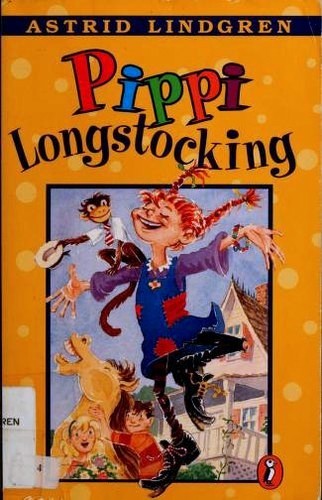
Astrid Lindgren published Pippi Longstocking in Sweden in 1945, and the book has not stopped moving since. It has been translated into over seventy languages, adapted into films, television series, and stage productions on every continent, and it has made its central character one of the most recognizable children’s fiction protagonists in the world. The book arrived at a specific historical moment, post-war Europe, when the idea of a child who answers to no authority and needs no adult protection carried a charge that was both fantastical and quietly radical. Eight decades later, Pippi still reads like a provocation, because the question she poses (what if a child were truly free?) has never stopped being interesting.
The setup is deceptively simple. Pippi Longstocking is nine years old, fabulously strong (she can lift a horse), fabulously rich (a suitcase full of gold coins), and entirely alone in a ramshackle house called Villa Villekulla. Her mother is dead; her father, a sea captain, has been lost at sea. She keeps a horse on the porch, a monkey named Mr. Nilsson on her shoulder, and she has no interest whatsoever in being told what to do by anyone. Her neighbors are two ordinary children, Tommy and Annika, who become her friends and through whose eyes the reader watches Pippi’s particular brand of chaos unfold. Lindgren builds the book as a series of loosely connected episodes rather than a tight narrative arc, and this structure suits her material perfectly: Pippi’s world is one of perpetual surprise, and a conventional plot would domesticate her.
Character Arcs and Development
Pippi does not arc in the conventional sense, and that is the point. Most children’s protagonists learn something over the course of their story: they discover courage, or the importance of honesty, or the value of friendship. Pippi arrives with all of that already in place and refuses to develop past it. She is fully herself on page one and fully herself on the last page. This is either the book’s limitation or its most radical feature, depending on how you read it. Lindgren seems to intend it as a feature: Pippi is a fantasy of completeness, a child who has already figured out who she is and has no interest in being shaped into something more acceptable.
Tommy and Annika, by contrast, exist precisely to develop. They begin as rule-following, authority-respecting children who have been taught how the world works. Over the course of the book, Pippi repeatedly shows them that the rules are more arbitrary than they believed. They never become Pippi (the book is too honest for that), but they loosen. They learn to ask questions about the rules before accepting them. That is the actual arc: not Pippi’s, but theirs, and by extension the reader’s.
The adult characters in the book (schoolteachers, police officers, ladies from the child welfare office) are treated with a comic dismissiveness that would be troubling if Lindgren were not also clearly fond of human beings in general. The adults are not cruel; they are simply operating from a set of assumptions that Pippi refuses to share. When two police officers arrive to take her to a children’s home, she outruns them, outlifts them, and chases them down the road. The scene is funny because the gap between official authority and actual power has rarely been illustrated more directly in children’s literature.
Pacing
The episodic structure keeps the book moving at a brisk, unpredictable pace. No chapter tells you what the next chapter will bring, which captures something true about how Pippi experiences the world (every moment is new, nothing is predictable) and about how children experience good adventure stories. The individual episodes vary considerably in tone: some are purely comic (Pippi at school, Pippi attending a coffee party), some have a hint of genuine feeling (Pippi imagining her father), and some are action-set-pieces (Pippi rescuing children from a burning building). This tonal variety keeps the book from becoming monotonous over its full length.
The lack of an overarching plot means there is no building tension or climactic payoff, which may frustrate readers who come to the book expecting traditional narrative momentum. But Lindgren is not trying to build to a moment; she is trying to sustain a state of being. The state is Pippi’s worldview, and the book succeeds at transmitting it fully.
Deeper Thematic Exploration
At its deepest level, Pippi Longstocking is a sustained argument about the relationship between freedom and responsibility. Pippi is free in a way no real child can be, and Lindgren does not pretend otherwise. The book is a fantasy, and what it fantasizes is not simply strength or wealth but the absence of obligation to any external authority. Pippi obeys her own code: she is honest, she is generous (she gives away gold coins freely), she does not hurt people who do not hurt others, and she keeps her word. Her ethics are her own, arrived at through her own reasoning, not installed by school or church or family. That is a genuinely unusual thing for a children’s book to propose, and it is part of why Pippi has felt dangerous to some readers in every generation.
There is also a thread about the difference between imagination and lying. Pippi tells elaborate stories about her adventures in far-off places that are almost certainly invented. Adults call this lying. Pippi calls it storytelling. Lindgren clearly sides with Pippi, and the book makes a quiet case for the value of imaginative excess over pedantic accuracy. This is not a negligible position. The ability to make up stories about what the world could be like is presented as one of childhood’s most important capacities, and one that official education tends to squeeze out.
The question of loneliness runs beneath all of this. Pippi is brave and funny and self-sufficient, but she is also nine years old and entirely without family. Her cheerfulness about this is partly bravado, and Lindgren lets readers feel the weight of it without making Pippi’s world grim. The moments when Pippi thinks about her father, the lost sea captain she calls a “Cannibal King,” are the book’s most tender, and they suggest that all of Pippi’s freedom is purchased at a cost she knows but does not advertise.
Style and Voice
Lindgren’s prose, in the standard English translations, has a quality of transparent delight: the narration stands slightly back from Pippi, watching her with the same mixture of awe and affection that Tommy and Annika feel. The sentences are clean and often funny. Lindgren has the gift of the perfect comic detail: Pippi’s mismatched stockings (one brown, one black), her shoes twice the length of her feet, the way she sleeps with her feet on the pillow. These specific physical details give Pippi a reality that her impossible strength would otherwise undermine. She is fantastic, but she is also concretely, amusingly present.
The book’s humor is broad enough for young children and layered enough for adults reading aloud. The school scenes in particular reward adult readers who know how school systems actually work. The scene in which Pippi is told to learn arithmetic and responds by inventing her own system is one of the funniest in children’s literature and also, obliquely, one of the most pointed critiques of rote education ever written for children.
Verdict
Pippi Longstocking is one of a handful of children’s books that genuinely changed what children’s fiction could do. Before Pippi, the genre had heroines who were brave within limits. Pippi has no limits, and the permission she gives readers to imagine what limitlessness might feel like is still, eighty years on, a gift. The book is funny and warm and occasionally anarchic, and it asks nothing from its reader except the willingness to follow a nine-year-old who has decided the world is hers. That is not a small ask, and most children who try it find they are very glad they did.
Frequently Asked Questions about Pippi Longstocking
What is Pippi Longstocking by Astrid Lindgren about?
Pippi Longstocking follows Pippi, a nine-year-old girl of impossible strength and boundless independence who lives alone in a house called Villa Villekulla with a horse and a monkey. She befriends two neighboring children named Tommy and Annika, and the book follows their adventures through a series of comic, anarchic episodes in which Pippi repeatedly upends adult authority and conventional rules with cheerful disregard.
When was Pippi Longstocking written and what was the historical context?
Astrid Lindgren wrote the first Pippi story in 1941 as a get-well gift for her daughter, and the book was published in Sweden in 1945. It arrived in the immediate aftermath of World War II, when the image of a completely free, self-sufficient child who needed no institutional protection resonated deeply. The book was initially rejected by one Swedish publisher before Rabén and Sjögren published it to immediate success.
What age group is Pippi Longstocking appropriate for?
The book is typically recommended for children ages six through ten, with seven to nine being the sweet spot for independent reading. It is also an excellent read-aloud for younger children from about age five onward. The humor operates on multiple levels, and adult readers will find layers in the school and authority scenes that children may miss but will absorb instinctively.
Is there a movie or TV adaptation of Pippi Longstocking?
Yes, several. The most beloved adaptations are the Swedish television series from 1969 starring Inger Nilsson, which became a definitive version for generations of European children. There have also been multiple theatrical films, an animated series, and stage productions around the world. The 1969 television series was compiled into feature films that circulated internationally throughout the 1970s and 1980s.
What are the main themes in Pippi Longstocking by Astrid Lindgren?
The central themes are freedom, self-determination, and the questioning of arbitrary authority. Pippi operates by her own ethical code rather than by rules imposed from outside, and the book implicitly asks readers to consider which rules are genuinely necessary and which exist only to enforce conformity. Themes of loneliness, imagination as a form of truth-telling, and the power of unconditional generosity run alongside the main anarchic comedy.
How does Pippi Longstocking compare to Astrid Lindgren’s other books?
Lindgren went on to write many celebrated books, including the Emil of Lonneberga series, Ronja Rövardotter (Ronia, the Robber’s Daughter), and the deeply moving The Brothers Lionheart. Pippi is her most internationally famous creation and the most purely comic. The Brothers Lionheart is often cited by critics as her most profound work, but Pippi remains the book most associated with her name and her legacy.
Why is Pippi Longstocking considered a feminist icon?
Pippi was one of the first major female protagonists in children’s fiction who did not define herself in relation to male authority or domestic expectation. She is stronger than any man she meets, she earns and manages her own money, she lives alone, she refuses to be institutionalized or civilized, and she decides for herself what good behavior looks like. In 1945, and in many ways still today, that combination of traits in a female character was genuinely unusual.
Should I read Pippi Longstocking to my child or let them read it alone?
Either works well. The book is a strong independent read for children from about seven onward, and a wonderful read-aloud for younger children. Reading it together gives you access to the school and authority scenes as a shared joke, which can open interesting conversations about which rules in your child’s life make sense and which might be questioned. Pippi invites that conversation, and it is one worth having.
Book Details
- Title
- Pippi Longstocking
- Author
- Astrid Lindgren
- Genre
- Children's
- Publisher
- Raben and Sjogren
- Year Published
- 1945
- Pages
- 160
- WritersReview Rating
- 4.7 / 5