
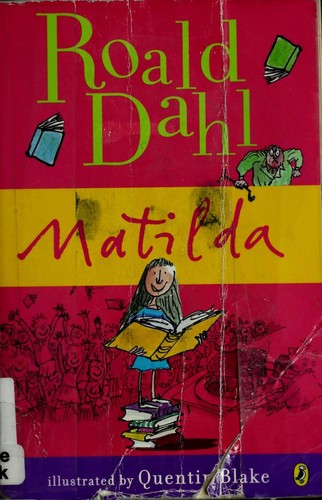
Roald Dahl published Matilda in October 1988, three years before his death, and it is widely considered the finest novel he wrote for children. Published by Jonathan Cape in the UK and illustrated by Quentin Blake, it follows Matilda Wormwood, a girl of extraordinary intelligence born into an indifferent, frankly negligent family in a small English village. Her father sells used cars with tampered speedometers; her mother spends her days watching television and gambling at bingo; her older brother Michael is unremarkable in every sense. None of them take any interest in Matilda, who taught herself to read by age three and a half, worked through the entire children’s section of the local public library by the time she was four and a quarter, and had moved on to adult classics like Great Expectations and Jane Eyre before she ever set foot in a classroom.
When Matilda finally starts school at five and a half, she finds in her teacher, Miss Jennifer Honey, the first adult who sees her clearly and values what she sees. She also encounters the headmistress, Miss Agatha Trunchbull: a former Olympic hammer-thrower who despises children with a passion both theatrical and genuinely frightening. Trunchbull runs the school through terror, inventing punishments so improbable and extreme that no parent would believe a child who reported them. She is one of the great comic villains in English children’s fiction, and Dahl handles her with obvious relish.
As the novel develops, Matilda discovers a power she did not know she had. When she is unjustly blamed for a prank she did not commit, the fury at the injustice produces something unexpected: a glass of water, tipped over the headmistress by an unseen force. Matilda has telekinesis. What she does with it, and how it costs her, is where the novel finds its emotional center.
Character Arcs and Development
Matilda is one of the most satisfying child protagonists in English-language fiction, and her appeal comes largely from what Dahl refuses to do with her. He never makes her modest or self-effacing about her gifts. She knows she is extraordinarily intelligent and uses that intelligence, almost always in service of justice. When her father humiliates or dismisses her, she does not sulk; she plans. The hat glued to his head with superglue, the parrot hidden in the chimney to mimic a ghost, the peroxide slipped into his hair tonic: each prank is conceived and executed with something close to scientific precision, and Matilda registers her satisfaction quietly, with a private pleasure that readers will share entirely. You are on her side from the first page, and you stay there.
Miss Honey is a gentler creation, but no less carefully observed. She begins the novel as someone who has been comprehensively defeated: by Trunchbull’s cruelty, by poverty, by the theft of what was rightfully hers. She lives on bread and margarine in a cottage she can barely heat. Yet she has not turned hard or bitter. She is patient, warm, and genuinely astonished by what she finds in her youngest student. The relationship between Matilda and Miss Honey forms the emotional spine of the novel’s second half: a child who has never been seen, and an adult who has never been championed, finding each other at the same moment they were each needed most.
Miss Trunchbull deserves her own paragraph. She is physically enormous, permanently enraged, and always one step more extreme than you expect. The Chokey, her dark closet lined with broken glass and protruding nails; the hammer throw of pigtailed Amanda Thripp over the playground fence; the forced consumption of an eighteen-inch chocolate cake by the boy who stole a slice: these punishments are conceived to be so outrageous that no parent would believe a child who reported them. Trunchbull knows this. That calculation is what makes her genuinely frightening beneath all the comedy, and Dahl walks the line between those two tones with considerable skill.
Pacing
Matilda moves with the forward momentum that is Dahl’s signature. The novel divides into clear phases, each with its own internal logic: the Wormwood household, the library, the start of school, the escalation of Trunchbull’s cruelties, the discovery of Matilda’s power, and the final confrontation. Dahl rarely lingers past the point of interest, and most chapters end just when you want them to continue.
The middle section does flatten slightly. The chapters that catalogue Trunchbull’s misdemeanors one after another, including the gym class and the chocolate cake episode, feel episodic rather than cumulative, and the novel loses a little momentum for twenty or thirty pages. But each episode is so vividly realized that the structural looseness is forgivable. Once Matilda begins practicing her telekinesis in secret, the book recovers its drive and races to its resolution with satisfying efficiency. The ending arrives faster than some readers expect. This is a real if minor structural complaint, and it is also, in some ways, the right choice: a book about wish fulfillment of the most elemental kind should move quickly once the wishes start coming true.
Deeper Thematic Exploration
Matilda is, on its surface, a fantasy about a gifted child who gets a happy ending. Look a little closer and you find a sustained argument about what adults owe children, and what they routinely refuse to provide.
The central critique is not of cruelty but of indifference. The Wormwoods are, in a certain sense, more damaging to Matilda than Trunchbull is, because Trunchbull at least registers that children exist. The Wormwoods simply cannot be bothered. They see their daughter’s intelligence as an inconvenience; at worst, as an affront to their comfortable mediocrity. Mr. Wormwood cannot look at a pile of library books without feeling vaguely threatened by them. This is what Dahl is really writing against: not the active malice of the monster headmistress, but the passive refusal of ordinary adults to see what is right in front of them.
Reading runs through the novel as both plot device and moral argument. Matilda’s access to books is what preserves her sanity and, arguably, what develops the mental capacity that eventually produces her telekinesis. The library is presented as a place of genuine safety: Mrs. Phelps, the librarian, asks no questions and imposes no limits. This stands in direct contrast to the school, where Trunchbull crushes learning and administrative indifference keeps Matilda stranded in a class far below her abilities. Dahl’s daughter Lucy said the novel was partly about her father’s fear that books might one day disappear, and you can feel that fear in every scene where a child reaches for a shelf.
There is also a class consciousness running through the book that rarely gets enough attention. The Wormwoods are aspirationally working class: proud of the television set and the new car, contemptuous of anyone who reads for pleasure. Miss Honey lives in quiet poverty despite being educated and genuinely good, her salary quietly siphoned off for years. Trunchbull has money and property she obtained through implied wrongdoing. Dahl is not writing a simple morality tale: virtue does not protect you from poverty, and intelligence does not guarantee respect. What changes things, in this book, is a combination of supernatural power and the willingness to act. And the novel makes clear that Matilda could only develop that willingness because someone, finally, believed in her.
Style and Voice
Dahl’s prose in Matilda is at the height of his powers: clean, fast, and shot through with a wickedness that children respond to immediately. He never talks down to his readers, and never over-explains. When Matilda’s plan with the hat succeeds exactly as intended, Dahl does not tell you she is pleased; the description of her father tugging and swearing and eventually leaving for work with the hat still fixed to his head conveys everything. Dahl can be simultaneously funny and frightening in the same paragraph, and he exercises this ability throughout without effort.
The omniscient narrator has a knowing, slightly conspiratorial quality. Dahl occasionally addresses the reader directly, establishing a relationship of mild alliance: we are the perceptive ones, watching the stupid and the cruel make fools of themselves. Quentin Blake’s illustrations amplify this wonderfully. His Trunchbull is so precisely monstrous that she looks as though she has always existed, as though Dahl described her and Blake was simply reporting what he saw. The voice of the book is ultimately one of its warmest qualities. Dahl is entirely on the children’s side, without qualification, and children feel that in every page. It is, in the end, why the book has sold seventeen million copies and keeps finding new readers more than thirty-five years on.
Verdict
Matilda is the book you give to children who love reading and want to see someone like themselves on the page: curious, independent, and in real need of a champion. But it is more than a mirror for bookish children. It is a warm, angry, and deeply satisfying argument that children deserve to be seen and taken seriously, and that adults who refuse to do this are, in their own way, the real villains of any story. The slightly episodic pacing in the middle section is a genuine flaw, and the ending moves faster than the emotional stakes quite earn. But these are the observations of an attentive reader, not the complaints of a disappointed one.
What Dahl achieves here is rarer than it appears: a comedy that is also a genuine portrait of loneliness and rescue, a fantasy that is also a social critique, a children’s book that trusts its readers completely. If you have not read it since childhood, read it again. You will find more there than you remember.
Frequently Asked Questions about Matilda
What is Matilda by Roald Dahl about?
Matilda is the story of Matilda Wormwood, an extraordinarily gifted five-year-old who is ignored and belittled by her parents but finds a true ally in her kind teacher, Miss Honey. Set in a small English village, the novel follows her through a school run by the terrifying headmistress Miss Trunchbull, the discovery that she has telekinetic powers, and her decision to use those powers on behalf of people who deserve justice.
Is Matilda by Roald Dahl based on a true story?
Matilda is fiction, but several elements draw on real places and people from Roald Dahl’s own life. The village library where Matilda reads was inspired by the library in Great Missenden, Buckinghamshire, where Dahl lived. The character of Miss Trunchbull was partly inspired by the owner of a sweet shop Dahl visited as a boy in Cardiff, whom he described as mean and unpleasant. Mr. Wormwood was reportedly based on a real figure from Dahl’s home village.
What are the main themes in Matilda?
Matilda explores the damage done to children by adult indifference (not just active cruelty), the importance of reading and education as paths to freedom and self-development, the way money and power protect wrongdoers from consequence, and the transformative effect of being genuinely believed in by even one person. The relationship between Matilda and Miss Honey is the emotional core: two people who each needed a champion, finding each other at the right moment.
How long is Matilda and is it a difficult read?
Matilda is 240 pages long in most editions and is written for confident readers aged seven to eleven. Adults read it in two to three hours. Dahl’s prose is clear and propulsive throughout, with no difficult vocabulary or complicated structure, so it presents no real challenge to any reader who can follow a plot. Many adults who pick it up again find themselves unable to stop until they have finished it.
Is there a movie or TV adaptation of Matilda?
Yes, several. The 1996 film directed by Danny DeVito and starring Mara Wilson as Matilda relocated the action to the United States and became a cult classic with a 90% score on Rotten Tomatoes. Matilda the Musical, written by Dennis Kelly and Tim Minchin and commissioned by the Royal Shakespeare Company, premiered in 2010, ran for years in London’s West End and on Broadway, and won multiple Olivier and Tony Awards. A film version of the musical, starring Alisha Weir and Emma Thompson as Miss Trunchbull, was released by Netflix and Sony Pictures in 2022.
What age group is Matilda for and is it appropriate for sensitive readers?
Matilda is aimed at children aged seven to eleven, though younger children enjoy it read aloud and the book holds up for adults returning to it. Some parents wonder about Miss Trunchbull’s punishments, but they are framed clearly as monstrous and resolved with justice. Dahl trusts children to handle real villainy, and most children respond with exactly the outrage and delight he intended. The content is theatrical and exaggerated rather than graphic or traumatic.
How does Matilda compare to Roald Dahl’s other children’s books?
Matilda is widely regarded as Dahl’s finest children’s novel, placed above even Charlie and the Chocolate Factory by most critics. What distinguishes it is the emotional seriousness underneath the comedy: the portrait of Matilda’s loneliness, the quiet desolation of Miss Honey’s circumstances, and the genuine warmth of their friendship give the book a depth that some of Dahl’s other novels, wonderful as they are, do not quite reach. Since 2016, Matilda has outsold all of his other works, which suggests readers agree.
Should I read Matilda and is it worth it for adults?
Yes, completely. Matilda works on adults returning to it just as well as it does on children reading it the first time. If you love books, you will feel understood by it. If you care about what children are given and denied, it will have things to say to you. It is short enough to finish in an evening and substantial enough to stay with you far longer. If you have not read it since childhood, you will find more in it than you remember.
Book Details
- Title
- Matilda
- Author
- Roald Dahl
- Genre
- Children's
- Publisher
- Puffin Books
- Year Published
- 1988
- Pages
- 240
- ISBN
- 9780142410370
- WritersReview Rating
- 4.8 / 5