
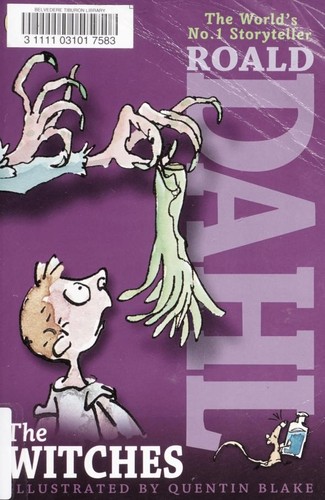
The Witches
Jonathan Cape · 1983 · 208 pages
ISBN: 9780142410110
Review Editor
Hannah Bright
Published in 1983 and illustrated by Quentin Blake, Roald Dahl’s The Witches is one of the most beloved and genuinely frightening books in children’s literature. The story begins with the narrator, a young English boy living in Norway, learning from his grandmother that real witches exist. These are not the pointy-hat, broomstick variety of fairy tales but ordinary women who walk among us, wearing gloves and wigs and shoes to disguise their claws, bald heads, and squared-off feet. This is not something the grandmother whispers with a wink. She is completely serious, and by the time she finishes explaining, so are you.
When both of the boy’s parents die in a car accident (Dahl doesn’t soften this at all), he goes to live with his grandmother in England. The two of them are close in the way that grandparents and grandchildren sometimes become, a bond that skips the complications of parenting and arrives directly at something like friendship. His grandmother is old and unwell, a cigar-smoking former witch-hunter from Norway, and she is the best person in the book by a wide margin.
The crisis arrives when the boy and his grandmother check into a hotel in Bournemouth for a holiday, only to find that the English witches are holding their annual convention in the ballroom. The Grand High Witch herself has traveled from overseas to preside, and she has unveiled a new weapon: Formula 86, a chocolate that turns children into mice. The boy hides behind a screen and witnesses the entire plan. When he is discovered, the Grand High Witch transforms him on the spot. What follows is a small mouse’s quest to stop the witches before they can carry out their scheme, armed with nothing but cleverness and his grandmother’s unwavering support.
Character Arcs and Development
The boy narrator has no name, which is one of Dahl’s deliberately unsettling choices. He represents any child reading the book, and his namelessness gives the story a slightly mythic quality, as if this could happen to you specifically. What he does have is a clear personality: curious, brave in an unheroic way, and deeply attached to his grandmother. He does not shrug off danger or pretend not to be afraid. He is scared, regularly, and does things anyway. That particular kind of courage, the kind that does not feel heroic from the inside, is one of the book’s genuine gifts to young readers.
The grandmother is the book’s real star. Dahl’s grandmother figures tend to be formidable, and this one is the best of them. She is old, ill with diabetes, opinionated, and completely unflappable in the presence of supernatural evil. She has spent her life studying witches and lost a finger to one as a girl. Her relationship with her grandson is specific and warm and funny: she calls him by Norwegian endearments, tells him witch stories as bedtime entertainment, and accepts his new mouse form with more grace than almost any adult in fiction would manage. Their bond holds the emotional architecture of the story together, and Dahl writes it with obvious affection.
The Grand High Witch is one of Dahl’s great villains. She is frightening before she removes her human disguise and genuinely monstrous afterward. Her scene in the ballroom, where she reveals Formula 86 while berating the English witches for their insufficient child-killing record, is both terrifying and deeply funny. She has the theatrical quality that Dahl loved in his antagonists: she performs her evil with evident pleasure. She also has a consistent logic to her worldview. Her plan is coherent, her reasoning follows through, and she genuinely believes in what she is doing. That is always more frightening than random cruelty.
Pacing
The book moves well for most of its length. The opening sections, where the grandmother explains the nature of real witches, are more compelling than slow. Dahl writes the witch mythology with such specific, sensory detail (witches have no toes; their nostrils are wider than normal to detect the smell of children; they see a child not as a child but as a creature coated in dog droppings) that you believe every word even as you know you probably shouldn’t. The hotel ballroom sequence is the narrative high point, propulsive and frightening and funny all at once, and the boy’s transformation from child to mouse is handled with surprising emotional weight for a scene that could have been pure slapstick.
The book eases off somewhat in its final third. Once the boy is a mouse and the plan is in motion, the plot becomes somewhat mechanical: acquire the formula, get it into the kitchen, and let events run their course. This section moves fast precisely because it does not resist much. For a 208-page book aimed at middle-grade readers, a slightly brisk resolution is forgivable. Dahl earns the ending with everything that came before it, and the final pages carry a quiet emotional punch that catches you off guard.
Deeper Thematic Exploration
The Witches has a reputation as a scary children’s book, which is accurate, but it is doing something more complicated than providing frights. Dahl opens the book by declaring that real witches, not the Halloween variety, exist in every country in the world. He is asking his readers to hold a troubling idea: that some ordinary-looking adults intend to do children harm, and that you cannot always identify who is safe by looking at them. The witch-detection advice the grandmother offers (watch for women who never remove their gloves; who seem to dislike children; whose eyes shift color) is deliberately unverifiable, and it stays active in the back of your mind long after you finish the book.
The book also takes death seriously in a way that children’s literature frequently avoids. The boy’s parents die in the second chapter. His grandmother is unwell. He spends part of the story as a mouse, with a mouse’s life expectancy. The question of what happens next, whether any of these losses can be adequately answered, runs underneath everything else. Dahl does not pretend the world is safe or that love is sufficient protection against loss. What he does argue is that love, particularly the love between this boy and this grandmother, makes life worth living regardless of what it takes from you.
There is also something being said about the specific vulnerability of children in adult spaces. The hotel is an adult world. The witches’ convention is adult business. The Grand High Witch holds authority over a room full of women who are afraid of her. The boy in the ballroom is hiding behind a screen, watching adults make decisions about what will happen to children. This is, as it turns out, a fairly accurate description of much of childhood, and Dahl is not gentle about naming it. Children do not control their circumstances. What they can control is how they respond, which is the only form of agency the book offers its young protagonist.
Style and Voice
Dahl wrote the book in the first person, from inside the boy’s perspective, and the voice is one of its great pleasures. It reads like a child telling you something important and wanting you to understand it correctly. The sentences are clear and direct. The details are physical and specific. When the Grand High Witch removes her face in the ballroom, Dahl describes what is underneath with the same matter-of-fact precision he uses for describing a good meal, which makes it considerably worse.
Quentin Blake’s illustrations are part of the experience, and any edition that includes them is the one to read. Blake draws the witches as subtly sinister in disguise and almost comically horrible in their true forms, which matches exactly how Dahl writes them. The prose is, as usual with Dahl, deceptively simple. He uses repetition deliberately, the way good storytellers do, to create rhythm and emphasis. When the grandmother lists witch characteristics, the repetition builds a cumulative dread. When the boy lists his own qualities as a mouse, the same technique produces an entirely different emotional texture: wry and a little sad and brave at the same time.
Verdict
The Witches is one of those books that reads differently depending on how old you are when you meet it. As a child, it is scary and funny and exciting in approximately equal measure. As an adult reading it to a child, you notice the grief sitting underneath the plot, the genuine care Dahl has for his audience, and the way the grandmother delivers difficult true things without condescension or false comfort. It works at both levels because Dahl did not treat them as separate concerns.
Read this if you love a villain with real menace and a plan, if you want a children’s book that takes young readers seriously, or if you appreciate fiction that is funny and frightening in the same sentence. If you need comfort and resolution above all else, this might leave you unsatisfied. But if you want something that earns its reputation, something that stays with you and rewards rereading, this is exactly that book.
Frequently Asked Questions about The Witches
What is The Witches by Roald Dahl about?
The Witches follows a young boy and his Norwegian grandmother who discover that England’s witches are holding a convention at the very hotel where they are staying. The Grand High Witch reveals a plan to turn all of England’s children into mice using a magical chocolate formula called Formula 86. The boy is caught and transformed, and the story follows his efforts to stop the witches’ scheme before it succeeds.
How scary is The Witches by Roald Dahl for children?
The Witches is genuinely scary, more so than most children’s books. Dahl describes the true appearance of witches in visceral, specific detail, and the ballroom scene is designed to frighten. Most children aged eight and up handle it well, often finding it exciting rather than overwhelming, but younger or more sensitive readers may find some passages disturbing. The book’s tone is dark comedy rather than pure horror, which makes it more manageable than a straight scare story.
What are the main themes in The Witches by Roald Dahl?
The book explores several interlocking themes: the difficulty of distinguishing evil from the ordinary, the love between grandparents and grandchildren, and the vulnerability of children in a world controlled by adults. It also deals with death and loss more directly than most children’s fiction, treating these subjects honestly rather than shielding its readers from them. Appearance versus reality runs through the whole story, since every witch looks like a normal woman.
How long is The Witches and is it a difficult read?
The Witches is 208 pages in most standard editions and reads quickly: a motivated child could finish it in a day or two. The language is accessible for ages eight and up, with short chapters and clear, direct prose. Roald Dahl’s style is friendly to reluctant readers because the sentences move fast and the plot never stalls for long.
Is there a movie or TV adaptation of The Witches by Roald Dahl?
There are two film adaptations. The 1990 version starred Anjelica Huston as the Grand High Witch and is widely regarded as faithful and effectively scary. A second film was released in 2020 with Anne Hathaway, relocated to 1960s Alabama. Both are available on streaming platforms. Readers of the book tend to prefer the 1990 version, which hews closer to Dahl’s original setting and tone.
What age group is The Witches by Roald Dahl appropriate for?
Most children aged eight to twelve are in the book’s natural audience, though adults who missed it in childhood enjoy it just as much. Because some scenes are deliberately frightening, parents reading with sensitive children under eight may want to preview it first. The book does not shy away from death or danger, which is part of its appeal for older children in that age range.
How does The Witches compare to Roald Dahl’s other children’s books?
The Witches is darker than Charlie and the Chocolate Factory or James and the Giant Peach, closer in tone to Matilda or Danny the Champion of the World. Like those books, it centers on a child navigating an adult world that is not designed with children’s interests in mind. Fans of Dahl who want his most genuinely frightening work should start here. Readers who prefer his warmer, more fantastical stories might find The Witches heavier going.
Should I read The Witches by Roald Dahl and is it worth it?
Yes, absolutely. The Witches has remained in print for over forty years because it does things most children’s books do not attempt: it takes danger seriously, treats grief as real, and gives its young protagonist a genuine adversary rather than a manageable obstacle. The grandmother alone is worth the price of the book. If you have never read it, read it. If you read it as a child, it is worth rereading as an adult, when you will notice entirely different things.
Book Details
- Title
- The Witches
- Author
- Roald Dahl
- Genre
- Children's
- Publisher
- Jonathan Cape
- Year Published
- 1983
- Pages
- 208
- ISBN
- 9780142410110
- WritersReview Rating
- 4.3 / 5