
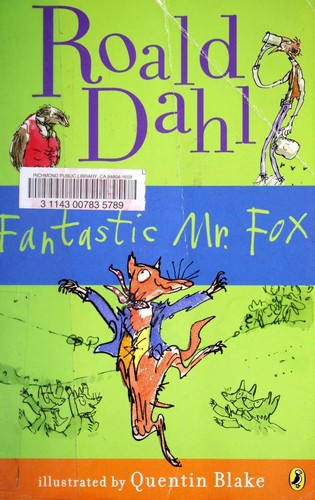
Fantastic Mr. Fox
Puffin Books · 1970 · 96 pages
ISBN: 9780142410349
Review Editor
Hannah Bright
Roald Dahl published Fantastic Mr. Fox in 1970, and in the fifty-plus years since, it has become one of those children’s books that parents rediscover with as much pleasure as their kids. It is lean and fast, clocking in at fewer than a hundred pages, and it delivers exactly what it promises on the cover: a fox who is fantastic, farmers who are awful, and a chase that keeps you turning pages. But the book is more than just a chase. Underneath its sprinting pace lies a genuinely satisfying story about cleverness, loyalty, and what it takes to keep a family together when the world is trying to grind you down.
The story opens with three farmers, memorably named Boggis, Bunce, and Bean, who share a valley and a consuming hatred for the fox who raids their chicken houses, duck ponds, and cider cellar. Dahl introduces them with a rhyme that children immediately love and never forget: Boggis is fat, Bunce is squat, Bean is thin. Each one is more horrible than the other two. The decision to make the antagonists grotesque in body as well as character is a conscious Dahl choice, and it works because it signals immediately that this is a story where the reader’s sympathy lies entirely with the animal family hiding underground.
Mr. Fox lives on a hill above the valley with Mrs. Fox and their four small children. He is clever, confident, and devoted to providing for his family. When the farmers grow tired of losing livestock and band together with guns and shovels to dig him out, Mr. Fox faces a genuine threat: not just to himself but to everyone depending on him. The book picks up immediately from this premise and never really slows down.
Character Arcs and Development
What is interesting about Mr. Fox is that he does not have much of an arc in the conventional sense. He does not start out flawed and become better. He is already excellent at the beginning, and the story is about whether excellence is enough when three determined men with machines come after you. That sounds like a thin premise for character development, but Dahl handles it cleverly. The pressure of the chase reveals the depths of Mr. Fox’s character rather than changing it. There is a moment midway through the book when the digging has gone on for days, when the children are starving and Mrs. Fox is barely conscious, and Mr. Fox simply refuses to stop thinking. He keeps planning. You realize this is who he has always been, and the story needed the crisis to show it.
Dahl gives Mrs. Fox less page time but uses her well. She is the emotional register of the family. While Mr. Fox projects optimism, Mrs. Fox expresses the exhaustion and fear that a reader might otherwise miss in the book’s breezy tone. There is a quiet scene where she tells him she thinks they are finished, and he responds with such warmth and certainty that the reader feels the weight of what he carries. It is not a long scene, but Dahl knows exactly how much it needs to be.
The three farmers are flat by design, but they are more memorable than most fully-drawn antagonists. Dahl gives each one a single distinguishing characteristic and then trusts the reader to fill in the rest. Bean in particular, who is thin and barely eats and instead drinks cider all day, has a sinister quality that the other two lack. He is the one who thinks, and that makes him genuinely threatening. The animals and the secondary characters underground, including Badger and his family, serve mainly as a chorus and as recipients of Mr. Fox’s generosity in the book’s final act, but they give the story its sense of community.
Pacing
This is where Dahl is operating at close to his technical peak. The book is almost entirely forward motion. There are very few scenes that could be cut without loss, and the transitions between them feel natural and inevitable. The structure alternates between Mr. Fox underground and the farmers above ground, and Dahl times the switches so each perspective ends at a moment of tension that the other perspective briefly resolves before introducing a new problem. By chapter six or seven you are reading chapters not because you need to know what happens but because you are simply enjoying the speed of the thing.
If there is a lull, it comes in the middle section when the digging has paused and Mr. Fox is planning his next move. This is necessarily slower than the chase sequences, and a restless eight-year-old may feel it. But it is short, and it sets up the book’s most satisfying sequence, so it earns its place.
Deeper Thematic Exploration
On the surface, Fantastic Mr. Fox is about survival. But the values it embeds in that survival story are worth sitting with. The farmers represent a particular kind of power: organized, industrial, relentless, and fundamentally uninterested in what they destroy so long as they get what they want. They bring in mechanical diggers. They sit and wait for weeks. They are willing to ruin a hillside and starve out an entire community of animals rather than accept that the fox has outwitted them. Dahl never editorializes about this. He does not need to. The farmers’ behavior is self-evidently monstrous, and the reader arrives at that conclusion on their own, which is the most effective kind of moral teaching a children’s book can do.
The fox family, in contrast, operates entirely on the basis of what is needed for the community to survive. When Mr. Fox ventures out underground, he does not only gather food for himself. He invites the other animal families. He throws a feast. There is something almost deliberately anti-hoarding about this: the answer to scarcity is generosity, not competition. For a book aimed at early readers, this is a quietly radical message.
There is also a theme running through the book about the relationship between intelligence and brute force. The farmers have numbers, money, machines, and patience. Mr. Fox has none of that. What he has is the ability to think quickly and creatively under pressure, and Dahl presents this as not just sufficient but superior. He does not romanticize poverty or pretend that intelligence always wins in the real world. But inside this book, cleverness is the only currency that matters, and children who feel outmatched by bigger, louder forces tend to respond to that idea very strongly.
Dahl also embeds a quiet commentary on pride. The farmers could have given up at any point, but their hatred of being outwitted keeps them going long past the point of reason. Bean in particular treats the fox as a personal insult. Their inability to admit defeat turns a manageable problem into a siege that costs them far more than the stolen chickens ever did. Mr. Fox, for his part, never gloats in any way that actually invites retaliation. He simply outmaneuvers, provides for his family, and moves on.
Style and Voice
Dahl’s prose in this book is deceptively simple. The sentences are short and the vocabulary is accessible, but the rhythm is never flat. He varies his sentence lengths carefully, using short bursts for action and slightly longer constructions for the moments that need a beat of breathing room. The result is a book that reads aloud extremely well. A parent reading Fantastic Mr. Fox to a six-year-old will find natural places to pause, speed up, and drop their voice for the scarier moments, because Dahl has built those cues into the structure of the sentences.
The three-farmer rhyme is the most famous example of his voice in this book, but it is not the only one. He has a gift for the grotesque detail that is funny without being genuinely disturbing. Boggis stuffing himself with chicken stew three times a day, Bean’s cider habit, Bunce’s doughnut-and-goose-liver paste sandwiches: these are vivid enough to be disgusting and specific enough to be funny. Dahl understands that children enjoy being a little revolted, and he uses that knowledge precisely.
The illustrations in most editions (by Quentin Blake, whose scratchy energy matches the book’s pace perfectly) deserve mention, though they are not Dahl’s work. Blake’s drawings of the farmers are particularly effective: they look exactly as unpleasant as they should.
Verdict
You should read this to your children, or if they are a bit older, hand it to them and stand back. Fantastic Mr. Fox is the kind of book that gets devoured in a single afternoon and then immediately requested again. It works at every age: young children love the chase and the animal characters, older readers start to notice the themes, and adults reading it aloud find themselves genuinely entertained rather than just dutifully performing a bedtime book.
It is not a long or complicated book, and it does not pretend to be. If you want depth and emotional weight in a children’s book, Dahl’s later work, particularly Danny the Champion of the World, goes much further. But for sheer enjoyment per page, for the feeling of reading something that does exactly what it sets out to do with absolute confidence, there are few books on the children’s shelf that come close. Give it to anyone between the ages of six and ten, and then be prepared to answer questions about why the farmers are so mean.
Frequently Asked Questions about Fantastic Mr. Fox
What is Fantastic Mr. Fox by Roald Dahl about?
Fantastic Mr. Fox tells the story of a clever fox who steals food from three horrible neighboring farmers to feed his family. When the farmers team up with guns and machinery to dig him out, Mr. Fox must outsmart them to keep his wife, children, and the entire community of underground animals alive. The book was first published in 1970 and is one of Dahl’s most beloved shorter works.
What age group is Fantastic Mr. Fox recommended for?
Most parents and teachers suggest Fantastic Mr. Fox for ages 6 to 10. It works well as a read-aloud book for children as young as four or five, since the sentences are short and the action is immediate. Children reading independently tend to fly through it somewhere around second or third grade. It is also a popular classroom read for early elementary grades.
How long is Fantastic Mr. Fox and is it a difficult read?
The book runs about 80 to 96 pages depending on the edition, and most children read it in a single sitting or over two short sessions. The vocabulary is simple, the sentences are direct, and the story moves quickly enough that there is very little to slow a new reader down. It is genuinely one of the more accessible Dahl books in terms of reading level.
What are the main themes in Fantastic Mr. Fox?
The book explores cleverness and resourcefulness as more valuable than brute force, the importance of family loyalty and community care, and the moral consequences of greed and pride. The three farmers represent power without wisdom, while Mr. Fox represents ingenuity in the face of overwhelming odds. Dahl also weaves in a quiet argument for generosity: Mr. Fox shares his gains with the whole underground community rather than hoarding them.
Is there a movie adaptation of Fantastic Mr. Fox?
Yes. Director Wes Anderson adapted the book as a stop-motion animated film in 2009, with George Clooney voicing Mr. Fox and Meryl Streep as Mrs. Fox. The film expands significantly on the book’s plot while keeping its spirit, and it is considered one of Anderson’s most successful films. It earned Academy Award and BAFTA nominations for Best Animated Feature.
Is Fantastic Mr. Fox based on a true story?
No, the story is entirely fictional. Dahl did, however, keep a chicken house at Gipsy House, his home in Great Missenden, England, and reportedly had ongoing battles with actual foxes over his chickens for years. Some biographers suggest that experience shaped his affectionate portrayal of the fox’s cunning. The three farmers are fictional characters, though the names Boggis, Bunce, and Bean may have been loosely inspired by local figures.
How does Fantastic Mr. Fox compare to Roald Dahl’s other books?
Fantastic Mr. Fox is shorter and faster-paced than most of Dahl’s other children’s novels. It shares his love of grotesque villains and triumphant underdogs with books like Charlie and the Chocolate Factory and James and the Giant Peach, but it is more stripped down than either of those. If you are looking for a longer, more emotionally layered Dahl, Danny the Champion of the World covers similar territory with more depth. But Fantastic Mr. Fox is the one you reach for when you want something that children will love immediately.
Should I read Fantastic Mr. Fox to my child?
Almost certainly yes. It reads aloud beautifully, takes about two or three sessions to finish, and is genuinely funny for adults as well as children. The farmers provide enough mild menace to make the stakes feel real without being actually frightening, and the ending rewards the reader in a way that feels earned rather than convenient. It is one of those books where children will likely want to hear it again right after you finish.
Book Details
- Title
- Fantastic Mr. Fox
- Author
- Roald Dahl
- Genre
- Children's
- Publisher
- Puffin Books
- Year Published
- 1970
- Pages
- 96
- ISBN
- 9780142410349
- WritersReview Rating
- 4.3 / 5