
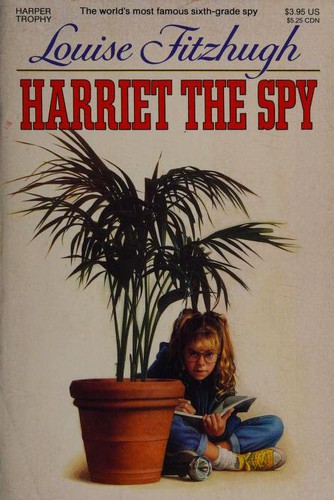
Harriet the Spy
Harper & Row · 1964 · 298 pages
ISBN: 9780064403313
Review Editor
Hannah Bright
Harriet the Spy opens in the middle of a routine that Harriet Welsch has refined to an art form. She is eleven years old, she lives in a comfortable house on the Upper East Side of Manhattan, and every day after school she takes what she calls her “spy route”: a circuit through the neighborhood during which she observes her neighbors, climbs into dumbwaiters, peers through windows, and records every detail in a composition notebook. Harriet has decided she wants to be a writer, and she takes the assignment seriously. She watches the lonely bachelor Harrison Withers and his legion of cats. She studies the bedridden, reclusive Robinsons. She observes the Dei Santis in their grocery store and a family of little boys crammed into a small house. She writes what she sees with complete frankness and no softening at all.
Two people anchor Harriet’s world beyond the spy route. Ole Golly is her Scottish-American nurse and governess, a woman who has shaped Harriet’s intellectual life more than anyone else, pressing books into her hands, insisting she observe, telling her that life is a great mystery and must be written about. Sport (Simon Rocque) is her closest friend, a boy who keeps house for his scatter-brained writer father because there is no one else to do it. Then there is Janie Gibbs, Harriet’s other close companion, an aspiring scientist who keeps dangerous equipment in her room and talks openly about blowing up the school. Harriet moves through her days surrounded by these people, but she keeps herself at a slight remove from everything, notebook always in hand.
Everything changes in two waves. Ole Golly leaves the Welsch household to marry a man named George Waldenstein, and the departure leaves Harriet unmoored in ways she does not fully understand yet. Then, during a game of tag at school, Harriet loses her notebook. Her classmates find it and read it. What they discover is that Harriet has written about all of them, and not kindly: Sport is a poor boy with a dirty house; Marion Hawthorne has no lips; Janie will probably end up in a mental hospital. Her classmates form a spy-catcher club and declare systematic war on Harriet. The social catastrophe that follows is the book’s engine, but Fitzhugh is more interested in what it reveals about Harriet’s character than in the pranks and punishments themselves.
Character Arcs and Development
Harriet is one of the more genuinely unusual protagonists in children’s fiction. She is not kind, exactly. She is curious, observant, and relentlessly honest in her notebook, but she is not warm in the way children’s book heroes usually are. Fitzhugh shows us this early: Harriet’s notebook entries about her neighbors are perceptive but often unkind, and her judgments carry a cold clarity that has nothing to do with cruelty and everything to do with the way she has trained herself to see. She notices everything, judges constantly, and refuses to edit herself. The question the book asks, quietly, is whether that kind of honesty is a virtue or a problem.
The departure of Ole Golly is the emotional hinge of the book. Ole Golly gave Harriet the intellectual framework for her life. When she leaves, Harriet does not lose a caretaker; she loses her compass. Fitzhugh handles this with care: Harriet does not collapse dramatically. She goes dull. She stops eating. She stops writing. The grief shows up as absence rather than eruption, which is truer to how children often mourn than the theatrical crying that younger fiction tends to prefer. The spiral Harriet enters after her notebook is discovered, the weeks of isolation and rage and anguish that her parents misread as depression requiring a psychiatrist, all follow from that earlier loss. Ole Golly’s departure set something loose in her, and the notebook disaster finds that loose thing and shakes it hard.
Fitzhugh draws the secondary characters sharply but keeps them at arm’s length, which is appropriate: we see them through Harriet’s eyes. Sport is kind and domestically capable, a boy whose tenderness is coded as strength rather than weakness. Janie is eccentric, focused, and consistently funny. Marion Hawthorne is exactly as small-minded as Harriet perceives. The Robinsons and Harrison Withers function less as full characters than as portraits, little windows into the kinds of lives adults lead when children are not watching. That deliberate thinness is a feature: this is a book told from a point of view that sees clearly but not all the way in.
Pacing
Harriet the Spy moves slowly in its opening third, and that slowness is intentional and effective. The spy route sequences are meditative: Harriet climbs in and out of the dumbwaiter at the Dei Santis’, she records her observations, she goes home and eats her tomato sandwich. Fitzhugh lets this daily rhythm settle before she disrupts it. The pace quickens when Ole Golly leaves, and quickens again sharply when the notebook is found. The middle section, covering the weeks when Harriet is under siege from the spy-catcher club, drags slightly. The campaign of small torments (ink spilled, erasers dropped, constant exclusion) gets thorough treatment but could lose a scene or two without losing anything essential. Fitzhugh’s instinct to catalog cruelty completely is admirable but a little exhausting. The final third recovers its energy as adults try to help Harriet reintegrate, and the resolution arrives with enough ambiguity to feel honest rather than tidy.
Deeper Thematic Exploration
The central tension in Harriet the Spy runs between honesty and kindness, or more precisely, between the kind of unsoftened observation that makes a writer and the social adjustments that make a person bearable to live with. Harriet writes what she actually thinks. Her classmates, when they read it, are hurt because they recognize the accuracy. Fitzhugh does not pretend Harriet is wrong about any of them. The book makes you sit with an uncomfortable truth: if sharp observation is the basis of art, and if art requires honesty, what do we do with the fact that honesty, expressed without tact, causes genuine harm?
Ole Golly’s resolution to this problem, delivered in a letter after the notebook catastrophe, is the moral center of the book: you must apologize to the people you hurt, and sometimes you must lie. She does not tell Harriet to stop observing or stop writing. She tells her to maintain two registers, private honesty and public grace. It is a more sophisticated piece of advice than most children’s books offer. It does not dissolve the tension so much as name it clearly and ask Harriet to hold both things at once. The book’s willingness to end there, in continued tension rather than easy resolution, gives it a staying power that neater stories lack.
Class and New York shape the book’s texture throughout. Harriet lives in real prosperity: her parents go to cocktail parties, her household has a nurse. Sport lives in genteel poverty, cooking and keeping house because no one else will. The Dei Santis work in their grocery every day. The bedridden Robinsons have everything and nothing simultaneously. Harriet watches all of this with equal attention, and Fitzhugh uses the spy route as a cross-section of Manhattan life in the early 1960s, particular and observed and quietly political. Gender runs alongside this. Harriet wants to be a writer. She has no interest in the social performance her mother manages, and the book treats that as a given rather than a rebellion: Harriet has already decided, and no one in the story argues her out of it. For a book published in 1964, that matter-of-factness is worth noticing.
Style and Voice
Fitzhugh writes in close third person, and Harriet’s interiority surfaces most sharply in the notebook entries that punctuate the novel. “Harrison Withers has 26 cats. He is weird.” These entries are funny because they are so ruthlessly unadorned: they apply the same economy to human observation that a ledger applies to numbers. The contrast between the notebook voice and the narrative voice is slight, both are direct, both are dry, and both trust the reader to keep up. Fitzhugh does not explain her jokes.
The prose has a specific rhythm that comes from physical repetition. Harriet moves through her world in described steps: she eats a tomato sandwich, she takes her particular route, she climbs through windows in a consistent order. This repetition builds the world carefully before pulling it apart, and the effect, when the spy route becomes meaningless because the notebook is gone, is genuinely disorienting. Fitzhugh built a machine and then showed you what happens when the central gear is removed.
Verdict
Harriet the Spy is best suited for readers aged eight to twelve, but adults who first read it as children will find it holds up with unusual stubbornness. It is not a comfortable book. Harriet is not a comfortable protagonist. She is observant, honest, and she causes real harm with those qualities, and then she has to figure out how to remain herself while making room for other people. The book’s answer to that problem is good and hard and unsentimental. If you have a child who reads constantly, writes in notebooks, and finds the social world genuinely confusing, this book will feel like recognition rather than instruction.
The pacing drag in the middle section is real, and some readers will find Harriet difficult to sympathize with. It rewards patience and a tolerance for a protagonist who is not always easy to like. What it offers in return is a portrait of a particular kind of childhood, the interior, notebook-keeping, world-observing kind, rendered with more precision and respect than almost anything else in the genre. Fitzhugh took a child seriously, gave her a complicated inner life, and did not wrap that life in consolations it did not need. Sixty years later, the book still earns its reputation.
Frequently Asked Questions about Harriet the Spy
What is Harriet the Spy by Louise Fitzhugh about?
Harriet the Spy follows Harriet M. Welsch, an eleven-year-old girl in Manhattan who keeps a notebook full of brutally honest observations about everyone she knows. When her classmates find and read the notebook, they turn on her, and Harriet has to navigate the fallout while also coping with the loss of her beloved governess Ole Golly. The book is about honesty, friendship, the cost of self-expression, and what it takes to become a writer.
Why did Harriet the Spy cause controversy when it was published in 1964?
Some parents and reviewers objected to Harriet’s blunt, sometimes unkind observations about the people around her, and felt the book presented “disagreeable people and situations” without resolving them in a morally tidy way. Others found Ole Golly’s advice to Harriet, which includes telling her that lying is sometimes necessary, too morally ambiguous for children’s literature. The book now holds a respected place in the canon, but that early ambivalence was part of its reception.
What are the main themes in Harriet the Spy?
The book turns on four main tensions: honesty versus kindness, observation versus participation, ambition versus social belonging, and dependence versus independence. Fitzhugh uses Harriet’s notebook to ask whether the kind of unflinching honesty required of good writers is compatible with being a good friend. Class difference, gender expectation, and the texture of 1960s New York City all run through the novel as well.
How long is Harriet the Spy and is it a difficult read?
The HarperTrophy paperback edition runs 298 pages. The reading level is upper elementary, roughly grades 4 through 6, but the book’s ideas reward older readers who come back to it. The vocabulary is not difficult, and Fitzhugh’s sentences are short and direct. Some children find Harriet hard to warm to because she is not conventionally likable, which can make the emotional investment slower to build.
Is there a movie or TV adaptation of Harriet the Spy?
Yes. A 1996 live-action film starring Michelle Trachtenberg as Harriet and Rosie O’Donnell as Ole Golly was released by Nickelodeon Movies and Paramount Pictures. A direct-to-video sequel, Harriet the Spy: Blog Wars, followed in 2010. Apple TV+ released an animated series also titled Harriet the Spy in 2021, targeting a younger audience and updating the setting to a contemporary urban environment.
What age group or reading level is Harriet the Spy for?
The book is primarily aimed at readers aged 8 to 12. It appears on recommended reading lists for grades 4 through 6. The emotional complexity, particularly around loss and social exclusion, may resonate more with readers at the older end of that range. Adults who read it as children often return to it and find the book says more than they originally understood.
How does Harriet the Spy compare to other classic middle-grade novels of the same era?
Harriet the Spy is less concerned with adventure than most middle-grade classics of the 1960s and more concerned with interiority. It has more in common with Beverly Cleary’s Ramona Quimby books than with The Phantom Tollbooth or A Wrinkle in Time. Its urban specificity and psychological focus set it apart; Fitzhugh was not interested in fantasy or moral fable. The book is closer in spirit to realistic fiction aimed at adult readers than most children’s novels of its time.
Should I read Harriet the Spy and is it worth it?
Yes, particularly if you are the kind of reader who finds “likable protagonist” a less important criterion than “honest book.” Harriet the Spy asks a genuinely difficult question about the relationship between observation and belonging, and it answers that question with more nuance than most adult literary fiction manages. If you have a child who is a natural observer and writer, this book is worth pressing into their hands immediately. If you read it as a child, it holds up.
Book Details
- Title
- Harriet the Spy
- Author
- Louise Fitzhugh
- Genre
- Children's
- Publisher
- Harper & Row
- Year Published
- 1964
- Pages
- 298
- ISBN
- 9780064403313
- WritersReview Rating
- 4.2 / 5