
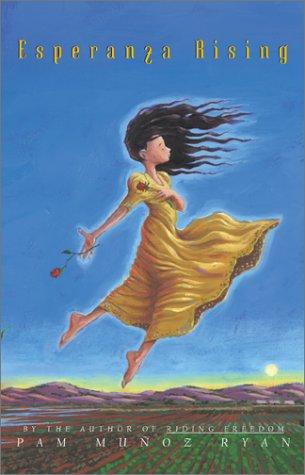
Esperanza Rising
Scholastic Press · 2000 · 262 pages
ISBN: 9780439120418
Review Editor
Hannah Bright
In 1930, in the wealthy ranch country of Aguascalientes, Mexico, a girl named Esperanza Ortega is days away from her thirteenth birthday and a life she has never had reason to question. Her father owns the land. The servants love her family. The harvest is good. Then, overnight, everything her family has built is taken from her in an act of violence that sets the novel’s events in motion.
Published in 2000 by Scholastic Press, Esperanza Rising is Pam Muñoz Ryan’s middle-grade historical novel about survival, class, and the hard work of becoming someone new. The book draws on the true story of Ryan’s own grandmother, who emigrated from Mexico to California as a migrant farm worker during the Great Depression. That biographical root gives the book an emotional honesty that keeps it from tipping into melodrama, even when the plot brings its protagonist to some very dark places. It has sold millions of copies, won the Pura Belpré Award in 2002, the Jane Addams Children’s Book Award, and is now a fixture on middle school reading lists across the country.
The story follows Esperanza from her privileged life in Mexico to the agricultural labor camps of the San Joaquin Valley, California, where she and her mother live alongside hundreds of Mexican and Mexican-American workers trying to make a life during one of the bleakest decades in American economic history. Each chapter is named after the crop being harvested that season: papayas, figs, grapes, potatoes, almonds. The structure works both as a quiet metaphor and as a practical engine, moving the novel forward with the logic of seasons and labor.
Ryan described writing the novel as a way of honoring her grandmother’s experience and the experience of thousands of Mexican families who made the same crossing. That intention shows in the details: the scent of roses that opens the book and recurs throughout, the image of Abuelita’s unfinished blanket that Esperanza carries across the border, the specific texture of farm work in the California heat. This is a book assembled from family memory, and it carries the weight of that origin.
Character Arcs and Development
Esperanza is a character who earns your patience. At the novel’s opening, she is not easy to like: imperious, sheltered, and genuinely oblivious to the lives of the people who work her family’s land. When she arrives in California and discovers that she is now one of those workers herself, her reaction is not graceful. She breaks down over blistered hands. She cannot figure out how to hold a baby without letting it fall. She recoils from the outhouse. Ryan does not soften any of this, and that honesty is what makes Esperanza’s eventual transformation feel real rather than tidy.
By the novel’s midpoint, Esperanza is working in the fields, managing money orders, and carrying the weight of decisions no thirteen-year-old should have to make alone. The shift is gradual and specific: you see her watching the older women, learning to braid bread, discovering that Marta, a girl she initially resented for her anger, is driven by something real and not wrong. Ryan takes her time with this arc, and the result is a protagonist whose growth feels lived-in rather than instructional.
The secondary cast is thinner but purposeful. Miguel, the son of the family’s former servant, has loved Esperanza since childhood and carries his own quiet anger about the discrimination he faces in California. He is perhaps the novel’s most underwritten character, present primarily to offer a counterpoint to Esperanza’s class assumptions. Ramona, her mother, is steadier: a woman who loses almost everything and keeps working, without making a performance of her suffering. And Abuelita, glimpsed mostly through memory and a half-finished blanket, becomes the novel’s emotional north star, representing a continuity between the life Esperanza lost and the person she is becoming.
Pacing
The seasonal chapter structure is both the novel’s greatest strength and its occasional weakness. The harvests create natural rhythm and forward motion, and Ryan uses them beautifully to show the passage of time and the grind of agricultural labor. But the middle section, covering Ramona’s illness and Esperanza’s solo efforts to keep things together financially, can feel drawn out. There are stretches where the forward motion of the plot stalls, and the novel relies on the accumulation of small daily details to carry readers through. For younger readers, especially those who encounter the book in a classroom setting, this section is the one most likely to lose momentum. It is not a fatal flaw, but it is worth knowing going in.
The final chapters pick up speed and deliver on the emotional promises made early in the book. Ryan brings the threads together without forcing them into neatness, which takes some craft. The ending is specific and hopeful without being saccharine, which is harder than it sounds.
Deeper Thematic Exploration
The title itself is a promise: Esperanza means “hope” in Spanish. But Ryan earns that meaning by putting her protagonist through something genuinely difficult first. The novel is not about hope as a passive condition; it is about hope as a decision made in the face of evidence that argues against it. When Esperanza learns that life can take everything from you with no warning and no fairness, and then chooses to keep working, keep caring, keep believing in reunion, that choice is the book’s real subject.
Class and its cruelties run through every chapter. Esperanza arrives in California with an aristocrat’s contempt for people she does not realize are her equals, and the novel traces the slow, painful education that corrects her. Ryan is careful here: she does not present the migrant workers as simple, noble victims. They argue, resent each other, make bad decisions, go on strike at great personal cost, and disagree about whether fighting back is worth the risk of deportation. The portrait of labor camp life in Depression-era California is more complicated than most middle-grade historical fiction attempts, and it gives the book a texture that rewards rereading.
Immigration and belonging are themes that land differently depending on when a reader encounters them. For a student in 2025, whose family may have navigated immigration enforcement or economic displacement, the scenes of deportation raids and anti-immigrant sentiment are not historical abstractions. Ryan wrote the book twenty-five years ago, but it has a quality shared by the best historical fiction: it illuminates the present by traveling through the past. The tensions between Mexican and Oklahoman migrant workers, the indifference of landowners to human suffering, the willingness to use immigration status as a weapon against workers organizing for better conditions: all of it rhymes with conversations still happening today.
Style and Voice
Ryan writes with a clarity that publishers sometimes call “lyrical” and that actually earns the word. Her prose has an oral quality, rooted in the rhythms of storytelling traditions that predate the novel as a form. Some passages read almost like folktales, which is fitting for a story that draws on the memory of a real grandmother and that sits at the intersection of personal history and myth.
The novel’s bilingual texture is handled with care. Spanish words and phrases appear throughout without translation, integrated into dialogue and description in ways that feel natural rather than pedagogical. For readers who speak Spanish, this is a quiet form of respect. For readers who do not, the context usually makes meaning clear enough, and a glossary is included for reference. The language choices reinforce the novel’s themes about belonging: language is one of the things Esperanza carries across the border, one of the things that cannot be taken from her.
The chapters named after harvested crops also allow Ryan to introduce the natural world of California agriculture in a way that feels integrated rather than educational. You come away with a sense of how hard the work is, how tied it is to seasons and weather, how little margin for error exists in the lives of the people doing it. This is accomplished without a single chapter that feels like a history lesson.
Verdict
If you are looking for a middle-grade historical novel to give a child between ten and fourteen, or to teach in a classroom where history and literature overlap, Esperanza Rising is one of the best available. It takes its readers seriously, asks them to grow alongside its protagonist, and does not flatten the history it inhabits into something comfortable and simple. Readers who love character-driven stories will find much to hold onto; readers who want a fast plot may find the middle section slow going.
There is a quiet bravery in what Ryan built here: a book willing to sit with grief, to let its protagonist fail repeatedly before she succeeds, and to trust that children can handle complexity. The novel does not tell you that everything will be fine. It tells you that hope is a thing you choose to carry, even when carrying it is heavy. That is a lesson worth spending 262 pages on.
Frequently Asked Questions about Esperanza Rising
What is Esperanza Rising by Pam Muñoz Ryan about?
Esperanza Rising tells the story of Esperanza Ortega, a wealthy Mexican girl whose father is murdered and whose family loses everything. She and her mother flee to California during the Great Depression, where they work as migrant farm laborers and must build a new life from nothing. The novel follows Esperanza from age thirteen to fourteen as she learns to work, to grieve, and to find hope in her changed circumstances.
What age group is Esperanza Rising appropriate for?
The novel is generally recommended for readers ages ten and up, typically classified as middle grade. Maturity level matters more than age: the book deals with a parent’s violent death, serious illness, threats of deportation, and economic hardship. It handles these topics with care, but younger or more sensitive readers may benefit from reading it alongside an adult who can answer questions. It is a standard assignment in grades 5 through 8.
What are the main themes in Esperanza Rising?
The novel’s central themes are hope, class and privilege, immigration and belonging, grief, and resilience. Ryan uses the Great Depression setting to explore what it means to lose everything and still choose to keep going. The story also examines how wealth shapes identity: Esperanza must unlearn assumptions about worth and work before she can truly see the people around her.
Is Esperanza Rising based on a true story?
Yes. Pam Muñoz Ryan based the novel on the life of her own grandmother, Esperanza Ortega, who emigrated from Mexico to California as a migrant farm worker during the Great Depression. The novel is historical fiction rather than biography, meaning Ryan invented characters, dialogue, and plot events, but the emotional and historical core draws on real family history. Ryan has discussed this background extensively in interviews and at author events.
What awards has Esperanza Rising won?
The novel won the Pura Belpré Award in 2002, which recognizes Latino writers and illustrators whose work best portrays and celebrates the Latino cultural experience. It also won the Jane Addams Children’s Book Award for Older Children (2001), the WILLA Literary Award for Children’s and Young Adult Fiction (2001), and the Judy Lopez Memorial Award. It received starred reviews from Publishers Weekly and School Library Journal.
Is there a movie or TV adaptation of Esperanza Rising?
As of this writing, no major film or television adaptation of Esperanza Rising has been produced, though the book has been widely discussed as strong source material. The novel has been adapted for educational audiobook formats and theatrical productions at the school and regional theater level. If a feature adaptation is announced, it would almost certainly draw significant attention given the book’s widespread readership and cultural significance.
How does Esperanza Rising compare to other books by Pam Muñoz Ryan?
Esperanza Rising is widely considered Ryan’s most important work, but she has written many other celebrated books for children. Echo (2015), a multi-generational novel woven together by a magical harmonica, shares the same scope and emotional ambition and won the Newbery Honor. Becoming Naomi León (2004) also explores Mexican-American identity and family separation. Readers who love Esperanza Rising for its historical depth and character work are likely to find similar rewards in Echo.
Should I read Esperanza Rising, and is it worth it?
Yes, if you appreciate character-driven historical fiction and are patient with a protagonist who takes time to grow into someone worth rooting for. The novel’s middle section moves slowly, and the plot does not prioritize action over character development. But if you read it for what it actually is, a story about learning to carry hope through genuine hardship, it delivers on its promises. It is the kind of book that stays with readers long after the story ends, which is rarer than it should be.
Book Details
- Title
- Esperanza Rising
- Author
- Pam Muñoz Ryan
- Genre
- Children's
- Publisher
- Scholastic Press
- Year Published
- 2000
- Pages
- 262
- ISBN
- 9780439120418
- WritersReview Rating
- 4.3 / 5