
The Legend of L’il Red — 9781935754749
University of Louisiana Lafayette Press · 2015 · 52 pages
ISBN: 9781935754749
Review Editor
Hannah Bright
There is a certain kind of book that earns its emotional weight before the story even begins. The Legend of L’il Red is one of those books, and its origin story is worth knowing. Zachary Richard, the Louisiana singer-songwriter and poet who has spent five decades as a custodian of Acadian and Cajun culture, wrote this fable for his step-daughter Sarah Lattès when she was eight years old. The manuscript sat in a drawer for twenty years. Then Sarah found it, picked up her brushes, and created the illustrations herself, transforming a private gift into a published book through the University of Louisiana at Lafayette Press in 2015. That arc, from a father’s bedtime story to a daughter’s illustrated tribute, gives the book its particular tenderness before you read a single line.
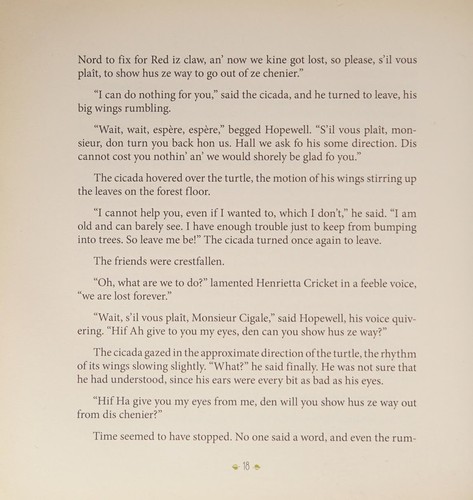
The story Richard tells is a fable in the tradition of Aesop: compact, character-driven, and wise without being heavy about it. L’il Red is a one-clawed baby crawfish living in the bayous of Louisiana. When a hurricane tears through the landscape, the young crawfish is swept into the company of a blind turtle, old and patient and thoroughly unbothered by storms. The two find in each other something each is missing: the turtle cannot see but carries immense experience of the world; L’il Red can see but lacks the confidence to trust what she finds. Together they set off on a quest to find a new claw for the crawfish, moving through a world populated with strange and memorable creatures, each encounter testing not just their courage but the attachment they have formed to each other.
Richard brings to this story the same instinct that shapes his best music: an ear for Louisiana as a living thing, not a backdrop. The hurricane that launches the plot is not incidental. In a region where storms have shaped the landscape, the culture, and the character of the people who stay and rebuild, a hurricane feels like exactly the right catalyst for a story about finding your footing in a world that has knocked you sideways. The crawfish, that most Cajun of creatures, is the perfect protagonist: small, clawed, stubborn, and entirely native to a place that the rest of the country often treats as a curiosity.
Character Arcs and Development
The heart of the book is the friendship between two characters defined by what they lack. L’il Red has one claw where there should be two, and that absence drives the plot. The turtle has no sight, yet navigates the world with more serenity than anyone who can see might manage. Richard makes their pairing feel inevitable rather than contrived. These are two beings who have learned to accommodate loss, and their companionship is built on the recognition that difference is not a problem to be solved but a fact to be worked with.
L’il Red’s arc follows the classic pattern of the young protagonist who goes looking for one thing and discovers something larger. The quest for a new claw is literal, but the journey reshapes the crawfish in ways that a new claw alone could never accomplish. By the time the quest resolves, L’il Red has gained persistence, a broader circle of belonging, and a more complicated understanding of what it means to be whole. The turtle, meanwhile, is not merely a guide figure who exists to dispense wisdom and step aside. The friendship changes the turtle, too, in quieter ways that the book handles with restraint rather than insistence.
The secondary characters they encounter along the way are drawn with the economy that fables require: vivid enough to make an impression, spare enough to leave the center of the story where it belongs. Richard understands that in a short fable, every creature on the page must earn its place by pushing the main characters toward something they could not have reached alone.
Pacing
At 52 pages, The Legend of L’il Red moves at the pace of a proper quest story, which is to say it pauses when it should and hurries when the moment calls for it. Richard spent decades writing songs, and that training shows in his sense of rhythm. The sentences carry a natural cadence, and the movement from scene to scene feels purposeful without being rushed. Children who are read this aloud will find the rhythm easy to settle into, and adults reading independently will appreciate that the book does not talk down to either audience.
The pacing also benefits from Sarah Lattès’s illustrations, which expand the text’s breathing room in the way the best picture book art does. Where the words compress, the images open up. Where the text leaves something unexplained, the illustration fills the space without crowding it. The collaboration between step-father and step-daughter, though it happened across two decades and considerable distance, produces a book that reads as genuinely unified.
Deeper Thematic Exploration
Richard has spent his life working at the intersection of culture and loss. He is Louisiana’s first French language Poet Laureate, a member of the Order of Canada, an Officer of France’s Ordre des Arts et Lettres, and a writer who has never stopped arguing that the Cajun and Acadian traditions are worth preserving. That background is not incidental to The Legend of L’il Red. The book is rooted in a particular place and a particular way of reading the world, and its themes, friendship, persistence, tolerance, and love, are not generic virtues but ones that carry specific weight in a culture that has survived exile, assimilation, flooding, and forgetting.
The disability represented by L’il Red’s missing claw and the turtle’s blindness is handled with a directness that children’s literature often avoids. Neither character regards their limitation as a tragedy to be overcome. They work around it, work with it, and find that what they can do together exceeds what either could manage alone. This is not a story about fixing yourself. It is a story about what happens when two incomplete things discover how completely they fit together.
There is also something in the hurricane opening that rewards thinking about. The storm in Louisiana is a recurring fact of life, a force that erases and resets, that terrifies and that also, in its aftermath, creates conditions for new connections. L’il Red and the turtle would never have found each other without the disruption of the storm. Richard uses the hurricane not as a symbol of pure destruction but as a catalyst for encounter, the event that makes the friendship possible. For children in Louisiana, this framing carries a particular resonance. For children everywhere, it offers a way of thinking about upheaval as something that can open doors rather than only close them.
The fable structure itself carries meaning. Aesop’s fables are teaching stories, but the best of them teach by showing, not by telling. Richard earns his comparison to that tradition by allowing the moral to live in the actions of the characters rather than in a tidy closing lesson. You know what the book is saying by the time it ends, but you arrived there through story rather than instruction.
Style and Voice
Richard writes with the easy authority of someone who has told stories, in song and poetry and prose, for fifty years. The voice is warm, slightly formal in the way that fables traditionally are, and grounded in the specific. The language has a southern Louisiana quality without being a caricature of it: you feel the place without being lectured about it. He trusts the reader to follow along without being held by the hand, which is rarer in children’s literature than it should be.
Sarah Lattès’s illustrations bring a European sensibility to a Louisiana story, and the combination is arresting. Born in Paris, trained as a multi-disciplinary visual artist, Lattès renders the bayou world with a palette and a looseness that feels affectionate rather than touristic. Her creatures are expressive without being cartoonish, and her landscapes carry the particular quality of light that the Gulf Coast produces: soft, humid, a little hazy at the edges. The illustrations were created by someone who knew the story personally, who had been told it as a child, and that intimacy shows in the way she draws these characters. L’il Red and the turtle feel loved, even when they are in trouble.
The relationship between text and image throughout the book is genuinely collaborative rather than merely illustrative. Lattès does not simply draw what the words say. She extends them, complicates them, and occasionally contradicts them gently in the way that good visual storytelling can. This is picture book art that asks you to look as carefully as you listen.
Verdict
If you are looking for a children’s book that respects its audience, carries real cultural weight, and leaves you with something to think about after the last page, The Legend of L’il Red delivers on all three. It is the kind of book that works for children being read to by adults and for adults picking it up on their own, which is not a common achievement in the genre. The collaboration between Zachary Richard and Sarah Lattès gives the book a layered quality: a story about finding what you are missing that was itself found and completed after twenty years of sitting unfinished. That circularity is not lost on anyone who knows the backstory.
Readers unfamiliar with Louisiana’s Cajun and Acadian culture will find this a genuinely illuminating introduction; those who already love the region will find it deeply familiar in the best sense. The book’s weaknesses are minor: some of the secondary characters pass through quickly, and the quest structure resolves more neatly than the weight of the themes might seem to warrant. But these are quibbles against a fable that knows what it is doing and does it with care. For families raising children who love animals, waterways, and stories about unlikely companions, this belongs on the shelf.
Frequently Asked Questions about The Legend of L’il Red
What is The Legend of L’il Red by Zachary Richard about?
The Legend of L’il Red is a children’s fable about a one-clawed baby crawfish named L’il Red and a blind turtle who meet during a hurricane in Louisiana. The two set off together on a quest to find a new claw for the crawfish, encountering a variety of remarkable creatures and facing significant challenges along the way. At its core, the book is a story about friendship, persistence, tolerance, and love.
Who wrote and illustrated The Legend of L’il Red?
The text was written by Zachary Richard, the Louisiana-born singer-songwriter, poet, and cultural activist who is widely regarded as one of the most important figures in Cajun and Acadian music. The illustrations were created by Sarah Lattès, a Paris-born visual artist who is Richard’s step-daughter. Richard originally wrote the story for Sarah when she was eight years old; she discovered the manuscript twenty years later and created the illustrations that led to its publication.
What age group is The Legend of L’il Red for?
The book is suitable for children ages 4 through 10 as a read-aloud experience, and for independent readers ages 6 and up. The fable structure and the straightforward quest plot make it accessible to younger children, while the thematic depth around friendship, difference, and resilience gives older readers and adults something to hold onto as well. The publisher describes it as a book “for children of all ages.”
What are the main themes in The Legend of L’il Red?
The four central themes are friendship, persistence, tolerance, and love. The book also explores disability and difference in a gentle but direct way, placing two characters defined by physical limitations at the center of the story without treating those limitations as sources of shame. A secondary theme involves resilience in the face of natural disaster, with a Louisiana hurricane serving as the event that sets the plot in motion.
Is The Legend of L’il Red connected to Louisiana’s Cajun culture?
Yes, deeply. Zachary Richard has spent his career preserving and celebrating the French language and Acadian heritage of Louisiana, and the book reflects that commitment. The crawfish is an iconic symbol of Cajun culture, the hurricane setting evokes the lived experience of Gulf Coast communities, and the fable’s sensibility draws on the storytelling traditions of the region. The book was published by the University of Louisiana at Lafayette Press, which specializes in Louisiana history and culture.
How long is The Legend of L’il Red and is it a difficult read?
The book is 52 pages long, illustrated throughout, and reads at a pace typical of picture books aimed at early elementary-age children. The vocabulary is clear and accessible, and the sentence structure follows the clean, rhythmic patterns of traditional fables. It is not a difficult read for adults or older children, and its brevity makes it well-suited for a single sitting at bedtime or story time.
Is there a movie or TV adaptation of The Legend of L’il Red?
No film or television adaptation of The Legend of L’il Red is known to exist. The book remains a print publication distributed primarily through the University of Louisiana at Lafayette Press and independent bookstores with a focus on regional literature. Given Zachary Richard’s prominence in Cajun music and his connections to both the Canadian and French cultural establishments, an animated version would not be surprising in the future, but none has been announced.
Should I read The Legend of L’il Red, and is it worth buying?
If you have children between the ages of 4 and 10, or if you have any interest in Cajun and Acadian culture, yes. The book works as a family read-aloud, as a classroom text, and as a thoughtful gift for a child who loves animals and adventure stories. Adults who appreciate literary picture books with genuine artistic ambition will find it rewarding on its own terms. At under fifteen dollars from the publisher, it is worth adding to any collection of books about Louisiana or fable literature for children.
Book Details
- Title
- The Legend of L’il Red — 9781935754749
- Author
- Zachary Richard
- Genre
- Children's
- Publisher
- University of Louisiana Lafayette Press
- Year Published
- 2015
- Pages
- 52
- ISBN
- 9781935754749
- WritersReview Rating
- 4.0 / 5