
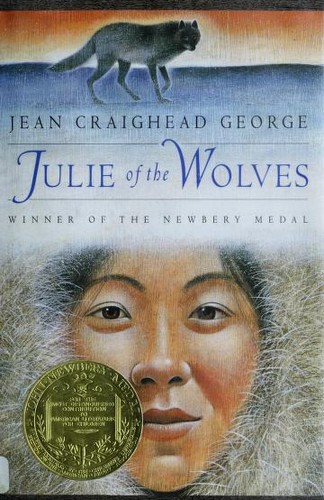
Julie of the Wolves
Harper & Row · 1972 · 176 pages
ISBN: 9780060219444
Review Editor
Hannah Bright
Jean Craighead George published Julie of the Wolves in 1972, and it won the Newbery Medal the following year. George was 52 when the book came out, already the author of more than a dozen nature books for children, and she had been studying wolves and arctic ecology for years. That preparation is visible on every page. This is not a book that uses wilderness as a backdrop. It is a book about the wilderness itself, about what a person has to understand to survive in it, and about the specific, irreplaceable knowledge that traditional Inuit culture accumulated over centuries and what happens when that knowledge disappears.
Miyax is thirteen years old. Her English name is Julie. She lives in the Alaskan village of Mekoryuk, raised by an aunt after her father, a respected Inuit hunter named Kapugen, disappeared into the wilderness following her mother’s death. When a prearranged marriage to a young man named Daniel turns dangerous, Miyax runs. She is heading to San Francisco, where her pen pal Amy lives, but she has no map and no real plan, only a compass and the knowledge that the Eskimo villages to the north might offer a passage. She gets lost on the North Slope of Alaska, one of the most remote and unforgiving stretches of tundra on earth, with dwindling food and no shelter, and the book opens with her already there, already in trouble, watching a wolf pack from the frozen ground and trying to figure out how to communicate with them.
The structure George chose is unusual and effective. The novel opens with Miyax on the tundra, learning the wolves. Part two reaches back to tell her childhood story: how she came to live with her aunt, what she learned from her father before he vanished, how her marriage to Daniel came about and why she left. Part three returns to the present. This arrangement means that readers encounter Miyax as a competent, active protagonist before they learn what she has survived, and that sequence matters. She is not introduced as a victim. She is introduced as someone solving a problem.
Character Arcs and Development
The central tension in Miyax’s character is not between her and the wolves or between her and the wilderness. It is the tension between her two names: Miyax, the Inuit girl who loved her father and spent her childhood learning to read the land, and Julie, the girl who learned English in school and began to imagine a different kind of life in the modern world. These two identities pull in opposite directions throughout the novel, and George refuses to resolve the conflict by pretending either one is wrong. Both names represent real things Miyax has loved and lost.
Her relationship with Amaroq, the black alpha male who leads the wolf pack, drives the first section of the novel. She cannot speak to Amaroq. She cannot explain her situation. She has to earn his acceptance through observation and patience, learning what his posture means, what sounds he makes in different circumstances, how the hierarchy of the pack works. When he finally acknowledges her, it is one of the quietest and most satisfying moments in the novel: a slight dropping of the head, an almost imperceptible recognition. George earns that moment by spending pages on failure. Miyax watches, tries, reads her attempts wrong, and tries again. The relationship develops in real time, with real cost.
The wolf Jello, who hovers at the edge of the pack and resists Miyax’s attempts to connect with him, functions as a foil for Amaroq’s steadiness, and his presence adds genuine danger to the middle section. Kapu, Amaroq’s son, becomes Miyax’s closest companion among the wolves, and George handles their bond with care: it is warm but never sentimental. These are wolves, and she is a human, and the book always remembers that.
Pacing
The novel’s first section is the slowest by conventional measures and the most absorbing in practice. George takes time with the process of wolf communication, fire-making, shelter-building, and food-gathering. The patience required to watch a wolf pack and understand it mirrors the patience required to survive on the tundra, and the prose reflects both. Sentences describing Amaroq’s behavior are precise and unhurried. George spent years observing wolves for this book, and that care shows. Nothing here feels invented.
The flashback section in part two is told with a warmer, more nostalgic register that contrasts noticeably with the spare tundra prose. This tonal shift is intentional and works well: the past is a place of story and memory, while the present demands a different kind of attention. The shift back to the present in part three carries additional momentum because of what has been revealed, and the final section of the novel moves with real urgency.
Some readers find the pace demanding. There are no villains to outrun, no deadlines ticking down. The threat in this book is cold and hunger and the slow erosion of survival margin, which is not the kind of danger that generates page-turning anxiety in the conventional sense. Readers who give the novel its own terms find it completely gripping. Readers who approach it expecting continuous action will struggle with the middle sections.
Deeper Thematic Exploration
George was writing about the destruction of Inuit culture at a moment when that destruction was accelerating. The book’s central argument is that the knowledge encoded in traditional ways of living is not superstition or backwardness. It is practical, hard-won, irreplaceable understanding of how to survive and live well in a specific place. Miyax survives the tundra precisely because she carries fragments of her father’s knowledge: how to find food beneath the snow, how to build a shelter from sod, how to read weather in the light. The modern world she is traveling toward does not contain this knowledge. It has no use for it.
The arrival of a small plane over the tundra midway through the novel crystallizes this conflict. The plane, which Miyax eventually understands carries sport hunters, is the book’s most direct confrontation between the old world and the new, and George handles it without softening what it means. The hunters shoot from the air. They kill for trophies. They are not cruel in any personal sense; they simply have no framework that would allow them to understand what they are doing. This is the novel’s most devastating argument: not that modernity is evil, but that it destroys things it cannot see.
The relationship between Miyax and the wolves speaks to something beyond survival. Inuit hunters did not see the animals they hunted as resources. They understood them as relatives, participants in the same world, deserving of respect and careful attention. Miyax carrying that framework is why she can communicate with Amaroq at all. The knowledge is practical, but it is inseparable from a way of seeing the world that modern life has largely discarded. George is not arguing for a return to pre-industrial living. She is arguing that something real and specific was lost, and that the loss matters.
The question Miyax confronts at the novel’s end is not answered tidily. She knows what she loves. She knows what the modern world has cost. She has to find a way to carry both names, and George does not pretend this is easy or that any reconciliation will come without grief. The ending is honest in a way that cheaper books would not attempt.
Style and Voice
George writes the tundra sections in a style stripped of ornamentation. Sentences are declarative and specific. The cold is described in terms of what it does to metal and food and skin. The sky is described in terms of what it means for travel. The prose has the texture of a mind paying close, practical attention to its environment, which is exactly the texture Miyax’s survival requires. There are no purple passages. When something beautiful appears, it appears because Miyax notices it, and she notices it the way a person notices something beautiful when they have just spent three days being very cold.
The flashback sections shift to a warmer register that carries the quality of remembered childhood: sensory and episodic, full of specific textures and smells. George moves between these two voices without calling attention to the transition, and the contrast does real work. It makes the tundra colder and the memory more golden. The bilingual texture of the novel, Miyax moving between Yup’ik concepts and English equivalents, is handled with lightness. George uses the Inuit terms naturally and does not over-explain them, trusting readers to absorb meaning from context.
Verdict
If you have a ten-to-fourteen year old who responds to books about the natural world, this is one of the essential ones. It is serious without being grim, difficult without being inaccessible, and it treats its young protagonist as a fully realized person navigating a genuinely complex situation. The wolf behavior descriptions are still accurate by current research standards, which is remarkable for a book published more than fifty years ago.
Adults returning to it will find that the environmental and cultural themes carry more weight with age. The question the book asks about what knowledge gets lost when ways of life disappear is not a children’s question. George embedded it in a survival story so it could reach readers who were not yet ready to hold it directly, and it works on both levels. Read it yourself first if you have any doubt. You will not regret the two or three hours it takes, and you will know exactly which young reader needs it next.
Frequently Asked Questions about Julie of the Wolves
What is Julie of the Wolves by Jean Craighead George about?
Julie of the Wolves follows Miyax, a thirteen-year-old Inuit girl known by her English name Julie, who becomes stranded alone on the Alaskan tundra while running away from a dangerous home situation. To survive the North Slope wilderness with no supplies, she learns to communicate with a pack of wild wolves, earning their trust and relying on their protection. The novel moves between her present struggle for survival and flashbacks to her childhood and the traditional Inuit knowledge her father taught her.
Did Julie of the Wolves win any awards?
Yes. Julie of the Wolves won the 1973 Newbery Medal, awarded by the American Library Association to the most distinguished contribution to American children’s literature published the previous year. The recognition helped establish the book as a permanent fixture in school curricula and library collections, and it has remained continuously in print since its original publication by Harper and Row in 1972.
What are the main themes in Julie of the Wolves?
The novel works through several interlocking themes: the survival value of traditional indigenous knowledge and what is lost when that knowledge disappears; the conflict between Inuit and modern American ways of life, represented by Miyax’s two names and two possible futures; the relationship between humans and wild animals, specifically the respect and attention required to coexist rather than dominate; and what it costs a young person to reconcile an identity split between two worlds that pull in opposite directions. George weaves all four into the survival narrative rather than stating them as lessons.
Is Julie of the Wolves based on a true story?
Julie of the Wolves is fiction, but Jean Craighead George based the wolf behavior in the novel on extensive firsthand research. She spent considerable time studying wolf packs and consulting with biologists, and the communication methods Miyax uses to earn Amaroq’s trust reflect actual wolf body language and social dynamics as understood by researchers of the era. The accuracy of those descriptions has held up well over time. The cultural detail about Inuit life similarly draws on research rather than imagination.
What reading level is Julie of the Wolves and what age is it for?
Julie of the Wolves is typically taught in grades 5 through 8 and is most appropriate for readers aged 10 to 14. It reads at approximately a 5th-to-6th-grade level, with clear prose accessible to strong readers in upper elementary school. The themes are sophisticated enough to reward discussion, and the novel includes some difficult material that teachers and parents may want to address with younger readers. Many adults find it genuinely absorbing on first or return reading.
Is Julie of the Wolves part of a series?
Yes. Julie of the Wolves is the first book in a trilogy. The second book, Julie, was published in 1994 and follows Miyax back to the village as she navigates her complicated feelings about her father’s new life and works to protect her wolf friends from hunters. The third book, Julie’s Wolf Pack, published in 1997, shifts perspective to the wolves themselves and follows Kapu’s pack through seasons of survival and change. The original novel stands completely on its own and can be read without the sequels.
Is there a movie or TV adaptation of Julie of the Wolves?
As of this writing, there is no major film or television adaptation of Julie of the Wolves. Rights to the book have been optioned at various points over the decades, but no production has reached completion. Readers looking for films in a similar spirit might look at Never Cry Wolf (1983), based on Farley Mowat’s memoir about living among wolves in the Canadian north, which shares the novel’s interest in the human relationship to wild animals in a remote landscape.
Should I read Julie of the Wolves and is it worth it?
Yes, particularly if you are drawn to wilderness survival, animal behavior, or the specific history of Inuit culture and its encounter with American modernity. The novel does what the best children’s literature does: it takes a young person’s situation completely seriously, refuses to soften the difficulty, and trusts its readers to handle complexity. Adults who read it in school and remember it as the wolf book will find considerably more in it on a return visit. Two or three hours that will stay with you.
Book Details
- Title
- Julie of the Wolves
- Author
- Jean Craighead George
- Genre
- Children's
- Publisher
- Harper & Row
- Year Published
- 1972
- Pages
- 176
- ISBN
- 9780060219444
- WritersReview Rating
- 4.4 / 5