
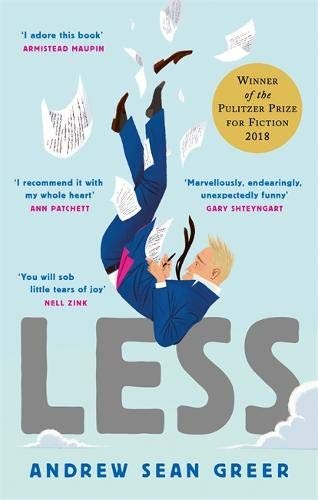
Less
Little Brown · 2017 · 272 pages
ISBN: 9780316316132
🏆 Pulitzer Prize for Fiction (2018)
Northern California Book Award
Review Editor
admin
Arthur Less is not the kind of protagonist you expect to carry a Pulitzer Prize-winning novel. He is, by most measures, a failure. At forty-nine, he has published a handful of novels that critics have largely ignored, he lives in a borrowed house in San Francisco, and he is about to be dumped by the younger man he loves. When he receives an invitation to his ex-boyfriend Freddy Pelu’s wedding, he does what any self-respecting coward would do: he runs. Not down the street or across town, but around the entire world, stringing together a series of increasingly dubious literary engagements in New York, Mexico City, Turin, Berlin, Morocco, India, and Kyoto. Andrew Sean Greer’s 2017 novel Less follows this comic flight from heartbreak with a warmth and structural ingenuity that sneaks up on you. What begins as a picaresque farce about a bumbling American abroad gradually reveals itself as something richer: a novel about the terror of growing older, the strange persistence of love, and the ways we underestimate ourselves.
Greer, who had published four previous novels to modest attention, wrote Less as something of a creative gamble. The book draws openly on the comic novel tradition, channeling the spiraling misadventures of P.G. Wodehouse and the emotional precision of E.M. Forster. It won the 2018 Pulitzer Prize for Fiction, a decision that surprised many in the literary establishment, partly because the book is so funny, and partly because its protagonist is a middle-aged gay white man whose problems are largely of his own making. The Pulitzer committee’s choice was, in its own way, a statement: comedy can hold as much truth as tragedy, and a novel about an ordinary person’s small heartbreaks can matter as much as one about history’s great upheavals.
The setup is deceptively simple. Less has been invited to Freddy’s wedding, and he cannot bear to attend. He also cannot bear to decline, because declining would mean admitting he cares. So he fills his calendar with every invitation he has ignored for years: a conference in Mexico, a literary prize ceremony in Italy, a teaching stint in Germany, a magazine assignment in Morocco, a retreat in India, a food writing gig in Japan. Each stop produces new humiliations, new misunderstandings, and new encounters with the absurdity of the international literary circuit.
Character Arcs and Development
Arthur Less is one of the most precisely drawn comic characters in recent American fiction. Greer builds him through accumulation: Less is tall, blond, blue-eyed, and utterly convinced of his own insignificance. He speaks terrible versions of every foreign language he attempts. He wears the wrong clothes to every occasion. He is the kind of person who orders the wrong dish at a restaurant and then eats the whole thing rather than send it back. These details could make him merely pathetic, but Greer keeps pushing deeper. Less’s self-deprecation is not affectation; it is the scar tissue left by decades of living in the shadow of Robert Brownburn, the older, celebrated poet who was his first great love. Robert shaped Less’s taste, his ambitions, and his sense of his own inadequacy. Even after their relationship ended, Less never stopped measuring himself against Robert’s towering reputation.
What makes Less a great character rather than just a funny one is the gap between how he sees himself and how others see him. To Less, he is a minor novelist of no real talent, a man who has wasted his best years on a love that went nowhere. To the people around him, he is kind, generous, handsome in a rumpled way, and more talented than he knows. Greer never resolves this contradiction with a tidy epiphany. Instead, he lets us sit inside both versions of Less simultaneously, feeling the comedy of his self-delusion and the ache of his real loneliness.
Freddy Pelu, the ex-boyfriend whose wedding triggers the entire journey, exists mostly offstage, but his presence haunts every chapter. We learn about him in fragments: his youth, his ambition, his frustration with Less’s emotional unavailability. By the novel’s end, Freddy emerges as a fully realized character despite his absence, which is a structural trick Greer pulls off with quiet confidence. Robert Brownburn, the elder poet, appears in flashback as both a romantic ideal and a cautionary tale. Through Robert, Greer explores the particular cruelty of age-gap relationships in the gay community, where youth and beauty carry a currency that depreciates faster than anyone wants to admit.
Pacing
The novel moves with the rhythm of travel itself: brisk and disorienting in some stretches, languid and reflective in others. The early chapters, as Less prepares for his trip and departs New York, clip along with sitcom energy. Every new country brings a new set of comic mishaps, and Greer cycles through them quickly enough that no single gag overstays its welcome. The Germany section, where Less teaches a creative writing seminar in halting German to a class of skeptical students, is the longest sustained sequence, and it earns its page count. Here the comedy slows and the emotional stakes rise, as Less confronts not just his linguistic incompetence but his deepest fears about his work and his worth.
The India section sags slightly, with a meditation retreat that, while thematically relevant, lacks the comedic and narrative momentum of the European chapters. But Greer recovers with the Japan section, which delivers the novel’s most beautiful writing and its most emotionally naked moments. The final chapters build to a revelation that reframes everything that came before, and the pacing accelerates to match the protagonist’s belated self-understanding. At 272 pages, the novel never feels padded. If anything, you wish certain stops on the journey lasted a little longer.
Deeper Thematic Exploration
On the surface, Less is about a man running from a wedding. Underneath, it is about the particular terror of turning fifty as a gay man in America. Less came of age in the 1980s, during the AIDS crisis, when survival itself was an open question. He lost friends. He watched a generation disappear. And he emerged into a world that had changed in ways he never anticipated: a world where gay men could marry, adopt children, and live openly in ways his younger self could not have imagined. The novel never dwells on this history with anything like solemnity, but it is always there, shaping Less’s sense of gratitude and displacement. He is alive, and he is free, and he has no idea what to do with either gift.
Greer also takes aim at the American abroad, a figure with a long literary pedigree from Henry James to Paul Bowles. Less is spectacularly bad at being a global citizen. He bumbles through foreign customs, mangles languages, and displays a cheerful ignorance that could read as arrogance from a different angle. But Greer is careful to distinguish Less’s obliviousness from entitlement. Less does not expect the world to accommodate him; he is genuinely surprised when it does. His failures abroad become a mirror for his failures at home: in both cases, he is a man who wants desperately to connect but keeps getting in his own way.
The novel’s deepest theme, though, is the relationship between comedy and suffering. Less is a funny book about painful things: loneliness, aging, creative mediocrity, the slow erosion of romantic love. Greer never treats these subjects as raw material for jokes. Instead, he suggests that humor is how certain people survive. Less laughs at himself because the alternative is despair, and the novel takes that coping mechanism seriously without ever sentimentalizing it. There is a moment late in the book where Less realizes that his life, which he has always considered a series of comic failures, might actually be a love story in disguise. It is one of the most moving passages in recent American fiction precisely because it arrives through laughter rather than tears.
Style and Voice
Greer writes in a third-person voice that is both intimate and slightly distanced, as if the narrator is watching Less from across a room and narrating his misadventures with affection and exasperation in equal measure. The prose is clean and deceptively simple, built on short declarative sentences that occasionally bloom into longer, more lyrical passages. Greer has a gift for the precise physical detail: the way Less tugs at his cuffs when nervous, the exact shade of gold in a Moroccan sunset, the specific horror of a German classroom in winter. These details never feel decorative; they do the emotional work that a more sentimental writer would hand to interior monologue.
The narrative voice conceals a structural secret that becomes clear only in the final pages. This is not a gimmick; it is the novel’s central act of love, and when it clicks into place, it transforms everything you have read. Re-reading the novel with this knowledge is a different experience entirely, because you start to hear the longing embedded in every seemingly offhand observation. Greer pulls off this trick so gracefully that many readers miss it on a first pass, which is itself a kind of achievement. The voice never calls attention to its own cleverness; it simply tells the story and trusts you to find the architecture underneath.
Verdict
If you have ever felt like a minor character in your own life, read this book. If you have ever traveled somewhere hoping to outrun a feeling, only to find that feeling waiting for you in the hotel lobby, read this book. Less is for anyone who has loved someone badly, failed at something publicly, or suspected that the best years might be behind them. It is also, and this cannot be overstated, extremely funny. Greer writes comedy with the structural discipline of a watchmaker, and the jokes land because they are always rooted in character rather than cleverness.
The novel is not without its limitations. Some readers will find Less himself too passive, too willing to let life happen to him rather than seizing it. The supporting cast, aside from Robert and Freddy, can feel more like comic sketches than fully realized people. And the tidy resolution of the final chapters strains plausibility, even by the generous standards of comic fiction. But these are minor complaints about a novel that accomplishes something genuinely difficult: it makes you laugh, it makes you think about how you have spent your time on earth, and it does both without a single moment of pretension. Arthur Less is a character you will carry with you long after you close the book, not because he is extraordinary, but because he is so thoroughly, recognizably human.
Frequently Asked Questions about Less by Andrew Sean Greer
What is Less by Andrew Sean Greer about?
Less follows Arthur Less, a 49-year-old novelist from San Francisco who embarks on a round-the-world trip to avoid attending his ex-boyfriend’s wedding. The novel tracks his misadventures across seven countries as he teaches, accepts awards, and fumbles through foreign cultures, all while confronting his fears about aging, love, and literary failure. It is a comic novel with a deeply emotional core.
Did Less by Andrew Sean Greer win the Pulitzer Prize?
Less won the 2018 Pulitzer Prize for Fiction, making Andrew Sean Greer the first openly gay author to win the award. The book also won the Northern California Book Award and was a finalist for the Lambda Literary Award for Gay Fiction. The Pulitzer win surprised many critics who expected a more conventionally “serious” novel to take the prize.
What are the main themes in Less by Andrew Sean Greer?
The novel explores aging and the fear of irrelevance, romantic love and its complicated aftermath, creative ambition and perceived failure, and the experience of being an American abroad. It also touches on queer identity across generations, the legacy of the AIDS crisis, and the relationship between comedy and suffering. Greer weaves these themes together through Arthur Less’s travel narrative without ever becoming heavy-handed.
How long is Less and is it a difficult read?
Less is 272 pages, making it a relatively quick read that most people finish in two to four days. The prose is accessible and witty, with short chapters organized around each stop on Less’s journey. It is not a difficult book in terms of language or structure, though the narrative voice hides a clever twist that rewards careful attention. Readers who enjoy literary fiction but want something light and funny will find it perfectly pitched.
Is there a movie or TV adaptation of Less by Andrew Sean Greer?
As of 2026, there is no released film or television adaptation of Less, though the novel’s cinematic structure and international settings have attracted interest from producers. The rights have been optioned, and Greer himself has discussed the possibility of an adaptation. The novel’s episodic, travel-based structure would lend itself well to a limited series format.
What age group or reading level is Less appropriate for?
Less is best suited for adult readers, roughly ages 18 and up. The novel contains some sexual content and deals with mature themes including romantic relationships, aging, and loss. There is no graphic violence or disturbing content. It is particularly resonant for readers in their thirties and older who have experienced the particular anxieties of midlife, though younger readers will appreciate the humor and travel writing.
How does Less compare to Andrew Sean Greer’s other books?
Greer published four novels before Less, including The Confessions of Max Tivoli (2004) and The Story of a Marriage (2008), both of which received critical praise but limited commercial success. Less represents a significant shift toward comedy and a lighter touch. He followed it with a sequel, Less Is Lost (2022), which continues Arthur Less’s story but did not match the original’s critical reception. Less remains his most acclaimed and widely read work.
Should I read Less by Andrew Sean Greer and is it worth it?
If you enjoy witty, character-driven literary fiction with a warm heart, Less is absolutely worth your time. Readers who loved novels like A Man Called Ove or The Storied Life of A.J. Fikry will find a similar blend of humor and tenderness here. The novel works best for readers who appreciate comedy that takes its characters seriously. If you strongly prefer plot-driven fiction or dislike novels about writers, it may not be for you, but it is worth giving fifty pages before deciding.
Book Details
- Title
- Less
- Author
- Andrew Sean Greer
- Genre
- Literary Fiction
- Publisher
- Little Brown
- Year Published
- 2017
- Pages
- 272
- ISBN
- 9780316316132
- Awards
- 🏆 Pulitzer Prize for Fiction (2018) Northern California Book Award
- WritersReview Rating
- 4.9 / 5