
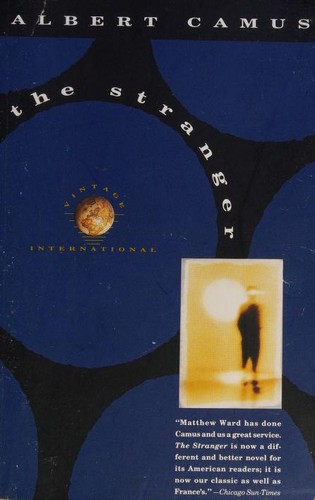
The Stranger
Vintage Books · 1942 · 123 pages
ISBN: 9780679720201
Review Editor
admin
Albert Camus published The Stranger in French in 1942 under the title L’Etranger, and the novel arrived at a moment when its argument – that the universe is indifferent to human life, and that this indifference should be faced without illusion – carried particular force. It has been translated dozens of times, debated by philosophers, assigned in classrooms on every continent, and adapted for film. At 123 pages, it is one of the shortest novels to have generated such sustained intellectual afterlife. That brevity is not accidental; every sentence does work.
What Happens in The Stranger
Meursault, a French Algerian clerk, learns at the novel’s opening that his mother has died. He goes to the nursing home where she lived, attends her funeral, returns to Algiers, sleeps with a woman named Marie, goes to the beach with a friend named Raymond, and on a sun-struck afternoon shoots and kills an unnamed Arab man. He is tried for murder. He is convicted and sentenced to death.
The novel divides cleanly into two halves. The first follows Meursault through the events leading to the murder with a flat, declarative style that records sensory experience and immediate action without interpretation or emotional coloring. Meursault does not explain himself. He notes what he sees, what he feels physically, what he does. His mother’s death does not distress him in any way he can articulate. Marie’s company pleases him. The sun is very bright on the beach.
The second half places Meursault in prison and on trial, and here the novel reveals its argument. The prosecution builds its case not primarily around the murder – Meursault’s guilt in that regard is not in dispute – but around his behavior at his mother’s funeral. He did not cry. He did not know how old she was. He smoked and drank coffee at the vigil. He went to the beach the next day. These facts, the prosecution argues, reveal a man without a soul, a moral monster, someone the jury should remove from society as a danger to it.
Meursault, in his cell and at trial, gradually arrives at a clarity that Camus presents as the novel’s philosophical conclusion: that the universe does not contain meaning, that no God oversees human affairs, that the certainty of death is the only fact, and that this recognition, fully accepted, is its own kind of freedom.
The Question of Style
Camus chose the flat, affectless style of the novel’s first half deliberately. Meursault narrates in the past tense but without the retrospective reflection that past tense usually implies; he registers his experience without organizing it into cause and consequence. This style is the argument before the argument is made explicit: a narrative that refuses to impose meaning on events is itself a demonstration that meaning does not inhere in events.
The translation question is genuine. The most celebrated English version, by Matthew Ward, renders the famous first line as “Maman died today.” Stuart Gilbert’s earlier translation used “Mother died today.” The choice of “Maman” – more childlike, more estranging – captures Meursault’s relationship to the language differently. Readers interested in the question can compare Ward’s version with more recent translations by Sandra Smith and Ryan Bloom.
The Absurd and What It Means
Camus called his central idea the Absurd: the collision between the human desire for meaning and the universe’s silence in response. The Stranger dramatizes this collision in Meursault’s trial. The court wants to know why Meursault killed the Arab; Meursault can only truthfully answer that it was because of the sun – because the heat and light were unbearable and his body moved before he thought. This answer is not accepted. The court needs a motive it can interpret, a psychological narrative it can judge.
Camus is not arguing that Meursault is innocent. He is arguing that the categories the court uses – guilt, responsibility, soul, moral character – are fictions imposed on experience, and that Meursault’s inability or unwillingness to perform the expected emotional responses does not make him a monster. It makes him honest.
Algeria in The Stranger
Later critics, particularly Albert Memmi and postcolonial scholars, have noted that the Arab Meursault kills has no name, no interiority, no life beyond his function in Meursault’s story. This omission is now understood as a significant feature of the novel’s world rather than an oversight: Camus was writing from within a colonial Algeria where Arab lives were, in the dominant French imagination, precisely this invisible. The novel has been read both as a critique of that invisibility and as an example of it.
Who This Book Is For
Any reader interested in existentialist thought, in the philosophical novel, or simply in a book that is exactly as long as it needs to be and not one word longer will find The Stranger essential. It is one of those rare books that reads differently at different ages, and that repays return visits with new problems rather than settled answers.
Frequently Asked Questions
- Is The Stranger an existentialist novel?
- Camus rejected the existentialist label, preferring the term absurdist. He disagreed with Sartre and the existentialists on several key points, including the question of whether the recognition of absurdity should lead to political commitment. The distinction matters more in philosophical than in literary contexts.
- Why does Meursault kill the Arab?
- He gives several reasons at different points: the sun, the heat, the glint of the Arab’s knife. None of these constitute a motive in the psychological sense the trial is looking for. This is Camus’s point: the act had causes but not meaning.
- What does “the stranger” refer to?
- Multiple things: Meursault is a stranger to the social conventions around him; he is a stranger to his own emotional life; the French in Algeria are strangers to the place they inhabit; existence itself is strange to the consciousness that experiences it.
- Is The Stranger still relevant?
- Yes, though its relevance has shifted. The philosophical argument about absurdism engages readers differently now than it did in 1942. The colonial dimensions of the novel – the unnamed Arab, the invisible Algerian majority – are now central to how the book is taught and read.
- How long does it take to read The Stranger?
- Most readers finish it in two to three hours. Its brevity is deceptive; the book rewards slow reading and rereading.
- Which translation of The Stranger should I read?
- Matthew Ward’s 1988 translation is generally considered the most accurate and most readable. Sandra Smith’s 2012 translation takes a different approach to the first-person voice and is worth reading alongside Ward’s for comparison.
- Does Meursault feel anything?
- He feels things physically – heat, pleasure, discomfort – with great intensity. What he does not feel, or cannot articulate, are the emotional responses that social convention requires: grief, remorse, guilt. Whether this makes him incapable of feeling or simply honest about what he feels is the novel’s central ambiguity.
- Is the novel nihilistic?
- No, and Camus insisted on this distinction. Nihilism holds that nothing matters; absurdism holds that meaning does not exist in the universe but that the recognition of this absence can itself be a source of clarity and even joy. Meursault’s final monologue, opening himself to the indifference of the world, is written as a liberation, not a defeat.
Book Details
- Title
- The Stranger
- Author
- Albert Camus
- Genre
- Literary Fiction
- Publisher
- Vintage Books
- Year Published
- 1942
- Pages
- 123
- ISBN
- 9780679720201
- WritersReview Rating
- 5.0 / 5