
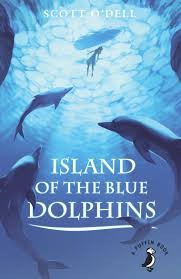
Island of the Blue Dolphins
Houghton Mifflin · 1960 · 177 pages
ISBN: 9780547328614
Review Editor
Hannah Bright
In 1960, Scott O’Dell published a novel that almost did not exist. His first publisher turned it down because the protagonist was a girl rather than a boy. O’Dell held firm, found another publisher, and the following year Island of the Blue Dolphins won the Newbery Medal. The book has been in print ever since, and it is the kind of book that earns that longevity on its own terms.
The story follows Karana, a young Nicoleño girl living on a small island off the California coast in the early nineteenth century. Her people have lived there for generations, fishing and hunting and surviving as best they can, until the arrival of Russian fur hunters and their Aleut workers sets off a chain of violence that leaves the village with far too few men to sustain itself. A ship eventually comes to take the survivors to the mainland. Karana boards it, then leaps into the sea when she sees her younger brother Ramo left behind on the shore. The ship leaves without them. That night, Ramo is killed by a pack of wild dogs. And Karana, alone now, must figure out how to live.
The novel draws on a true historical account. The woman O’Dell based his story on was known as the Lone Woman of San Nicolas Island: a Nicoleño Native American who lived in solitude for roughly eighteen years before being discovered in 1853. She died seven weeks after reaching the mainland, unable to communicate with anyone because no surviving person spoke her language. O’Dell’s novel gives her a name, a family, and an interior life, though he invented most of the specific details of her years alone. The island itself is real: San Nicolas, the most remote of the California Channel Islands, where the Pacific presses in from every direction and the nearest mainland is nearly sixty miles away.
Character Arcs and Development
Karana begins the novel as a girl with a community, a family, and a sense of where she belongs. She is observant and capable, with a quiet stubbornness that the story gradually reveals as her most essential quality. When the Russian hunters arrive and negotiations with her father grow tense, she pays close attention to things the other children miss. This habit of careful attention turns out to be exactly what keeps her alive.
After Ramo’s death, Karana changes without ceremony. She does not grieve loudly or collapse into helplessness. She gets to work. She gathers food, repairs her shelter, makes plans. When she decides to hunt the leader of the dog pack, she crosses a line her people have held for generations: women are not permitted to make weapons. She makes them anyway. And then, in the moment when she could finally kill the wounded dog leader, she stops. She treats his injuries instead. She names him Rontu. This is the pivot point of the entire book. From that moment, Karana is not merely surviving. She is building a life on her own terms, with the only materials she has.
Secondary characters appear briefly but with real precision. Ramo, in the short time we know him, is full of the particular energy of a boy who has not learned caution yet. His death arrives fast and leaves a wound the narrative never quite fills. Tutok, the Aleut girl who secretly befriends Karana when the hunters return years later, is the book’s warmest presence: two young women from enemy nations exchanging small gifts and simple words across a language barrier, each grateful simply to be seen. The friendship ends when the Aleuts sail away. After that, Karana notices the island’s silence differently than she did before.
Pacing
The book moves in seasons rather than in dramatic incidents. Karana marks time by the return of birds, by storms, by the cycles of the hunt. This rhythm can feel slow to readers who expect escalating plot and frequent action. There are long stretches where very little happens on the surface: she repairs a canoe, gathers roots, watches the dolphins from the cliffs at dusk. These passages do real work, though. They build the island as a living presence, not merely a backdrop, and they make Karana’s daily acts of maintenance feel significant rather than filler.
The middle section, which covers years of solitude, is where readers either commit fully to the book or start losing patience. O’Dell trusts his readers, and for most of them that trust holds. The tension here is not conventional tension. It is the quieter, more persistent question of whether a person can endure, and what endurance costs, and whether surviving alone is the same thing as living. Not every reader will stay with it. The ones who do will find something that most louder, faster books cannot deliver.
Deeper Thematic Exploration
Survival is the obvious subject, and O’Dell handles it practically and without sentimentality. Karana learns to do what her culture forbids because she has no other choice. But the book is clear that survival is never only a physical challenge. It also asks what a person is willing to surrender and what she refuses to give up. Karana names her animals. She tends them when they are hurt, grieves when they die. This is not a soft choice: it is her insistence on being fully human in a situation that could easily have reduced her to something less.
Beneath its surface, the novel also carries a story about colonialism and the destruction of Indigenous peoples. The historical reality that prompted O’Dell was one of total erasure: the Nicoleño community was devastated by disease and violence, and when the last known survivor died in Santa Barbara in 1853, she could not tell anyone her name or her people’s stories because no one spoke her language. Scholars have noted that Island of the Blue Dolphins participates in what is sometimes called the vanishing Indian narrative, in which Native communities disappear from the story rather than continuing. The Nicoleños are effectively gone before Karana’s story begins. Her story ends with rescue and assimilation into a world that has no place for who she was. O’Dell does not resolve this tension, and perhaps the book is more thoughtful for not trying.
More immediately, and most powerfully for young readers, the novel asks which rules are worth following when the world that made those rules has ended. Karana breaks the weapons taboo because she must. She forms bonds with animals her people would have hunted because she cannot survive without connection of some kind. By the time the book closes, she is a person her original community would not entirely recognize. What survives of her culture is what she chose to carry. This is not a small question to put before a child, and O’Dell frames it simply enough that it enters readers without lecturing them.
Style and Voice
O’Dell writes in a first-person voice that is spare and exacting. Karana does not explain herself or reach for emotional language. She describes what she sees and what she does, and the weight comes from what she omits. When Ramo dies, she says almost nothing about grief directly. She says she could not sleep. She says she could not eat. Then she says she woke the next morning knowing she could not stay where she was. The restraint is more devastating than any passage of elaborate mourning would be, because it mirrors how grief actually operates: wordless, forward-moving, bone-deep.
The prose has an almost ceremonial quality: simple sentences, declarative rhythms, strong concrete nouns. “The sun was in the west when I made the harbor” is a characteristic line. It places you exactly where Karana is without any fuss. Some readers will find this flatness distancing. Others will find it absorbing in the way that a field notebook or a letter can be absorbing: not because the language displays itself, but because you trust it completely. O’Dell keeps that trust throughout.
Verdict
Island of the Blue Dolphins is the kind of book that rewards patience. If you come to it expecting conventional adventure, with rising action and a climactic confrontation, you will be waiting for a long time. What you get instead is rarer: a sustained, deeply interior portrait of what it means to make a life from whatever remains. Karana does not ask for sympathy. She does not explain herself. She simply acts, and acts, and keeps acting, and the cumulative effect over the course of the book is quietly extraordinary. Her story gets under your skin precisely because it never pushes you.
This is a book for readers who are not afraid of quiet. It works well for children around ages eight to twelve, and it holds up when adults return to it, usually finding more than they remembered. If you read it as a child and have never forgotten Karana, that is not childhood nostalgia doing the work: the book earns that memory. If you missed it the first time around, sixty-five years of readers cannot all be wrong.
Frequently Asked Questions about Island of the Blue Dolphins
What is Island of the Blue Dolphins by Scott O’Dell about?
Island of the Blue Dolphins is a 1960 children’s novel about Karana, a young Nicoleño girl who is stranded alone on a remote California island in the early nineteenth century after her people are transported to the mainland. She survives for years on her own, learning to make weapons, build shelter, tame animals, and endure isolation. The story is based on the real historical account of Juana Maria, the Lone Woman of San Nicolas Island.
Is Island of the Blue Dolphins based on a true story?
Yes. The novel is grounded in the story of a Nicoleño woman known as the Lone Woman of San Nicolas Island, who lived alone on San Nicolas Island off the California coast for approximately eighteen years before being discovered and brought to the mainland in 1853. She died seven weeks after her rescue, and because no living person spoke her language, her real name was never recorded. Scott O’Dell invented Karana’s name, her family, and most of the specific events in the book, but the core situation is historical fact.
What are the main themes in Island of the Blue Dolphins?
Survival and resilience are the most visible themes, but beneath them the book explores what it means to remain fully human under conditions that could strip a person down to mere existence. Karana breaks cultural taboos, forms bonds with animals, and gradually builds a life that belongs entirely to her. Scholars have also found rich material in the book about colonialism and the erasure of Indigenous peoples, gender and transgression, and the ethics of care for the natural world.
How long is Island of the Blue Dolphins and is it a difficult read?
The novel is approximately 177 pages, making it a short read for most children and adults. The prose is clear and spare, accessible to readers around age eight and up. The pacing is deliberate and quiet rather than action-driven, which can feel slow to readers who expect frequent incidents, but the language itself is never complicated. Most children who encounter it for school or on their own find it manageable, and many find it stays with them longer than faster, louder books.
Is there a movie adaptation of Island of the Blue Dolphins?
Yes. A film was released in 1964, directed by James B. Clark and starring Celia Kaye as Karana. Universal Pictures produced it, and Kaye won a Golden Globe Award for New Star of the Year for her performance. The film received a wide release and earned an estimated two million dollars in North American rentals. No major television or streaming adaptation has been produced since. The 1964 film is available through classic film archives and streaming services.
What age group or reading level is Island of the Blue Dolphins for?
The book is most commonly read by children between ages eight and twelve and has been part of elementary school curricula for decades. The vocabulary is clear and the content is appropriate for that age range, though the deaths of animals and of Karana’s brother may be difficult for particularly sensitive younger readers. Adults who return to the book frequently find more in it than they expected, and it holds up well for any reader willing to slow down to its pace.
How does Island of the Blue Dolphins compare to Scott O’Dell’s other books?
O’Dell wrote several other historical novels for young readers, including Zia (1976), the direct sequel to this book, and The Black Pearl (1967), a sea adventure set off the Baja California coast. His work consistently features strong protagonists facing difficult circumstances in historical settings, with particular attention to the experiences of Indigenous peoples in the American West. Island of the Blue Dolphins is widely considered his finest and most enduring work, though The Black Pearl and Sing Down the Moon (1970) have also remained in print for decades.
Should I read Island of the Blue Dolphins and is it worth it?
If you can give it the patience it asks for, yes: this book is worth your time. It is one of the most sustained and careful portrayals of solitude and resilience in children’s literature, and its central question (how do you decide who you are when no one else is watching?) stays with readers long after the last page. Readers who want constant plot movement may find it slow. Readers willing to stay with Karana’s rhythms will find something that most longer and noisier books never quite manage to deliver.
Book Details
- Title
- Island of the Blue Dolphins
- Author
- Scott O'Dell
- Genre
- Children's
- Publisher
- Houghton Mifflin
- Year Published
- 1960
- Pages
- 177
- ISBN
- 9780547328614
- WritersReview Rating
- 4.4 / 5