
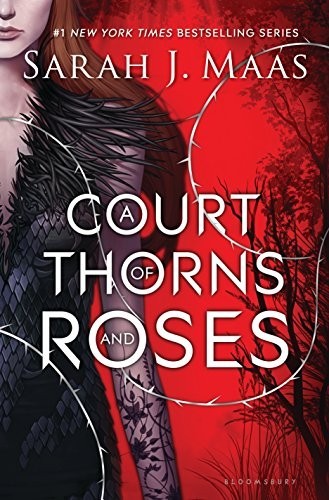
A Court of Thorns and Roses
Bloomsbury Publishing · 2015 · 432 pages
ISBN: 9781619634442
Review Editor
Zoe Adler
Feyre Archeron is nineteen years old and barely keeping her family alive. She hunts in the woods outside their decaying village not because she has any great love of it, but because someone has to, and her father is broken and her sisters are helpless and the alternative is watching all of them starve. One winter morning she kills a wolf in the forest. The wolf, it turns out, is a faerie in disguise, and under the ancient treaty between mortals and fae, Feyre owes a debt. A beast arrives at her door to collect it, and she is taken across the Wall into Prythian, the immortal land of the High Fae, to live out the rest of her days there.
Sarah J. Maas published A Court of Thorns and Roses in May 2015, and it launched what became one of the most-read fantasy series of the decade. The novel draws from several sources: the fairy tale structure of Beauty and the Beast, the sacrificial bargain at the heart of the Scottish ballad Tam Lin, and the icy peril of the Norwegian tale East of the Sun and West of the Moon. Maas doesn’t follow any of these templates closely. Instead she uses them as scaffolding for a world of her own, a system of eight faerie courts ruled by High Lords, all of them living under an ancient curse that nobody discusses directly.
The Spring Court, where Feyre is confined, is warm and lush, full of enchanted forests and masked revelries and an irritating abundance of beauty for someone who expected to be imprisoned. Tamlin, the High Lord who brought her there, wears a mask she cannot remove and speaks to her with a wariness she can’t quite place. His emissary Lucien, sarcastic and red-haired, makes it clear that she is both a problem and an obligation. Feyre adjusts. She paints the murals that have been tugging at her since childhood. She learns to read, slowly, with help she didn’t ask for. She argues and observes, and the book builds a patient, careful case for why she starts to love a place she was brought to against her will.
Character Arcs and Development
Feyre is a better protagonist than she first appears. She arrives in Prythian with a chip on her shoulder the size of the Wall itself, bitter at circumstances and quick to assume the worst of anyone around her. She doesn’t soften easily or quickly, and the gradual opening of her worldview over the first half of the novel is the most convincing character work Maas does. By the time Feyre faces the story’s real dangers, you believe in her not because she’s exceptional but because the book has shown you, piece by piece, exactly how she got here and what she’s learned along the way.
Tamlin presents more of a challenge. He’s handsome, guarded, powerful, and haunted, which checks all the boxes for a faerie love interest, but Maas keeps him deliberately mysterious for so long that he never quite solidifies into a full person. There are moments of genuine warmth: a scene where he helps her learn to read, the way he handles her nightmares, his visible discomfort at being someone she should fear. But he functions primarily as a mystery to be solved, and when the mystery resolves, the romantic tension loses some of its charge. He’s more a situation than a character, and the novel is aware enough of this that the second book redirects its attention accordingly.
Lucien is the novel’s consistent pleasure. Wry, loyal, scarred in ways both literal and otherwise, he gives Feyre someone to argue with who will argue back, and the friendship that develops between them is built on a more honest foundation than the romance. Rhysand, the High Lord of the Night Court, appears toward the end of the first act and alters the atmosphere of every scene he enters. He is cold, theatrical, and specifically dangerous in a way that Tamlin never quite manages, and the contrast between them plants a seed the rest of the series tends very carefully.
Pacing
A Court of Thorns and Roses takes its time. Readers who want fantasy to open with swords or a chase will need to recalibrate their expectations for the first two hundred pages, which belong to domestic tension and growing attraction. Maas writes these sections well: the atmosphere is sustained, the stakes are present even when nothing overtly threatening happens, and the relationship between Feyre and the Spring Court develops with enough specificity to earn its payoff. But it is genuinely slow, and some readers will find the middle sections harder to push through than either the beginning or the end.
The second half accelerates into something the first half doesn’t quite prepare you for. Amarantha, the fae queen who has enslaved the High Lords under her curse, arrives with the full weight of a villain built through absence, and the trials she imposes on Feyre are physically brutal and psychologically precise. The pacing in the final hundred pages is relentless, and Maas handles physical and emotional danger with more skill than the quieter romance sections might have suggested. The ending lands with genuine force, even as it leaves enough unresolved to send you straight to the second book.
Deeper Thematic Exploration
The most interesting current running through the novel is the question of what captivity looks like when the cage is beautiful. Feyre is brought to Prythian against her will, held there by the same laws that condemned her, and she starts to love it anyway. Maas doesn’t treat this as simple or uncomplicated. The Spring Court’s beauty is itself a kind of trap, even for the fae who live there, caught as they are under Amarantha’s curse. Feyre’s growing affection for Tamlin and his world exists alongside an awareness that she cannot leave, and the book holds those two facts in tension rather than resolving them too quickly.
The Beauty and the Beast structure asks a specific question: what does love require? In Maas’s version, the answer is quite a lot, and most of the requiring falls on Feyre. She gives up her human life, her family, her freedom, and ultimately something more irreversible than any of those things. Tamlin gives up much less, which is either a realistic portrayal of how power asymmetry shapes relationships or a limitation in how the novel distributes its emotional labor, depending on what you bring to it. What’s worth noting is that the ending doesn’t simply celebrate Feyre’s sacrifice. It complicates the nature of what she’s given up in ways that feel like the beginning of a more difficult argument.
There’s a quieter thread woven through the novel about literacy and self-knowledge that doesn’t get as much attention as the romance but matters more than it might seem. Feyre cannot read when the story begins, and learning to do so becomes a private, meaningful transformation. She goes from someone who understands herself only in terms of what she can provide for others to someone who can take in the world directly. For a mortal trapped in an immortal world where she is constantly underestimated, knowledge turns out to be the one form of power she can actually accumulate. The book earns this, which is not nothing.
Style and Voice
Maas writes in close first person, and her prose is sensory and atmospheric without being ornate. She has a gift for texture: the Spring Court feels inhabited rather than described, with specific details doing the work that exposition would otherwise handle. The voice is informal in the way that good first-person narration often is, not stylized but specific, with Feyre’s particular way of noticing the world coming through consistently. Where the prose occasionally falters is in emotional interiority: we know what Feyre observes and does with more precision than we know what she feels about it, which makes some of the novel’s more intense moments land with less weight than they should.
The faerie world-building draws on Celtic and Norse traditions in ways that will be familiar to readers of the genre, and the system of eight courts with their distinct seasonal characters is established with reasonable efficiency. Where the world-building works best is in the details of specific places rather than the broad architecture. Amarantha’s court, glimpsed in the second half, is oppressive and theatrical and distinct. The Night Court, barely seen in this book, is genuinely unsettling in a way that makes you want to learn more about it. These smaller revelations do more for the novel’s atmosphere than any amount of explanatory prose would.
Verdict
A Court of Thorns and Roses is a solid, enjoyable first entry in a series that develops considerably from here. The romance is warm, the faerie world is well-realized, and the second half delivers a kind of concentrated intensity the first half only hints at. If you want to read Sarah J. Maas, this is the right place to start. If you’re looking for a Beauty and the Beast retelling with genuine menace and a heroine who earns every step of her journey, this will reward your patience.
The readers who will find the most to love here are those who read for romantic tension first and action second, and who don’t mind a slow build before the plot makes its real demands. Those who want conflict from page one, or who find the captive-falls-for-captor dynamic hard to get behind, may have a harder time with the first half, though the back half is worth their patience either way. Start here; plan to continue. The series earns its reputation in the second book, but this one lays the foundation honestly.
Frequently Asked Questions about A Court of Thorns and Roses
What is A Court of Thorns and Roses by Sarah J. Maas about?
A Court of Thorns and Roses follows Feyre Archeron, a nineteen-year-old mortal huntress who kills a faerie wolf and is taken to Prythian, the land of the High Fae, as payment under ancient law. There she lives in the Spring Court, develops feelings for the masked High Lord Tamlin, and becomes entangled in a centuries-old curse that threatens all the faerie courts. It is a fantasy romance loosely based on Beauty and the Beast and the Scottish ballad Tam Lin, set in a richly imagined world of eight faerie courts.
What fairy tales is A Court of Thorns and Roses based on?
Maas drew primarily from Beauty and the Beast, the Scottish ballad Tam Lin, and the Norwegian tale East of the Sun and West of the Moon. The finished novel doesn’t follow any of these stories closely; instead it synthesizes elements from each into an original world. The Beauty and the Beast influence is most visible in Feyre and Tamlin’s dynamic, while Tam Lin’s structure of a mortal saving a fae from enchantment shapes the book’s climactic second half.
What are the main themes in A Court of Thorns and Roses?
The central themes include captivity and freedom, the cost of love, and the relationship between knowledge and power. Feyre is brought to Prythian against her will and comes to love it despite herself, and the novel holds the tension between those two facts without resolving it too quickly. The book also explores what love actually requires of people when one person holds much more power than the other. Literacy and self-knowledge run through the novel as a quieter thread: Feyre’s learning to read is also her learning what she’s capable of.
How long is A Court of Thorns and Roses and is it a difficult read?
The book is 432 pages and is written in a clear, accessible first-person style. It is not a demanding read in terms of vocabulary or sentence complexity; Maas writes for atmosphere and pace rather than stylistic difficulty. The challenge for some readers is the pacing of the first half, which is slow and romance-focused before the plot accelerates. If you can push through the slower sections, the second half is considerably more propulsive and delivers a strong payoff.
Is there a TV show or movie adaptation of A Court of Thorns and Roses?
A television adaptation has been in development at Hulu, with producer Ronald D. Moore (Battlestar Galactica, Outlander) attached as developer alongside Sarah J. Maas. As of 2024, the project was still in development without a confirmed cast or production start date. The status has been reported as both active and paused depending on the source, and no premiere date has been announced. An earlier standalone movie option from 2015 also did not move forward to production.
Is A Court of Thorns and Roses appropriate for teens?
The novel was originally published as Young Adult, though Bloomsbury has since reclassified the series as New Adult. The first book contains romantic content that is heated but not graphically explicit; later books in the series become more explicitly sexual. It also contains violence, including physically intense trial sequences in the second half. Many teens read it comfortably, but the reclassification to New Adult reflects content that becomes more mature as the series progresses.
How does A Court of Thorns and Roses compare to A Court of Mist and Fury?
Most readers and critics consider A Court of Mist and Fury, the second book, to be significantly stronger than the first. It is longer, more emotionally complex, and introduces new character dynamics that many readers find more compelling than the first book’s central relationship. A Court of Thorns and Roses is best understood as setup: it builds the world and establishes the stakes, but the series finds its depth and its most devoted following in the second installment. Reading the first book is worth it, but plan to continue.
Should I read A Court of Thorns and Roses and is it worth it?
If you enjoy fantasy romance, faerie world-building, and slow-burn relationships with a genuine emotional payoff, yes. The first half takes patience, but the second half delivers enough to justify the investment, and the series as a whole is considerably more than the sum of its first entry. If you are curious about romantasy as a genre, Sarah J. Maas is one of its defining writers, and this is where her most popular series begins. Give it until the midpoint before you decide whether to continue.
Book Details
- Title
- A Court of Thorns and Roses
- Author
- Sarah J. Maas
- Genre
- Young Adult
- Publisher
- Bloomsbury Publishing
- Year Published
- 2015
- Pages
- 432
- ISBN
- 9781619634442
- WritersReview Rating
- 4.0 / 5