
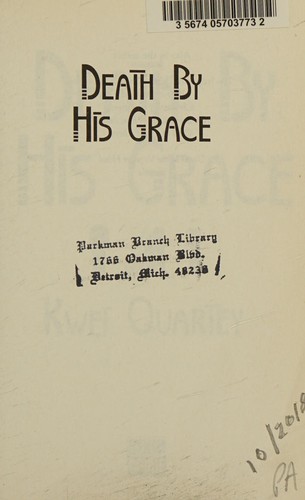
Kwei Quartey’s Death by His Grace is the fourth novel in his Inspector Darko Dawson series, published in 2017. Set in Accra, Ghana, the book opens with a violent murder that sends Dawson into a world of evangelical churches, Pentecostal fervor, and the complex social dynamics of a modern West African city navigating tradition and modernity at the same time. Quartey writes from the inside: he was born in Ghana and brings the texture of daily life there with an authenticity that no amount of research alone could supply.
The story centers on Josephine Akrampah, a young woman found dead in the bedroom of her family home the morning after her wedding. Her wealthy and powerful family is connected to one of Accra’s most prominent churches, and the circumstances of her death are murky enough to require careful investigation. Dawson, who has appeared in three previous novels and carries his own personal history of trauma and family difficulty, is assigned to the case and must navigate around powerful people who have strong incentives to control the official version of events.
Quartey is a physician by profession, and he brings a doctor’s eye for clinical detail to his crime fiction. He is also a sharp observer of Ghanaian social life: the novel pays close attention to how class, religion, family obligation, and gender operate in contemporary Accra. The result is a crime novel that works as entertainment while offering readers something genuinely illuminating about a city and a culture that most Western crime fiction ignores entirely.
Character Arcs and Development
Darko Dawson is the kind of series protagonist you root for without quite being able to explain why he keeps making his life harder than it needs to be. He is perceptive, principled, and constitutionally unable to let institutional pressure redirect his investigation away from people who matter. His relationship with his wife Christine and their son Hosiah, who has a congenital heart condition, gives the series an emotional through-line that does not intrude on the mysteries but adds weight to Dawson’s choices. In this book, the domestic scenes carry particular resonance: Hosiah is approaching surgery, and Dawson is simultaneously trying to hold his family together and solve a killing that powerful people would prefer he abandon.
The victim, Josephine, is given enough depth in retrospect to feel like a real person rather than simply a plot mechanism. Quartey constructs her character through the testimony of people who knew her, each of whom saw a different aspect of the woman she was. The investigation becomes a kind of archaeology: the more Dawson uncovers, the more clearly he can see the forces that surrounded her.
The secondary characters are among the strongest in the series. Josephine’s family members are drawn with moral complexity: none of them are simply villains, and several are simultaneously sympathetic and complicit in ways that feel true to how human beings actually behave under pressure.
Pacing and Tension
Quartey plots his novels with the efficiency of a physician who respects his reader’s time. Death by His Grace does not waste pages. The investigation moves forward steadily, each new discovery either advancing the case or deepening the reader’s understanding of the world the victim inhabited. Quartey is particularly good at the middle section of a mystery, the part where the initial energy of the opening has settled but the resolution is still far away: he keeps the pages turning through character and revelation rather than manufactured incident.
There is one sequence involving Dawson’s covert attendance at a church service that is among the best in the book: funny, uncomfortable, and genuinely revealing about the social dynamics the novel has been mapping. Quartey earns his climax through the accumulation of these smaller scenes rather than through sudden revelation.
Deeper Thematic Exploration
The novel uses its central murder to explore the relationship between religious authority and social control in contemporary Ghana. The church at the center of the story is powerful not just spiritually but economically and politically: its pastor has influence over institutions and individuals that makes him effectively untouchable by normal processes. Quartey examines this power without condemnation: he is interested in how it operates and what it costs the people inside it, not in making a simple argument about religion.
Gender is the novel’s other major preoccupation. Josephine’s death turns out to be entangled with questions about what women are expected to be and do within both family and religious structures. The investigation reveals how completely those structures can close around a woman who fails to conform to expectations, and how little institutional support exists for women who find themselves in danger from people with social power. Quartey does not lecture about this. He lets the story carry the argument, which makes it more effective.
There is also a thread running through the book about what it means to be a police officer in a system where the institutions you rely on are themselves partly captured by the interests you are trying to investigate. Dawson’s frustrations are not just personal: they illuminate something real about how justice operates in societies where formal institutions compete with informal networks of power.
Style and Voice
Quartey writes in a clear, observational prose style that suits both the police procedural structure and the social observation he layers into it. His sentences are direct without being flat. He has a particular gift for the scene-setting paragraph that gives you the physical reality of Accra without turning into a travelogue: the heat, the traffic, the specific quality of light at different times of day, the sounds and smells of specific neighborhoods. You feel genuinely located in a place that has its own texture and logic.
The dialogue is strong throughout, with Twi phrases and Ghanaian idiom woven naturally into conversations without requiring a glossary. Quartey trusts his readers to pick up context from usage rather than providing footnotes, which is exactly the right call.
Verdict
If you have not encountered the Darko Dawson series, Death by His Grace makes a strong argument for starting at the beginning and working your way here. Quartey writes intelligent, character-driven crime fiction set in a world that most of the genre ignores, and he does it with a combination of affection and clear-eyedness that is genuinely rare. Readers who love procedurals but have grown tired of their usual geography will find this deeply satisfying. Readers who care about fiction that opens new windows onto unfamiliar social worlds will find that too.
The novel is not without small weaknesses: a subplot involving Dawson’s superior officer occasionally feels like it is going somewhere before retreating, and the finale arrives slightly faster than the buildup warrants. But these are minor complaints about a book that delivers consistently on its considerable ambitions.
Frequently Asked Questions about Death by His Grace
What is Death by His Grace by Kwei Quartey about?
Death by His Grace is the fourth Inspector Darko Dawson mystery, set in Accra, Ghana. A young woman is found murdered the morning after her wedding, and Dawson must investigate while navigating the powerful evangelical church her wealthy family belongs to. The novel is both a tightly plotted crime story and a sharp portrait of contemporary Ghanaian society.
Do I need to read the previous Darko Dawson books first?
Death by His Grace works well as a standalone, though readers who start earlier in the series will have richer context for Dawson’s family situation and professional relationships. The previous novels are Wife of the Gods, Children of the Street, and Murder at Cape Three Points. Any of them makes a good entry point, and the series improves as it goes.
What are the main themes in Death by His Grace?
The novel explores religious authority and its relationship to social control, the position of women within both family and church structures, and the difficulties of policing in systems where informal power networks compete with formal institutions. Quartey weaves these themes into the investigation without making them feel didactic.
Is Death by His Grace based on real events in Ghana?
The novel is fiction, but Quartey draws extensively on the real dynamics of Pentecostal and evangelical Christianity in contemporary Ghana, where large churches exercise significant social and political influence. The specific events of the novel are invented, but the social world they inhabit is rendered with documentary accuracy.
How long is Death by His Grace and is it accessible to new readers of African crime fiction?
The novel runs 257 pages and reads quickly. Quartey’s prose is accessible and he provides enough cultural context that readers unfamiliar with Ghana will not feel lost. The book functions as both a satisfying mystery and an introduction to a world that deserves more attention in English-language crime fiction.
Is there a film or TV adaptation of the Darko Dawson series?
As of the publication of Death by His Grace, there is no film or television adaptation of the Darko Dawson series. Quartey’s work has received strong critical attention and multiple award nominations in the crime fiction community, but the series remains exclusively in print form.
How does Death by His Grace compare to other African crime fiction?
Quartey occupies a distinctive position in African crime fiction: he writes procedurals set in urban West Africa with the same level of social and psychological complexity that readers associate with Scandinavian noir. His closest comparison points might be Alexander McCall Smith’s Botswana series for the African setting, or Fred Vargas for the combination of character depth and investigative rigor, though Quartey’s tone is darker than either.
Should I read Death by His Grace?
Yes, particularly if you want crime fiction that takes you somewhere genuinely new. Quartey is a skilled plotter who also has serious things to say about justice, power, and gender. Readers who want a smart mystery set outside the usual Anglo-American geography will find this exactly what they are looking for.
Book Details
- Title
- Death
- Author
- Kwei Quartey
- Genre
- Mystery & Thriller
- Publisher
- Soho Crime
- Year Published
- 2017
- Pages
- 257
- ISBN
- 9781616957087
- WritersReview Rating
- 4.1 / 5