
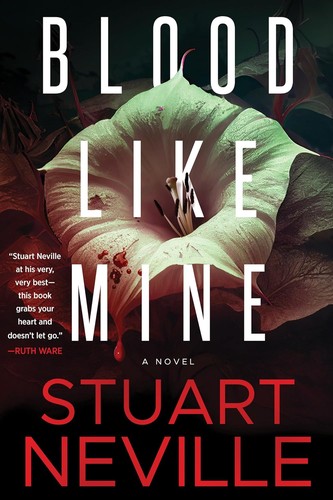
Blood Like Mine
Soho Crime · 2024 · 300 pages
ISBN: 9781641295413
Review Editor
James Voss
Stuart Neville’s Blood Like Mine, published by Soho Crime in 2024, marks the Northern Irish writer’s return to the dark, morally complex territory where he does his best work. This is a standalone novel rather than an entry in one of his series, and the freedom of that choice shows: Neville builds a premise of considerable ambition and follows it without the structural constraints that series fiction imposes. The result is one of his most psychologically intense works, a novel about violence, complicity, and the inheritance of guilt in a post-Troubles Northern Ireland that has changed less than it sometimes claims.
The story centers on a woman named Sara Keane who is released from prison after serving time for a crime whose circumstances are not immediately clear to the reader. She returns to Belfast and to a family that has been reshaped by her absence and by the events that preceded it. Neville withholds information strategically: the novel’s opening sections are deliberately partial, and the reader assembles the full picture of what happened and why as Sara navigates the present-tense dangers of her return. Someone does not want her back, and their efforts to prevent her return escalate in ways that force Sara to confront both the past she served time for and the people who shaped the circumstances that put her there.
Neville is best known for The Ghosts of Belfast, which won the Los Angeles Times Book Prize for Mystery and Thriller in 2009, but his range is considerable and Blood Like Mine demonstrates that he has continued to deepen as a writer in the years since that debut.
Character Arcs and Development
Sara Keane is the kind of protagonist who demands the reader’s patience before she earns their investment. Neville withholds enough about her history that she can seem opaque in the early sections, but as the novel discloses what it knows about her, she becomes one of the most fully realized characters in his work. Her guilt, which is real, is complicated by the context that produced it: she is neither innocent nor simply culpable, and Neville is interested in that middle territory.
The people Sara returns to are drawn with the specificity of a writer who has spent his life in the world he depicts. Her family members are not abstractions of the Troubles and their legacy: they are specific people with specific histories, and their responses to her return are shaped by those histories in ways that feel psychologically accurate rather than dramatically convenient. Several of the antagonists are given enough interior life to be genuinely frightening: not cartoons, but people who have convinced themselves that their violence is justified.
Pacing and Tension
Neville builds tension through controlled disclosure and through a physical menace that enters the novel gradually and becomes relentless. The early sections are primarily psychological: Sara navigating Belfast and her family while the reader works to understand what happened before the novel begins. As the danger escalates, Neville shifts registers without losing the psychological ground he has established: the thriller mechanics emerge from the character work rather than replacing it.
The novel moves quickly once it gets going, and the final third has a momentum that is difficult to interrupt. Neville knows how to construct a climax that delivers on both the thriller and the character dimensions of the story simultaneously, which is a harder skill than it looks.
Deeper Thematic Exploration
The novel’s deepest subject is the inheritance of violence: how the Troubles created conditions in which ordinary people made choices that could not be undone, and how those choices echo through the subsequent decades in ways that shape what their children and communities can become. Neville is not interested in the political history for its own sake: he is interested in the human interior of that history, what it did to people and what it left behind in them.
Sara’s crime, when we understand it fully, is a case study in how ordinary people become complicit in extraordinary violence: not through ideology or malice, but through loyalty, fear, and the specific logic of a community under siege. Neville handles this without excusing or simplifying: he wants the reader to understand how it happened while still feeling the weight of it.
The novel also examines what return means for someone who has been incarcerated: the specific difficulties of re-entering a world that has continued without you, the relationships that have been distorted by absence, and the question of whether forgiveness is possible or even appropriate when the harm was real. Neville does not offer easy comfort on any of these points.
Style and Voice
Neville writes in a prose style that is controlled, terse, and occasionally beautiful in its precision. He has a particular gift for the sentence that carries multiple registers simultaneously: a physical description that is also an emotional state, a piece of dialogue that says more in what it omits than in what it includes. The Belfast he renders is a specific city with specific geography, and the way different neighborhoods carry different histories and dangers is woven into the texture of every scene.
The withholding structure of the novel’s opening sections requires some trust from the reader, but Neville earns that trust consistently: the information withheld early is genuinely significant when it arrives, and its disclosure is handled with care.
Verdict
Blood Like Mine is a mature, psychologically rich crime novel from a writer who has been producing work at this level for fifteen years. Readers who love Neville’s earlier work will find this among his best standalone novels. Readers encountering him for the first time will get a comprehensive demonstration of what he can do at the height of his powers.
This is not a light or comforting read: Neville is interested in the darkness of the territory he explores, and he does not soften it. But for readers who want crime fiction that takes its moral and psychological dimensions seriously, Blood Like Mine is exactly what the genre can be when it is working at its best.
Frequently Asked Questions about Blood Like Mine
What is Blood Like Mine by Stuart Neville about?
Blood Like Mine follows Sara Keane, a woman released from prison in Belfast who returns to her family and the city that shaped her, only to find that someone powerful does not want her back. As danger escalates around her return, the novel gradually discloses the history of what she did, why she did it, and who was responsible for the conditions that made her complicit. Published by Soho Crime in 2024, it is a standalone psychological thriller set in post-Troubles Northern Ireland.
Is Blood Like Mine connected to Stuart Neville’s other series?
Blood Like Mine is a standalone novel, separate from Neville’s Serena Flanagan and Jack Lennon series. Readers familiar with his earlier work will recognize the Belfast setting and the characteristic moral seriousness of his approach, but no prior knowledge of his other novels is required. The book stands entirely on its own.
What are the main themes in Blood Like Mine?
The novel explores the inheritance of Troubles-era violence across generations, the psychology of complicity and how ordinary people become involved in extraordinary harm, the difficulties of return and redemption after incarceration, and the specific ways that communities shaped by political violence carry that history in their relationships and their silences. Neville treats all of these themes through Sara’s particular story rather than as general propositions.
Is Blood Like Mine very violent and is it suitable for sensitive readers?
The novel contains violence, some of it graphic, consistent with its setting and subject matter. Neville does not gratify in violence: it serves the story and the moral seriousness of the material. However, readers who are sensitive to depictions of violence or who prefer crime fiction that is not rooted in political or communal conflict should approach with appropriate awareness. This is serious, dark material handled with craft and purpose.
How long is Blood Like Mine?
The novel runs approximately 300 pages in the Soho Crime edition. The withheld-information structure of the opening sections means it takes slightly longer to orient than a more conventionally plotted novel, but once it establishes momentum, it reads quickly. Most readers will complete it in two or three sessions.
How does Blood Like Mine compare to The Ghosts of Belfast?
The Ghosts of Belfast, Neville’s debut, was set in the immediate aftermath of the IRA ceasefire and featured a former paramiltary haunted by his victims. Blood Like Mine is set in a later period and takes a different approach to the same underlying concerns about guilt, violence, and the legacy of the Troubles. Both are excellent, but Blood Like Mine reflects a more mature and formally controlled writer. Readers who loved the debut will find this equally rewarding.
Is there a film or TV adaptation of Blood Like Mine?
Blood Like Mine was published in 2024 and no adaptation had been announced at that time. Stuart Neville’s earlier work, including The Ghosts of Belfast, has attracted interest from screen adaptors over the years, and the Belfast setting makes his work a natural fit for the current appetite for Northern Irish drama, but Blood Like Mine remains exclusively in print.
Should I read Blood Like Mine by Stuart Neville?
Yes, without hesitation, if you enjoy psychologically serious crime fiction with genuine moral complexity. This is Neville at the peak of his powers: assured, uncompromising, and genuinely moving in its portrayal of what violence leaves behind in the people it touches. Readers who want crime fiction that respects both its characters and its readers will find this deeply satisfying.
Book Details
- Title
- Blood Like Mine
- Author
- Stuart Neville
- Genre
- Mystery & Thriller
- Publisher
- Soho Crime
- Year Published
- 2024
- Pages
- 300
- ISBN
- 9781641295413
- WritersReview Rating
- 4.3 / 5