
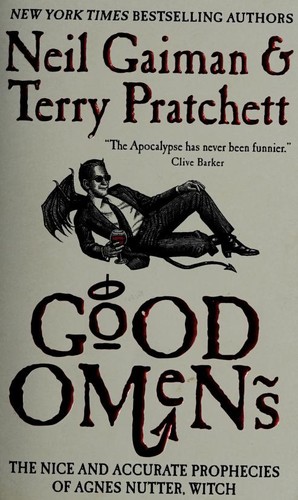
Good Omens
HarperTorch · 1990 · 432 pages
ISBN: 9780060853983
Review Editor
James Voss
Good Omens: The Nice and Accurate Prophecies of Agnes Nutter, Witch is the 1990 novel by Terry Pratchett and Neil Gaiman, two of the most beloved fantasy writers of the twentieth century. It arrived when both were building their reputations: Pratchett was deep in the Discworld series, Gaiman was making a name through comics. The book bears the unmistakable fingerprints of both: Pratchett’s humanism and his genius for absurdist bureaucracy, Gaiman’s darker mythological sensibility and feel for the otherworldly. Written largely over long-distance phone calls and floppy-disk exchanges between their homes in England, it reads with the energy of two friends trying to make each other laugh and mostly succeeding.
The premise is simple and beautifully ridiculous: the Antichrist has been born, Armageddon is eleven years away, and an angel named Aziraphale and a demon named Crowley have decided they would rather not let the world end. The two have been stationed on Earth since the Garden of Eden, and after six thousand years of watching humans muddle through, they have grown rather fond of the place. Crowley, who “did not so much Fall as saunter vaguely downwards,” has a flat in Mayfair and a vintage Bentley. Aziraphale runs an antiquarian bookshop in Soho and refuses to actually sell any of the books. They share a comfortable, deeply unlikely friendship that only makes sense after millennia of mutual understanding.
The problem is that the infant Antichrist, delivered by Hell’s own courier service, was accidentally placed with the wrong family. Instead of growing up with an American diplomat and receiving carefully calibrated demonic influence, the real Antichrist, Adam Young, grows up in the English village of Lower Tadfield as the son of perfectly ordinary people, with a gang of friends called the Them and a large mongrel named Dog. As the appointed day of Armageddon approaches, reality begins bending around Adam in increasingly spectacular ways. The Amazon rainforest regenerates. Atlantis rises. Both Heaven and Hell begin to notice that something has gone very wrong.
Character Arcs and Development
The novel’s heart is the relationship between Aziraphale and Crowley. For millennia, these two have maintained a quiet private arrangement: why work twice as hard when one can do the blessing and the other the tempting, and they both take the afternoon off? What makes them compelling is not the arrangement itself but what it reveals. Both have spent so long among humans that they have developed something Heaven and Hell never planned for: preferences. Aziraphale frets about his books and is quietly horrified whenever a situation demands decisive action. Crowley talks to his houseplants (threateningly, to keep them in line), maintains the Bentley with devotion, and is genuinely fond of the Earth in a way neither his bosses in Hell nor Aziraphale’s superiors in Heaven fully understand. They are not traitors to their respective sides so much as creatures who have, accidentally, become persons.
The surprise is Adam Young. You might expect the Antichrist to arrive as either a villain or a victim, but Adam is neither. He is an eleven-year-old boy who loves his friends, reads conspiracy-theory magazines with enthusiasm, and has a vivid imagination that the novel takes completely seriously. When his powers begin waking, it is not through rage or temptation but through curiosity. The shape of the world quietly shifts to match what he has been reading about. His trajectory through the book is, at its core, a question about power and identity: what do you do when you can have anything, and what happens when you realize that having everything is not what you actually wanted? The novel answers this through the Them, his three friends, who bring him back not through drama but through the specific, irreplaceable friction of children who still expect their friend to act like himself.
Secondary characters land with varying degrees of success, but the best are genuinely memorable. Agnes Nutter, the seventeenth-century witch whose “Nice and Accurate Prophecies” drive a major subplot, appears only in flashback, yet she leaves a clear impression: a woman who foresaw everything, told no one, and arranged for a spectacular exit when the Witchfinder Army finally came for her. Her descendant Anathema Device is sharp and practical without sliding into wish fulfillment. Newton Pulsifer, the hapless Witchfinder recruit with a supernatural ability to cause mechanical failures in any device he touches, is the comedy everyman done right: genuinely inept, unexpectedly sweet, useful in exactly one way at exactly the right moment.
Pacing
The novel moves with confidence through its first two acts. The early chapters establish tone quickly: warm, satirical, and comfortable with its own absurdity. The story accelerates as the converging storylines begin pulling toward Lower Tadfield, and the midpoint turn, when the real nature of Adam’s situation becomes clear to all parties simultaneously, lands with genuine weight. Pratchett and Gaiman never seem to lose the thread, even while juggling half a dozen separate storylines across two continents and several decades.
The one stretch where momentum softens is in the transition from setup to climax, when multiple characters travel toward the same destination and the plot requires them to keep arriving slightly too late or slightly too early. This is a structural choice as much as a flaw: the book is built on the formal logic of farce, and farce requires mistiming. But readers who prefer their comedies lean may feel the third act takes longer than necessary to arrive at what the first two acts have been promising. It does not undermine the novel. It is simply worth knowing before you read it.
Deeper Thematic Exploration
Beneath the comedy, Good Omens is thinking carefully about free will, institutional inertia, and what it actually means to be human. The central joke is that both Heaven and Hell are bureaucracies, and bureaucracies are fundamentally incapable of questioning their own instructions. The angels and demons pursue Armageddon not because they want the world to end but because it is in the manual and someone must have approved it at some point. Aziraphale and Crowley are anomalies: beings who have, through sheer proximity to humanity across six thousand years, developed something like individual judgment. They are, by the novel’s logic, more spiritually interesting than any of the creatures who follow orders without thinking, and the book finds this both funny and genuinely moving.
The treatment of childhood is quieter but worth noting. The novel frames Adam’s arc as an exploration of imagination and its limits, of the difference between wanting the world to be a certain way and being willing to live in the world as it is. His friends, Pepper and Wensleydale and Brian, are ordinary children without any powers, and that is precisely their function in the story: they represent the claims that ordinary human relationships make on us, and those claims turn out to matter more than the fate of the species. This is a characteristically Pratchett-and-Gaiman view of what holds things together: not grand gestures but specific loyalties.
There is also a strand running through the book about tradition and how to use it. Agnes Nutter’s prophecies are perfectly accurate but deliberately cryptic, requiring Anathema to decode them in real time, applying the past to a present Agnes never directly described. The Witchfinder Army has been maintained for centuries despite having run out of witches: an institution sustained by inertia, obsolete, ultimately harmless. Heaven and Hell are running an apocalypse according to a script written before humans existed, and neither side has paused to ask whether the script still applies. The novel suggests, gently, that inherited plans are useful only if you are willing to actually think about them.
Style and Voice
The prose is brisk, warm, and acutely aware of its own ridiculousness. Pratchett and Gaiman use footnotes extensively, in the tradition of Douglas Adams: footnotes that spiral into extended jokes, minor histories, and digressions that often contain the sharpest lines on the page. The narrative tone carries the particular flavor of British comedy that notices how relentlessly everything goes wrong and finds this funny rather than distressing. Specific passages, like the opening account of Crowley’s relationship with his houseplants or the description of how Agnes Nutter’s prophecy regarding “motorway diversions” was interpreted by every generation of Devices until 1987, are excellent in precisely the way that makes you want to read them aloud to someone nearby.
The two authors’ voices are distinguishable if you know where to look: Pratchett’s tendency toward compressed social satire, Gaiman’s toward the mythological and slightly haunted. But the seams are invisible at the sentence level. They wrote this book by sending drafts back and forth until neither could reliably say who had written what, and the result reads as a single, consistent thing. It does not feel collaborative the way collaborations often do, with visible joints and sections that feel owned by one party or the other. It feels finished.
Verdict
If you have any fondness for British comedy, fantasy, mythology, or the proposition that the world might be worth keeping, Good Omens is written for you. It is warm without tipping into sentimentality, funny without sacrificing coherence, and smart without requiring effort. The friendship between Aziraphale and Crowley is one of the most enduring portraits of an unlikely relationship in popular fantasy: two beings who disagree on almost everything and have arrived, across six thousand years, at the one thing that matters. The Amazon Prime adaptation (2019, with Michael Sheen and David Tennant) brought the book a new generation of readers, but the novel does things the series cannot: the footnotes, the pace of Agnes Nutter’s prophecies, the texture of Pratchett’s prose.
The book’s weaknesses are real but minor. A few supporting comic bits (the Chattering Order of St Beryl, the international delivery subplot) run longer than they need to. The final act takes its time arriving. But for the kind of reading experience that makes you want to find someone else who has read it so you can discuss the Bentley scene, or the moment Adam Young decides what kind of person he is going to be, or the very last paragraph, this book is hard to beat. Terry Pratchett died in 2015 and left a genuine absence. Good Omens is one of the places you can still find him at his best, writing something he clearly enjoyed enormously, alongside a friend who understood exactly what he was doing.
Frequently Asked Questions about Good Omens
What is Good Omens by Terry Pratchett and Neil Gaiman about?
Good Omens is a comedy novel about the coming of Armageddon and two supernatural beings (an angel named Aziraphale and a demon named Crowley) who have lived on Earth for six thousand years and have decided they would rather it not end. The book follows their attempts to prevent the Apocalypse while tracking the actual Antichrist, Adam Young, an ordinary eleven-year-old boy who grew up in the wrong family in an English village. The novel is funny, warmhearted, and deeply fond of the human race.
Who wrote Good Omens and how did the two authors collaborate?
Good Omens was written jointly by Terry Pratchett and Neil Gaiman, beginning in 1988 and published in 1990. The two wrote it by exchanging floppy disks and speaking on the phone daily, with Pratchett serving as keeper of the master copy. By the end, neither writer was entirely certain who had written which sections. Pratchett stated he wrote roughly two-thirds of the physical text, while Gaiman had significant influence on the opening and on several key characters and scenes.
What are the main themes in Good Omens?
The book explores several interlocking ideas: free will and the limits of institutional authority (both Heaven and Hell are bureaucracies following scripts neither questions), the value of choosing the world as it is over reshaping it to match your imagination, and the weight of ordinary human relationships as a stabilizing force. There is also a sustained thread about tradition and inherited plans: whether the scripts we have been handed still apply, and what it costs to follow them without thinking.
How long is Good Omens and is it a difficult read?
The original UK edition of Good Omens runs to 288 pages; the HarperTorch US edition (ISBN 9780060853983) runs to 432 pages including annotations and additional material. The prose is accessible and moves quickly. Readers who enjoy British comedy (Douglas Adams, P.G. Wodehouse) will find the tone immediately comfortable. There is no prior knowledge of either author’s other work required, though Pratchett fans will recognize his characteristic use of footnotes and Gaiman fans will recognize his mythological sensibility.
Is there a TV or film adaptation of Good Omens?
Yes. Amazon Prime Video released a six-episode limited series in 2019, with Michael Sheen as Aziraphale and David Tennant as Crowley. Neil Gaiman served as showrunner and adapted the scripts himself, following a request from Terry Pratchett before his death in 2015. Amazon renewed the series for a second season (released 2023) and a third and final season was announced in December 2023. A BBC Radio 4 adaptation also aired in 2014, and a graphic novel adaptation by Colleen Doran was funded through Kickstarter in 2023.
What age group is Good Omens suitable for?
Good Omens is written for adults and older teenagers, with a reading level roughly equivalent to accessible literary comedy. The humor is sophisticated and requires some cultural context (references to English village life, bureaucratic culture, and British comedy traditions), but nothing that will exclude readers not already familiar with Pratchett or Gaiman. The book contains some mild profanity and thematic content involving the apocalypse and demonology, all of which is treated with absurdist lightness rather than darkness.
How does Good Omens compare to Terry Pratchett’s Discworld books?
Good Omens shares Pratchett’s characteristic warmth, his love of footnotes, and his willingness to find genuine humanity in absurd situations. It is somewhat less satirically dense than the best Discworld novels, because it is also carrying Gaiman’s contribution: a slightly more mythological register and a greater interest in the specific texture of the supernatural. Readers coming to it from Discworld will feel at home immediately. Readers coming from Gaiman’s other work (American Gods, Neverwhere) will find it funnier and more optimistic than his usual mode.
Should I read Good Omens and is it worth it?
Yes, particularly if you want a book that will be funny for the whole of its length and leave you feeling good about the world by the end. The novel is best suited to readers who like their comedy rooted in character rather than plot mechanics, and who are willing to follow an ensemble cast across several converging storylines. If the Amazon series brought you to the book, the novel will give you things the adaptation could not: the footnotes, the internal voice of Agnes Nutter, and a version of Aziraphale and Crowley that belongs entirely to Pratchett and Gaiman rather than to anyone else’s interpretation of them.
Book Details
- Title
- Good Omens
- Genre
- Mystery & Thriller
- Publisher
- HarperTorch
- Year Published
- 1990
- Pages
- 432
- ISBN
- 9780060853983
- WritersReview Rating
- 4.4 / 5