
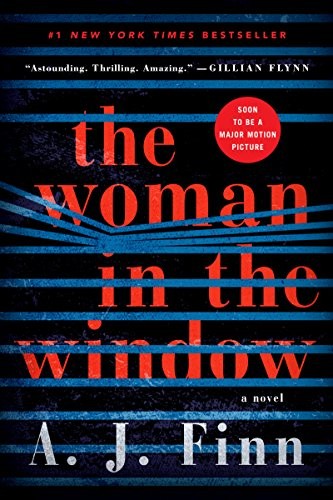
The Woman in the Window
William Morrow · 2018 · 448 pages
ISBN: 9780062678416
Review Editor
James Voss
Anna Fox has not left her house in ten months. She lives in a wide brownstone in Harlem, watching old films on a loop, drinking too much merlot, and tracking the lives of her neighbors through her windows. She is a child psychologist by training, though that work has stopped. Now she has agoraphobia, and her world has contracted to these rooms, this couch, this glass she refills more often than she should. When A.J. Finn begins his debut novel The Woman in the Window, published by William Morrow in January 2018, this is the life you are placed inside: solitary, medicated, and always watching.
The premise borrows from Alfred Hitchcock openly and without apology. Anna watches Hitchcock films throughout the novel, and the setup echoes Rear Window directly: a person confined to their apartment begins observing a family across the street and believes she witnesses a violent crime. The family is the Russells: husband Alistair, his wife Jane, and their teenage son Ethan. When Anna sees, through her rain-streaked window, what appears to be a stabbing, she calls the police. Officers arrive and bring a woman who identifies herself as Jane Russell. She looks nothing like the Jane that Anna had been getting to know. Anna’s medication, her alcohol intake, and her psychiatric history become immediate grounds for skepticism. The question the book is built around is not complicated to state: did Anna see what she thinks she saw?
The Woman in the Window hit number one on the New York Times bestseller list and sold into more than forty countries. A Netflix film followed in 2021, with Amy Adams playing Anna. The novel arrived carrying pre-publication attention that was unusual even by bestseller standards: a major advance, an early film sale, a marketing campaign pitched at readers who had made Gillian Flynn and Paula Hawkins into household names. What the book needed, once all of that settled, was to justify the attention on its own terms. It mostly does.
Character Arcs and Development
Anna Fox carries the novel, and Finn’s central achievement is making her both sympathetic and genuinely unreliable. She self-medicates with wine and with prescription drugs that do not mix well. She participates in an online forum for people with agoraphobia, and she is more honest there than she is with her therapist. The reader learns gradually that something happened to Anna’s family: a car accident, the details of which are parceled out slowly. What she tells us early about her husband Ed and her daughter Olivia shifts as the story moves forward. Finn handles these revelations without the cheap manipulation that the genre sometimes permits.
The small daily rituals of Anna’s life are drawn with specificity: the chess games played online, the two cats, the particular quality of winter light through old glass. These details accumulate until you feel the full weight of the life she has reduced herself to, and the life she had before. Her knowledge of classic film functions both as comfort and as a framework for interpreting what she sees outside, which is a smart piece of characterization even when it tips toward becoming a tic.
What distinguishes Anna from the genre’s typical unreliable narrator is that she spent her career professionally trained to observe human behavior. She read children in distress for a living: their silences, their deflections, the way a body holds itself when something is wrong. This instinct has not dissolved with her agoraphobia. It shapes how she watches the Russells, and it sharpens the particular sting when she begins to doubt herself: she is applying her own clinical framework to the question of her own reliability, and finding no clean answer.
Ethan Russell, the teenage son who crosses the street to knock on Anna’s door one afternoon, is the novel’s most interesting secondary figure. Their scenes together carry a quiet authenticity: two people who feel cut off from the world managing, in modest ways, to make contact. The other Russells are drawn with deliberate opacity because we always see them through glass, and that distance flattens character by design. David, the young man renting Anna’s basement apartment, serves the plot more than he serves the novel. He is present because the story needs him; Finn does what is necessary and not much more.
Pacing
The novel moves quickly. Finn structures it in short chapters, some only two or three pages, and the result is a forward pull that does not often relax. The first third establishes Anna’s routines, the Russells’ household, and the mood of a New York winter seen from inside a warm room with a full glass. A scene early on, where Anna steps outside for the first time in months and immediately feels the weight of open space pressing against her, is brief and precisely rendered.
The middle section, where Anna tries to convince the police and then herself that her account of events is accurate, requires the most patience. There is a structural challenge here: Anna cannot go out, she cannot prove anything, and she starts to doubt her own perception under the pressure of being repeatedly disbelieved. Finn keeps the narrative moving by feeding new information at regular intervals, but this section does plateau for a stretch before the third act takes over. It is not a flaw that breaks the novel, but it is where you will most clearly feel the machinery of the plot.
The final third accelerates sharply, and the revelations land in a sequence that has been carefully prepared. Readers familiar with psychological thrillers will see some of what is coming before it arrives. The construction of the climax is solid, and Finn earns the landing he sticks.
Deeper Thematic Exploration
The novel is built around a question of epistemology: what can a person trust herself to know? Anna’s access to reality is always mediated. She watches through windows, through a television screen, through the anonymizing distance of the internet. Everything she perceives comes filtered, and Finn makes this a structural principle rather than just a mood.
The novel also explores what trauma does to memory. The car accident that ended Anna’s previous life has not simply wounded her; it has reordered what she can access and what she suppresses. Whether her account of events can be trusted is inseparable from whether she has honestly processed what happened to her family. The text handles agoraphobia with more care than a blunt metaphor would allow. Anna is not unreliable because she is mentally ill; she is unreliable in specific and bounded ways, and her clinical intelligence is intact and functioning.
There is a sustained thread about gaslighting in the book. The police interview Anna and conclude she is not credible. Her therapist adjusts her medications. Alistair Russell presents himself as steady and patient. Each of these responses treats Anna’s account as a symptom rather than as testimony. Finn does not lean on this as a feminist argument, exactly, but it gives the novel more texture than a straightforward whodunit would have. You notice what it looks like when a struggling woman’s version of events is systematically replaced by others’ versions.
The Hitchcock references run deeper than atmosphere. Rear Window is a film about the morality of watching, about what it means to observe lives you have no right to observe. And the film Anna returns to most obsessively, Laura from 1944, is about a detective who falls in love with a portrait of a woman before he knows the woman herself. It raises a question the novel is quietly asking: how much of what Anna sees across the street is observation, and how much is projection?
Style and Voice
Finn writes in first-person present tense, which is the right choice. Present tense keeps perception immediate; Anna is inside events as they unfold, not looking back from a position of retrospective clarity. The prose is clean and purposeful without being spare. Anna’s voice has a controlled quality, as if she is watching herself from a few feet away, cataloging her behaviors with clinical detachment. When emotion breaks through that composure, it carries more force for having been contained.
The film references work best when they reveal something about how Anna thinks and worst when they feel like the author demonstrating a curriculum. Finn walks this line with reasonable discipline. The brownstone setting accumulates effectively: winter light, old wood, the silence of a house with one permanent occupant. These are not details that call attention to themselves; they build the novel’s emotional register steadily over hundreds of pages.
Verdict
The Woman in the Window is a well-constructed psychological thriller with a protagonist who earns your attention and a plot that pays its debts. It does not reinvent the genre. If you have read several unreliable-narrator thrillers over the last decade, you will recognize the architecture: withheld backstory, gradual revelation, accelerating conclusion. Finn deploys these tools skillfully without extending them significantly.
If psychological thrillers with a cinematic sensibility are your preference, this is one of the better examples the recent wave has produced. Anna Fox is better company than the premise promises, and the novel’s interest in what perception can and cannot be trusted to deliver gives it more substance than its marketing suggested. Read it in one or two long sittings, which is how it wants to be read, and you will find it earns the time you give it.
Frequently Asked Questions about The Woman in the Window
What is The Woman in the Window by A.J. Finn about?
The Woman in the Window follows Dr. Anna Fox, an agoraphobic child psychologist who has not left her Manhattan brownstone in ten months. While watching her neighbors across the street, she witnesses what she believes is a violent crime. When the police arrive skeptical and the woman she says she saw appears to have been replaced by someone else, Anna must determine whether she can trust her own account of events.
Who is A.J. Finn, and is it a pen name?
A.J. Finn is the pen name of Daniel Mallory, an American author and former book editor at William Morrow. He used initials rather than his full name when publishing this debut novel. In 2019, a New Yorker profile raised significant questions about fabrications in his personal history. The novel predates those revelations and has sold millions of copies in over forty countries.
Is The Woman in the Window based on a true story?
No. The novel is fiction. Its setup draws openly on Alfred Hitchcock’s 1954 film Rear Window, which Finn acknowledges throughout the text. Anna watches Hitchcock films on loop throughout the story, including Rear Window itself, and the structural parallels between the film and the novel are intentional rather than incidental.
What are the main themes in The Woman in the Window?
The central theme is whether personal perception can be trusted. Secondary themes include trauma and memory (Anna is processing a devastating personal loss she has not fully acknowledged), the experience of agoraphobic isolation, gaslighting and the credibility granted to women who are visibly struggling, and the ethics of voyeurism. The film Laura (1944), which Anna watches repeatedly, raises the additional question of whether she is observing the Russells or projecting a version of them from her own needs.
Is there a movie or TV adaptation of The Woman in the Window?
Yes. A film adaptation directed by Joe Wright and starring Amy Adams as Anna Fox was released on Netflix in May 2021. The supporting cast included Gary Oldman, Anthony Mackie, and Julianne Moore. The production had a complicated history that included reshoots and a delayed release from planned theatrical distribution to streaming. Critical reception was mixed; most reviewers found the film competent but noted that Anna’s interiority, which drives the novel, does not translate easily to screen.
How does The Woman in the Window compare to Gone Girl or The Girl on the Train?
All three books feature female protagonists whose reliability is in question and center on a crime that depends on who you believe. Gone Girl by Gillian Flynn is more structurally inventive and its dual narration feels more original. The Girl on the Train by Paula Hawkins is the closest structural parallel: a woman watching others from a fixed vantage point who witnesses something she cannot prove. The Woman in the Window is more self-consciously literary in its film references and gives more time to Anna’s interior life, which readers will either find satisfying or slower than they prefer.
How long is The Woman in the Window and is it a difficult read?
The hardcover edition runs 448 pages, but short chapters make it move faster than that count suggests. The prose is direct and the story is propulsive; readers comfortable with thriller fiction will find nothing technically demanding here. Most people finish it across one long session or a couple of evenings. It asks for sustained attention to detail rather than effort.
Should I read The Woman in the Window and is it worth it?
If psychological thrillers are your genre and you appreciate a protagonist with a real interior life, yes. Anna Fox is more interesting than the premise makes her sound, and the novel’s treatment of perception and memory gives it more substance than its commercial packaging suggested. If you find unreliable-narrator thrillers formulaic, this book will not change that view, but it is a skillful example of the form. Start it in the early afternoon and you will likely discover it has taken your evening as well.
Book Details
- Title
- The Woman in the Window
- Author
- A.J. Finn
- Genre
- Mystery & Thriller
- Publisher
- William Morrow
- Year Published
- 2018
- Pages
- 448
- ISBN
- 9780062678416
- WritersReview Rating
- 4.0 / 5