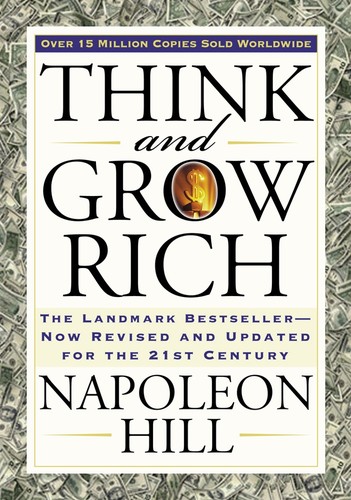
Napoleon Hill
Napoleon Hill was an American author and lecturer whose writings on success, achievement, and the power of the mind established the foundations of what would become the personal development industry. His most famous work, Think and Grow Rich, has sold more copies than virtually any other self-help book in history and has influenced generations of entrepreneurs, leaders, and aspiring achievers around the world.
Hill was born in 1883 in the Appalachian town of Pound, Virginia, into modest circumstances. His early life was marked by poverty and loss — his mother died when he was nine years old — but he pursued education tenaciously and began writing for local newspapers while still a teenager. A pivotal moment came in 1908 when, as a young journalist, he was assigned to interview the steel magnate Andrew Carnegie. That meeting changed the direction of Hill’s life: Carnegie was so impressed by the young man’s intelligence and ambition that he challenged him to spend twenty years studying the most successful men in America and distilling the principles of their achievement into a philosophy accessible to ordinary people.
Hill accepted Carnegie’s challenge and spent the next two decades interviewing hundreds of the most accomplished figures of his era, including Thomas Edison, Henry Ford, Theodore Roosevelt, John D. Rockefeller, and Alexander Graham Bell. He codified his findings in a series of works, beginning with The Law of Success (1928), a multi-volume course on achievement, and culminating in the concise and powerfully accessible Think and Grow Rich (1937). This latter book, written during the depths of the Great Depression, distilled his philosophy into thirteen principles — including desire, faith, specialized knowledge, imagination, organized planning, and the mastermind alliance — that he argued were the common foundations of all significant achievement.
Think and Grow Rich became one of the top ten bestselling self-help books of the twentieth century, selling over a hundred million copies worldwide. Its central thesis — that thoughts are things, and that a definiteness of purpose combined with a burning desire and persistent action can overcome virtually any obstacle — resonated powerfully in Depression-era America and has continued to inspire readers through every subsequent era of uncertainty and economic challenge.
Hill’s work is not without controversy — some of his specific claims about wealth and material success have been criticized as overpromising, and certain biographical details he recounted have been disputed. Nevertheless, his influence on the personal development field is incalculable: the concepts of the mastermind group, positive mental attitude, and the power of definiteness of purpose — all popularized by Hill — remain cornerstones of success literature and business coaching to this day.