
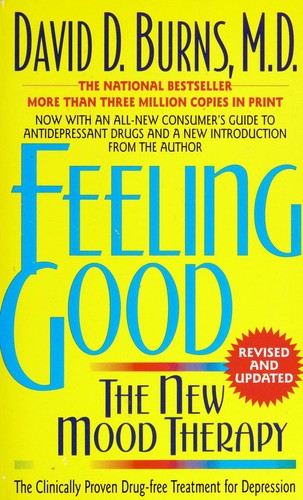
Feeling Good
William Morrow & Company · 1999 · 706 pages
ISBN: 9780380810338
Review Editor
Sofia Reyes
Feeling Good: The New Mood Therapy arrived in 1980 as a quiet challenge to the way psychiatry thought about depression. David D. Burns, a psychiatrist at Stanford and the University of Pennsylvania and a student of Aaron T. Beck (the psychologist who developed cognitive therapy), wrote a book built around a claim that sounded almost implausibly hopeful: depression is not primarily a chemical problem but a thinking problem, and the thinking can be changed. That argument, spelled out in the original 462-page edition and expanded to 706 pages in the 1999 revision, has now sold more than four million copies in the United States. In a national survey of mental health professionals, it was voted the most frequently recommended self-help book for depressed patients from a list of more than a thousand titles.
The method at the center of the book is cognitive behavioral therapy, taught through what Burns calls the “triple column technique”: write down the automatic negative thought you are having, identify which cognitive distortion it represents, then write a more rational and accurate response. To scaffold that process, Burns names and defines ten cognitive distortions that fuel depression and anxiety: all-or-nothing thinking, overgeneralization, mental filtering, disqualifying the positive, jumping to conclusions, magnification and minimization, emotional reasoning, should statements, labeling, and personalization. Each is described with clinical precision and illustrated with examples drawn from decades of practice. The distortions do not feel like abstract categories after you read about them; they feel like a field guide to your own interior landscape.
The 1999 revised edition, which is the version most readers encounter today, adds a substantial consumer’s guide to antidepressant medications and a new introduction situating the book in the context of twenty years of clinical research. The core method is unchanged. What Burns added was context: a defense of CBT’s track record against both skeptics who dismissed it and enthusiasts who oversold it, and a careful argument for how cognitive therapy and medication relate to each other without being the same thing.
Character Arcs and Development
Feeling Good has no fictional characters, but it is full of people. Burns draws on decades of clinical work to populate almost every chapter with anonymized case histories: the successful attorney who believes a single professional error defines him entirely; the mother whose grown children’s independence confirms for her, with terrible logic, that she has been a failure as a parent; the young man whose rejection by someone he barely knows hardens his conviction that he is fundamentally unlovable. These are not composites or illustrative sketches. They read like people: specific enough to be believable, familiar enough to serve as mirrors.
Each case history serves two functions simultaneously. It demonstrates a particular cognitive distortion in action with enough narrative detail that the pattern becomes recognizable, and it then shows the intervention in real time. Burns walks through the triple column technique with a specific patient, shows the exact words of the automatic thought, names the distortion, and models what a more rational and compassionate response looks like. You watch someone’s thinking change, step by step, on the page. These are not before-and-after summaries. They are the actual process, transcribed and slowed down so you can study the mechanism.
What makes these vignettes work is their honesty. Burns never tidies up the outcomes. A patient who significantly reduces her depression score by the end of a chapter has not been cured; she has acquired a tool. The secondary figures in the book, including therapists and colleagues who appear briefly, reinforce the same point: the method is transferable, teachable, and does not depend on one clinician’s unusual rapport. The human examples carry real emotional weight precisely because Burns never inflates them into success stories.
Pacing
The first third of Feeling Good moves with unusual momentum for a clinical self-help text. Burns introduces the theoretical foundation quickly and without condescension, then covers the ten cognitive distortions at a pace that makes each chapter feel immediately applicable. The specific usefulness of finishing a section on all-or-nothing thinking and then catching yourself doing it that same afternoon is a large part of what built the book’s long-term reputation. Therapists who began handing it to patients as supplementary treatment reported back on this effect, and it spread.
The middle sections, covering anger, perfectionism, and the need for approval, are solid but slower. Burns returns to the triple column technique and the daily mood log across multiple chapters, which creates productive reinforcement if you are actively working through the exercises and noticeable repetition if you are reading cover to cover. The book functions best as a workbook, taken a chapter at a time with a pen nearby, rather than as a text to be consumed in a few long sessions. Readers who approach it that way will find the pacing deliberate and well-calibrated. Those who read straight through may find the middle stretch harder to sustain.
Deeper Thematic Exploration
The most significant argument in Feeling Good is not about technique. It is about the nature of suffering. Burns proposes that depression is not something that happens to you; it is something your mind does in response to events, through interpretations that feel like facts but are not. That shift in framing carries consequences that extend far beyond treatment.
If your thoughts are generating your emotions, and thoughts can be examined and revised, then you are not simply a passive recipient of your suffering. Burns is careful not to let this become a statement of blame. The cognitive distortions he describes are automatic and largely unconscious. Catching them requires practice. Changing them requires sustained effort and, for many people, professional support alongside the book. The promise here is not a sudden shift in perspective but a learnable method, supported by clinical evidence that Burns reviews in the introduction and that subsequent research has continued to add to.
There is a strand of philosophical tradition running quietly through these chapters. Burns acknowledges it briefly: the Stoic idea that people are disturbed not by things but by the way they think about things goes back to Epictetus, and CBT is in part a clinical operationalization of that ancient insight. What Burns adds is structure: specific categories of cognitive error, specific exercises for testing and revising thoughts, and a body of evidence that the process produces measurable results across diverse patient populations.
The chapters on perfectionism are among the richest in the book. Burns draws a distinction that achievement culture almost never makes: perfectionism is not the same as the desire for excellence. It is a cognitive pattern that treats any gap between current performance and some ideal as evidence of personal failure, which conflates outcome with worth. That conflation is what makes perfectionism depressogenic. Releasing it does not mean lowering your standards. It means uncoupling your sense of yourself from any single result, which turns out to be considerably harder than optimizing a routine. Burns treats that difficulty with the seriousness it deserves, working through multiple examples and offering specific exercises rather than the usual exhortations to simply stop being so hard on yourself.
The book’s treatment of antidepressants is more balanced than readers sometimes expect. Burns is not hostile to pharmacology. He gives medication a thorough and fair hearing and acknowledges that antidepressants are appropriate, sometimes necessary, for certain presentations of depression. His argument is not that drugs are wrong but that they address a different level of the problem, and that the cognitive level is both accessible and potent on its own terms. Decades of clinical research since the original 1980 publication have supported that position, and the CBT techniques Burns teaches have since been validated in randomized controlled trials across dozens of studies.
Style and Voice
Burns writes with the precision of a clinician and the patience of a skilled teacher. The prose is clear and direct, occasionally warm, rarely elegant in the literary sense. He prefers short sentences and numbered lists, which gives the text a conversational quality that clinical self-help often trades away for inspirational register. He does not wind up before the useful parts. He leads with the method, explains the concept, and then provides an exercise. That economy of approach is rare in the genre and is part of what makes the book feel trustworthy.
Most self-help books operate on a cycle of story, principle, and affirmation. Feeling Good operates on a cycle of concept, example, and exercise. It does not ask you to believe in yourself or visualize a better version of your life. It asks you to write down a specific thought you had this morning, examine it against ten named categories of distortion, and notice whether it survives scrutiny. The difference in register is striking and the fidelity to evidence is what gives the book its unusual shelf life. A well-marked copy tends to look like a student’s notebook, with dog-eared pages, underlined passages, and margin notes accumulating across every chapter. That is what a genuinely useful book looks like.
Verdict
Feeling Good is worth reading if you have ever noticed that your own thinking is working against you; if you have been through therapy and found it useful but incomplete; or if you carry depression, anxiety, or chronic self-criticism that has not responded to more passive approaches. The method is learnable, the evidence for it is substantial, and it applies to a range of struggles far broader than clinical depression. Even readers who do not consider themselves depressed often find the chapters on perfectionism, approval-seeking, and emotional reasoning directly applicable to their lives.
It is not the right book for everyone. Readers dealing with severe or treatment-resistant depression should use it alongside professional care rather than in place of it. The medication chapters require an awareness that pharmacology has moved on considerably since 1999, and readers should consult a physician rather than relying on those sections for specific guidance. Those who prefer narrative momentum to structured exercises may find the pace difficult to sustain across 700 pages. For readers who come to it ready to do the actual work, though, Feeling Good delivers on its central promise: a practical, evidence-backed method for changing the thinking patterns that generate and sustain depression. Not a shortcut, not a cure. A method, taught clearly and well, by someone who spent a career helping people use it.
Frequently Asked Questions about Feeling Good: The New Mood Therapy
What is Feeling Good: The New Mood Therapy by David Burns about?
Feeling Good is a self-help guide to treating depression and anxiety using cognitive behavioral therapy (CBT). David D. Burns teaches readers to identify ten cognitive distortions, the systematic thinking errors that fuel negative emotions, and provides structured exercises for examining and changing those patterns. The book is based on decades of clinical practice and has been used by therapists as supplementary treatment for depressed patients since its original 1980 publication.
Does reading Feeling Good actually help with depression?
Clinical studies suggest yes. Evidence from at least six studies shows that reading Feeling Good as a form of guided bibliotherapy produced measurable reductions in depression symptoms, with the effect classified as large in research terms. Mental health professionals in the United States have consistently rated it the most frequently recommended self-help book for depressed patients in national surveys. It works best for mild to moderate depression and is most effective when readers engage actively with the exercises rather than reading passively.
What are the main techniques in Feeling Good by David Burns?
The central technique is the triple column method: write down an automatic negative thought, identify which of the ten cognitive distortions it represents (such as all-or-nothing thinking, overgeneralization, or emotional reasoning), then write a more accurate and balanced response. Burns also introduces the Daily Mood Log for tracking thought patterns over time, and dedicates specific chapters to techniques for perfectionism, anger, and the need for approval, each with targeted exercises.
How long is Feeling Good and is it a difficult read?
The 1999 revised edition runs to 706 pages, longer than most self-help books. The prose is clear and accessible; Burns writes in plain English and avoids clinical jargon. The challenge is not the language but the format: Feeling Good works best as a workbook taken slowly, with exercises completed in real time, rather than read cover to cover in a sitting. Readers who engage with it that way should plan on several weeks rather than a few afternoons.
Is there a sequel or companion book to Feeling Good by David Burns?
Yes. Burns followed the original with The Feeling Good Handbook (1989), which expands the CBT method to cover anxiety, relationship problems, and communication skills, with more extensive workbook exercises. He later published Feeling Great (2020), an update incorporating his newer TEAM-CBT framework developed over additional decades of clinical practice. Readers who find the original useful often work through the Handbook next for its broader scope.
What type of reader is Feeling Good best suited for?
The book is written for adults dealing with depression, anxiety, perfectionism, or chronic self-criticism, and requires no background in psychology. It is most useful for readers who are ready to engage actively with structured exercises rather than reading about mental health in a passive way. Mature teenagers have used it successfully, though it is written for an adult audience. Readers in acute crisis or dealing with severe depression will get more from it as a complement to professional care than as a standalone resource.
How does Feeling Good compare to other self-help books for depression?
Feeling Good stands apart by grounding its method in clinical research rather than personal testimony or motivational philosophy. Where most books in the genre ask for a shift in mindset through belief, Burns provides specific and testable techniques derived from CBT. It is often compared to Mind Over Mood by Greenberger and Padesky, which is more workbook-dense and less narrative in approach, and to Robert Leahy’s The Worry Cure for anxiety specifically. Among all self-help books on depression, Feeling Good has the strongest evidence base and the longest track record of clinical recommendation.
Should I read Feeling Good or see a therapist instead?
Ideally, both. Feeling Good works well alongside therapy and as a starting point for people without immediate access to professional care, but it is not a substitute for clinical treatment in cases of severe depression, suicidal thinking, or conditions that require diagnosis and monitoring. Burns himself makes this point clearly throughout the book. For mild to moderate depression or anxiety, many people find the book sufficient on its own; for more serious presentations, it is most effective as a structured complement to professional support.
Book Details
- Title
- Feeling Good
- Author
- David D. Burns
- Genre
- Self-Help
- Publisher
- William Morrow & Company
- Year Published
- 1999
- Pages
- 706
- ISBN
- 9780380810338
- WritersReview Rating
- 4.7 / 5