
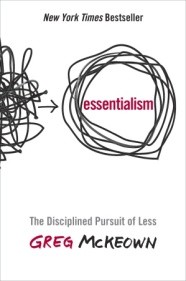
Essentialism
Crown Business · 2014 · 260 pages
ISBN: 9780804137386
Review Editor
Sofia Reyes
Greg McKeown published Essentialism: The Disciplined Pursuit of Less in 2014, and in the decade since, it has sold more than two million copies in over forty languages. That scale of readership doesn’t happen by accident. McKeown, a British-born author and consultant who trained at Stanford, identified something specific about the contemporary professional condition: most people are stretched thin not because they lack ability, but because they have been trained to say yes, to treat a full schedule as proof of importance, and to mistake activity for progress. His book argues for something different, and the argument is both principled and practical enough to have connected with readers far outside the world of business.
The book is organized around three movements. The first section, Explore, addresses how to discern what actually matters from the noise of everything competing for your attention. The second section, Eliminate, covers the harder work: cutting the commitments, habits, and obligations that don’t serve what you’ve identified as essential. The third section, Execute, deals with building systems that make the important things easier and the trivial things less tempting. McKeown presents these not as steps to follow once but as a continuous practice, a deliberate discipline that requires maintenance in a world designed to scatter your focus.
McKeown draws on his experience coaching Silicon Valley executives, on a broad sweep of psychological and organizational research, and on case studies from business, sports, and medicine. The combination produces a book that moves quickly and makes its case accessibly. The underlying premise is simple enough to state in a sentence: if you don’t choose your priorities deliberately, someone or something else will choose them for you. The rest of the book is about making that choice real, and the practices he offers are grounded in decisions that real people actually face.
Character Arcs and Development
McKeown builds his argument through a series of illustrative figures, and the most effective is himself. He opens by describing a period when he was trying to be a good husband, active father, rising consultant, and reliable friend simultaneously, and failing at all of it. The admission is disarming because it reverses the typical opening move in business books, where the author positions themselves above the reader’s problems. McKeown starts from inside the problem he’s trying to solve, and that honesty earns a kind of trust that would be hard to establish otherwise.
The recurring figure at the center of the book is what McKeown calls the non-essentialist: a smart, capable, hardworking person who has said yes to too much, not from weakness but from confusion about what those commitments mean. What makes this figure sympathetic is that the mistake feels virtuous while you’re making it. Saying yes to another project looks like ambition. Helping every colleague looks like generosity. Attending every meeting looks like dedication. McKeown’s argument is that these impulses, admirable in isolation, collectively hollow out your capacity to do any one thing well. The non-essentialist isn’t a failure of character; they’re a product of a system that rewards volume over depth.
The counterpoint is the essentialist: someone who has decided what to pursue and said no, gracefully and repeatedly, to almost everything else. McKeown is careful not to present this as selfishness. His cases include surgeons who slow down at the critical moment to think clearly, journalists who develop a single story with depth instead of producing dozens of shorter ones, and managers who clear their own calendars to make space for the people they lead. The essentialist brings more of themselves to fewer things, and McKeown argues consistently that the quality of the output reflects that concentration.
Pacing
Essentialism runs 260 pages, and its chapters are brief, rarely exceeding ten pages. Each one is organized around a single concept and anchored by one story or study before pressing forward. For most readers, this rhythm works in the book’s favor: the ideas arrive in quick succession and none of them overstay their welcome. You can read a chapter in twenty minutes and carry its central point into the rest of your day.
The weaker stretch is the middle section on elimination, where the argument is most compressed. A few chapters here, particularly those addressing how to gracefully limit obligations over time, develop an idea just as the page runs out. The book also has a habit of restating its central thesis at the opening of each new chapter, which readers already persuaded will want to skip. The execution section in the final third recovers well, building momentum as its concepts connect into a workable approach. The book ends stronger than it starts, which is not always the case in this genre.
Deeper Thematic Exploration
Below the productivity framework, Essentialism argues against something larger than bad time management. McKeown calls the opposing force the “undisciplined pursuit of more,” and what he describes is less an individual failing than a cultural default. The idea that more is better, that a packed schedule signals importance, that declining an opportunity is a form of failure: these are not just bad habits. They are inherited assumptions reinforced by every system around you, from corporate performance reviews that reward long hours to social media platforms that measure worth in engagement. The book, without quite naming it, is a quiet argument against the premise that busyness and significance are the same thing.
The book’s most philosophically interesting move is its distinction between choices and options. Options are what exist in the world. Choices are the decisions you make about your own life. When you believe circumstances have fixed your schedule and you have no real say in how you spend your time, McKeown argues, you have surrendered your agency without noticing. The essentialist move is to reclaim the question: what do I actually want to do with this time? That reframing applies well beyond workplace productivity. The same question reshapes how you think about relationships, where you live, and what creative work you are actually pursuing versus planning to pursue someday.
A second thread concerns scarcity and quality. McKeown repeatedly shows that constraints, handled well, tend to produce better work. The editor who focuses on one manuscript does sharper work than one managing fifteen. The designer who eliminates rather than adds finds the detail that makes the whole thing work. This connects Essentialism to a much older tradition of thought about simplicity as strength rather than deprivation: the same argument that runs through Japanese aesthetics, through Thoreau, through every discipline that takes reduction seriously as a creative act. McKeown doesn’t develop this thread as fully as it deserves, but its presence lifts the book above the typical time-management shelf.
The most emotionally resonant passage draws on a palliative care nurse’s observation that dying patients almost never wished they had worked more or attended more meetings. McKeown uses this not as a worn motivational flourish but as a precise diagnostic tool: looking back from the end, which of your current commitments would feel essential? Which ones would dissolve? The question changes the weight of today’s trade-offs in a way that purely tactical productivity advice cannot.
Style and Voice
McKeown writes in clear, businesslike prose with occasional flashes of the well-placed phrase. He is not a literary stylist, but he has a talent for the compressed, portable insight. Lines like “What if we stopped celebrating being busy as a measure of importance?” carry their point in a single beat and stay with you. The voice throughout is that of a thoughtful consultant rather than a motivational speaker, and for readers skeptical of the genre’s tendency toward hyperbole, that restraint matters. He doesn’t promise transformation; he describes a practice, and he delivers it with enough specificity to make the practice feel learnable.
The book’s structure enacts its argument. Chapters are short, ideas are stated plainly, and each section ends with a brief summary. Some readers will find the repetition tedious. Others, reading in fragments between other obligations, will find it exactly right. On balance, the format serves the content: a book about doing less and doing it better probably shouldn’t run to four hundred pages.
Verdict
Essentialism works best for readers who already sense they are overcommitted but haven’t found a clear vocabulary for why. McKeown provides that vocabulary, and more usefully, a set of practices grounded in real decisions rather than abstract principles. The book will not restructure your calendar on its own. But if you come to it willing to examine where your attention actually goes, it offers a perspective that is harder to find in most of what the productivity genre produces.
Its limitations are real: the case studies tend to center on high-agency professionals in tech contexts, which can make some of the advice feel harder to apply if you have less control over your schedule. A few ideas in the middle section get shortchanged by the book’s compressed pace. But the core argument holds up, the examples are well-chosen across a range of contexts, and the book has the rare quality of practicing what it preaches. It’s short, it doesn’t bury its point, and it ends with something you can actually use. If you find yourself ending weeks busy but uncertain what you actually accomplished, you will recognize yourself in these pages, and that recognition is where the book’s real value begins.
Frequently Asked Questions about Essentialism
What is Essentialism by Greg McKeown about?
Essentialism argues that most people spread themselves too thin by saying yes to too much, and that the solution is to deliberately identify what matters most and eliminate almost everything else. McKeown’s central claim is that doing less, but doing that less far better, produces both greater satisfaction and greater impact than the alternative. The book is organized around three principles: explore what matters, eliminate what doesn’t, and execute without friction.
Is Essentialism worth reading?
Yes, particularly if you frequently end the week feeling busy but not productive. The book’s core insights about attention, trade-offs, and the difference between urgent and important have held up well since the book’s 2014 publication. McKeown’s follow-up, Effortless, builds on the same foundation, but Essentialism remains the more rigorous and memorable of the two. It reads in a few hours and offers a different frame for thinking about how you spend your time.
What are the main ideas in Essentialism by Greg McKeown?
The book develops four central ideas. First: you can do anything, but not everything, and accepting that trade-off is the beginning of real effectiveness. Second: most of what we say yes to is driven by social pressure rather than deliberate choice. Third: real productivity comes from working on fewer things with full attention rather than many things with divided attention. Fourth: the systems around you will default toward more unless you actively design them toward less.
How long is Essentialism and is it a difficult read?
Essentialism is 260 pages, divided into short chapters that average around ten pages each. The prose is clear and direct, aimed at a general professional audience rather than an academic one. Most readers finish it in three to five hours. It is not a difficult read; the concepts are accessible and McKeown avoids jargon. The challenge is not understanding the ideas but applying them, which is a different kind of difficulty entirely.
How does Essentialism compare to Deep Work or Getting Things Done?
Essentialism operates at a higher level of abstraction than Getting Things Done, which is primarily a system for managing tasks. Cal Newport’s Deep Work shares Essentialism’s concern with focused attention but concentrates on knowledge work specifically and goes deeper into the neuroscience of concentration. McKeown’s book is the more philosophical of the three, more interested in why you choose what you choose than in how to organize what you’ve already committed to. They work well together: Essentialism sets the agenda; the others help execute it.
What does Greg McKeown mean by the disciplined pursuit of less?
McKeown distinguishes between cutting back because you have no choice and cutting back because you’ve made a deliberate judgment about where your highest contribution lies. The discipline is in the word pursuit: essentialism is not passive or reactive, but an active practice of regularly asking which of your commitments deserve to continue and which ones you’re maintaining out of habit, guilt, or social pressure. The pursuit of less is itself a form of ambition, a commitment to doing fewer things at a level of quality that distributed effort cannot reach.
Who should read Essentialism and who might not connect with it?
Readers who will get the most from this book are professionals with significant control over how they spend their time: managers, consultants, entrepreneurs, and people in roles where the volume of possible commitments exceeds any individual’s capacity. Readers who work in highly structured environments with little discretion over their schedules may find the book’s advice harder to apply directly. The book also works well for people in major life transitions who are rethinking what they actually want to be doing with the next few years.
Does Essentialism have any weaknesses as a book?
The book’s most consistent limitation is that its case studies tend to feature high-agency professionals, typically executives and entrepreneurs in Silicon Valley contexts, which can make some advice feel less applicable to people with less control over their schedules. The middle section also moves quickly through ideas that could use more development. And while McKeown addresses the social difficulty of saying no, readers dealing with deeply asymmetric power dynamics at work may find that guidance overly optimistic. These are real constraints, though they don’t undermine the book’s central value.
Book Details
- Title
- Essentialism
- Author
- Greg McKeown
- Genre
- Self-Help
- Publisher
- Crown Business
- Year Published
- 2014
- Pages
- 260
- ISBN
- 9780804137386
- WritersReview Rating
- 4.2 / 5