
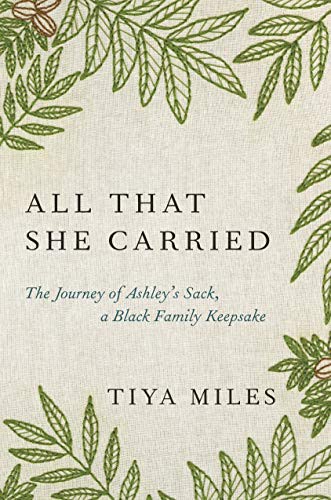
All That She Carried
Random House · 2021 · 352 pages
ISBN: 9781984856128
Review Editor
Priya Nair
Begin with a single object: a rough cotton flour sack, about the size of a pillowcase. In the early 1850s, somewhere in South Carolina, an enslaved woman named Rose packed it before her nine-year-old daughter Ashley was sold away from her, probably forever. Inside she placed a tattered dress, a handful of pecans, a braid of her own hair, and what she could only call her love. Decades later, Ashley’s granddaughter Ruth Middleton stitched those contents onto the fabric in a few lines of embroidery, preserving the moment against erasure.
That sack is the subject of All That She Carried: The Journey of Ashley’s Sack, a Black Family’s Keepsake, published in June 2021 by Random House. Harvard historian Tiya Miles uses it as a lens to examine three generations of Black women under American slavery, the brutality of the domestic slave trade, and the ways that families preserved love and memory when the law gave them no formal means to do so. Miles brings to this project her expertise in both African American and Native American history, and the result is a book that won the National Book Award for Nonfiction in 2021, the Kirkus Prize, the PEN/John Kenneth Galbraith Award for Nonfiction, and the Andrew Carnegie Medal for Excellence in Nonfiction.
Miles is clear from the start: Rose, Ashley, and most of the women in this story left almost no official trace. She does not invent. She builds instead from probate records, slave auction ledgers, census data, plantation inventories, and the broader scholarship of what daily life looked like for enslaved people in antebellum South Carolina. The sack itself, now held at the Smithsonian’s National Museum of African American History and Culture, is both the book’s subject and its most important primary source.
Character Arcs and Development
The people at the center of this book are real women who left almost nothing behind in the official record. Rose appears in Ruth’s embroidered text and nowhere else that Miles can find. Ashley exists as a name on a sale ledger and in those same stitched lines. Miles must work outward from these fragments, asking what these women likely knew, feared, and chose.
Rather than imagining conversations or supplying interiority she cannot verify, Miles reconstructs the material world around them. She asks: what did Rose know about drying and storing food? What would a nine-year-old child have experienced on the floor of a Charleston auction room in the 1850s? What resources did enslaved women draw on to make objects that could travel when they could not? The answers come from contemporary accounts, archaeological evidence, and the work of other historians, and they make Rose and Ashley present in a different way, not through invented feeling but through the texture of their probable daily lives.
Ruth Middleton is the most fully documented of the three. By 1921, when she embroidered the sack in Philadelphia, she was an adult woman looking back across sixty years and at least two generations of survival. Miles reads her word choices carefully. Ruth wrote that Rose “filled it with her Love,” capitalizing the noun. That decision, to name the love as a tangible thing alongside the dress and the pecans, is one of the book’s most quietly devastating moments. Ruth knew what her grandmother had understood: that love, in the absence of everything else, had to count as material.
Miles also considers what it took for Ruth to remember at all. The sack survived because someone kept it, washed it, stored it, passed it along. That chain of custody is its own kind of story about how Black families held onto the past when the institutions around them were designed to sever it. Ruth’s embroidery was not just a record. It was a refusal to let the record be blank.
Pacing
Miles is a professional historian, and the book moves like one in its opening third. She builds the historical and economic context for antebellum South Carolina carefully: the internal slave trade, the Charleston market, the demographics of planter households, the agricultural rhythms of cotton and rice cultivation. Some of this groundwork is dense, and readers looking for sustained narrative momentum will feel the weight of it.
The book finds its rhythm around the midpoint, as Miles follows the sack’s probable journey northward during and after the Civil War, then into the Great Migration, and finally to Ruth in Philadelphia. The chapters on what Black women carried with them, literally and figuratively, as they moved through a century of upheaval are the book’s strongest. By the final section, which examines memory and material culture and what the Smithsonian’s acquisition of the sack means now, Miles is writing with genuine urgency. The slow build earns itself, but readers should know it is a slow build.
Deeper Thematic Exploration
The sack holds several arguments at once, and Miles takes each of them seriously.
The first is the specific machinery of the domestic slave trade. Miles does not let the separation of Rose and Ashley remain an abstraction. She traces what Charleston looked like as a slave-trading center, what the law permitted and encouraged, and how the trade in people was presented to white Americans as ordinary commerce. The sack pushes back against that normalization. A mother who packed a child’s dress and her own braided hair for a nine-year-old being sold south was not passive in the face of that machinery. She was acting under conditions designed to make action impossible.
The second theme is what Miles calls the “gendered archive.” Enslaved women could not keep journals. They could not file documents or hold property. But they could make objects. Quilts, baskets, bags, braids, the textile arts that historians and curators long categorized as craft rather than history, carried information and meaning that official records refused to preserve. Miles reads Ashley’s sack as part of this tradition, and her argument extends outward: the absence of Black women from the historical archive is not a natural condition but a product of deliberate exclusion. The objects they made are a counter-archive.
The third theme is love as practical intelligence. Rose did not pack the sack with sentimentality. She packed it with what a child would need to survive: a dress, food. She also packed her own hair, which is something else entirely. Hair in African and African American culture carries spiritual weight, connection, identity. What Rose chose to put in the sack alongside the dress and pecans tells you that she was thinking simultaneously about her daughter’s physical survival and about the more difficult problem of how to remain present to a child she would not be allowed to see again.
Miles is also unflinching about the limits of what she can know. She names the gaps explicitly rather than filling them with plausible invention, and those moments (when she writes “I cannot find Rose” and means it as a statement about the archive rather than a personal failure) are among the most intellectually honest passages in recent American nonfiction. The honesty itself makes an argument: the absence is not neutral. Someone made it absent.
Style and Voice
Miles writes in a scholarly register, but she holds it in tension with something warmer and more personal. The book moves between close historical analysis, wide contextual chapters, and passages where she reflects on her own relationship to Black maternal history and to the difficulty of recovering lives that institutions actively erased. These shifts in register can feel abrupt for readers expecting either pure academic history or smooth narrative nonfiction, and the book’s structure (roughly: sack, context, journey, meaning) requires some patience with its own architecture.
At her best, Miles writes with a precision that approaches beauty. Her meditation on what a braid of hair means when you are never coming back reaches toward poetry without straining for effect. The language is consistently careful, never ornate, and her sentences earn their length. She does not reach for drama the material does not already contain.
The book closes with Miles at the Smithsonian, standing in front of the actual sack. That ending, grounding everything in the physical presence of the object, is exactly right. The sack survived because people chose to keep it. The book asks what it means that they did.
Verdict
All That She Carried is the rare work of history that changes how you think about what counts as evidence. Miles does not simply recover a story; she recovers a method, showing what becomes visible when you learn to read the objects that official archives refused to hold. For readers who approach it on its own terms, at its own pace, this book is essential.
It will reward anyone interested in American history, African American history, the history of women, or material culture. It will also reward readers with no particular specialist interest who simply want a serious book about what endures under conditions designed to prevent endurance. The one caveat is honest: this is not a quick read, and it does not try to be. If you come to it willing to sit with its slow accumulation of evidence and grief and love, it will not disappoint you.
Frequently Asked Questions about All That She Carried
What is All That She Carried by Tiya Miles about?
All That She Carried follows the history of a cotton flour sack that an enslaved woman named Rose filled and gave to her nine-year-old daughter Ashley before the two were separated and sold apart in South Carolina in the 1850s. Historian Tiya Miles uses the sack and the embroidered text Ashley’s granddaughter Ruth Middleton stitched onto it in 1921 to examine the lives of Black women under slavery, the violence of the domestic slave trade, and the ways families preserved love and memory when the law gave them no formal means to do so.
Did All That She Carried win the National Book Award?
Yes. Tiya Miles won the National Book Award for Nonfiction in 2021 for All That She Carried. The book also won the Kirkus Prize for Nonfiction, the PEN/John Kenneth Galbraith Award for Nonfiction, and the Andrew Carnegie Medal for Excellence in Nonfiction. It was a New York Times bestseller and one of the most critically recognized nonfiction books of 2021.
Is All That She Carried based on a true story?
Yes, completely. Ashley’s sack is a real artifact now held at the Smithsonian’s National Museum of African American History and Culture in Washington, D.C. Rose, Ashley, and Ruth Middleton were real people. Miles builds their story from historical records, including sale ledgers, census documents, and probate records, supplemented by careful contextual research. She is explicit about the limits of what the archive can confirm.
What are the main themes in All That She Carried?
The book explores the violence of the domestic slave trade and how it systematically destroyed Black families; the tradition of Black women preserving family history through material objects when official records excluded them; what love and motherhood meant under conditions of enslavement; and the limits of the historical archive when it comes to recovering the lives of people institutions tried to erase. Miles also writes about material culture as a form of counter-history, arguing that objects made by women carry knowledge that documents refused to hold.
How long is All That She Carried and is it a difficult read?
The main text runs approximately 352 pages, with additional notes, bibliography, and index. Miles writes in an accessible scholarly voice that sits between academic history and narrative nonfiction. The opening chapters, which establish the historical context for antebellum South Carolina, are the densest, and some patience is required. The prose itself is clear throughout, and any motivated adult reader will find it accessible. It rewards slow reading more than speed.
Where is Ashley’s sack now and can you visit it?
Ashley’s sack is part of the permanent collection of the Smithsonian’s National Museum of African American History and Culture in Washington, D.C. The Smithsonian acquired it from descendants of the Middleton family. Miles describes visiting the sack at the museum in the book’s epilogue, and the object has become one of the most significant artifacts in the institution’s collection.
How does All That She Carried compare to other books about slavery and Black history?
All That She Carried occupies a distinct space: it is neither a social history with sweep across decades nor a straightforward narrative of a single life, but a focused meditation on a single object and what it reveals about Black women’s material culture under slavery. Readers who found Edward Baptist’s The Half Has Never Been Told or Saidiya Hartman’s Lose Your Mother intellectually rewarding will likely respond well to Miles’s approach. It shares with those books a commitment to taking the archive seriously while also being honest about what the archive refuses to show.
Should I read All That She Carried, and who is it best suited for?
This book is worth reading if you are interested in American history, African American history, the history of women, or what it means to recover lives that official records tried to make invisible. It is also worth reading as an example of how a skilled historian approaches an incomplete archive without either inventing what is missing or giving up on the question. Readers who want a propulsive narrative may prefer to start elsewhere, but anyone willing to read at the book’s own deliberate pace will find it one of the most substantive works of American nonfiction in recent years.
Book Details
- Title
- All That She Carried
- Author
- Tiya Miles
- Genre
- Biography
- Publisher
- Random House
- Year Published
- 2021
- Pages
- 352
- ISBN
- 9781984856128
- WritersReview Rating
- 4.6 / 5