
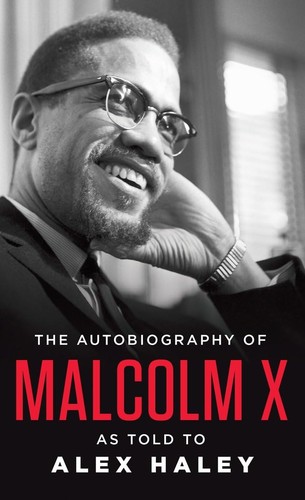
The Autobiography of Malcolm X
Ballantine Books · 1965 · 460 pages
ISBN: 9780345350687
Review Editor
Priya Nair
In October 1965, nine months after Malcolm X was shot and killed at the Audubon Ballroom in Harlem, Grove Press published the book he and journalist Alex Haley had spent two years building together. The Autobiography of Malcolm X is a conversion narrative told in stages: Malcolm Little the street hustler, Detroit Red the criminal, Malcolm X the Nation of Islam minister, and finally El-Hajj Malik El-Shabazz, the man who traveled to Mecca and began rethinking everything he thought he knew. No other American autobiography covers so much ideological ground in a single life, or does so with such urgency. You feel throughout the book that Malcolm knew he was living on borrowed time, and that feeling gives every page a particular edge.
Haley based the book on more than fifty interviews he conducted between 1963 and 1965, and he shaped those interviews into something that reads not like a transcript but like a man speaking directly at you. The collaboration between the two was genuinely complicated: Malcolm controlled the words, Haley controlled the narrative architecture. At one point, according to Haley’s epilogue, Malcolm wanted to rewrite earlier chapters as a polemic against Elijah Muhammad and the Nation of Islam, which he had recently left. Haley talked him out of it, arguing for “suspense and drama” rather than a settled score. The book became richer for it. What you read is not a finished ideological statement but a portrait of a mind in motion, which is exactly what makes it so difficult to put down and so difficult to categorize.
The context matters here. The Autobiography was published the same year as the Voting Rights Act, in the middle of a civil rights movement that was fracturing along generational and tactical lines. Malcolm X represented a voice that many readers had never encountered in print before: furious, self-educated, street-honest, and absolutely certain that American racism was structural and total. Even readers who disagreed with him found themselves unable to dismiss the book, because the evidence he drew on was his own life. He had watched his father die under suspicious circumstances, watched his mother collapse under the weight of poverty and prejudice, and had been told by a teacher that a career as a lawyer was “no realistic goal for a nigger.” He did not inherit his conclusions. He earned them.
Character Arcs and Development
The Autobiography traces one of the most dramatic personal transformations in twentieth-century American letters, and it does so in a way that refuses easy sentimentality. The Malcolm of the early chapters, hustling in Harlem and Boston as “Detroit Red,” is charismatic and self-destructive in roughly equal measure. Haley captures the swagger of that period without glamorizing it: Malcolm and his partner Shorty ran a burglary ring, got caught, and got sent to prison for six to eight years. The book does not apologize for this. It simply moves through it, the way a person does when looking back on a life they have genuinely left behind.
Prison is where Malcolm finds the Nation of Islam, and the transformation Haley captures in those pages is one of the book’s strongest sections. A man who had given up reading discovers a dictionary and copies it out word by word to teach himself vocabulary. He reads voraciously, argues theology with fellow inmates, and converts to the teachings of Elijah Muhammad. What makes this section work is that Haley does not present Malcolm’s conversion as the end of his journey but as one leg of it. The reader who knows how the story ends understands that even this profound change is not the final one. Malcolm himself acknowledges late in the book that his philosophy never stayed fixed in one position for long. That restlessness is the book’s engine.
The secondary characters who matter most are not the famous names who appear briefly but the people closest to Malcolm: his mother, Louise, whose mental collapse under poverty he describes with a kind of controlled grief; his brother Reginald, whose fall from Elijah Muhammad’s favor tests Malcolm’s loyalty in ways he is not proud of; and Elijah Muhammad himself, whose personal failures eventually force Malcolm to confront the gap between the Nation of Islam’s moral demands and the behavior of its leader. Each of these relationships reshapes Malcolm in ways he is honest enough to admit.
Pacing
The Autobiography moves quickly through the early years, spending less time than you might expect on Malcolm’s street life and prison years given how formative they were. This is partly intentional: Haley and Malcolm clearly wanted to get to the ideas, and the book’s middle section, covering Malcolm’s years as a Nation of Islam minister and national spokesman, has a different, more deliberate pace. These chapters cover the 1950s and early 1960s and require the reader to follow some fairly detailed internal theology. They reward patience.
The final third, which covers Malcolm’s break with the Nation of Islam, his pilgrimage to Mecca, and his travels in Africa, picks up again considerably. By the time you reach the epilogue, which Haley wrote after Malcolm’s assassination and which covers their working relationship and the events of Malcolm’s final months, the book has earned the elegiac quality it carries there. The only section that feels slightly rushed is the post-Mecca period: Malcolm was still working out his new framework when he was killed, and the book necessarily reflects that incompleteness. That is not a flaw so much as an honest limitation of the form.
Deeper Thematic Exploration
The most obvious theme is transformation, but the book is more interesting than a simple arc from criminal to prophet. What Malcolm X actually traces, across all his changes, is a sustained argument about self-knowledge. Every phase of his life involves Malcolm constructing a version of himself that makes sense of his circumstances: Detroit Red is the identity that survives on Harlem’s terms, Malcolm X is the identity that gives his anger a theological container, and El-Hajj Malik El-Shabazz is the identity that tries to outgrow both. The book’s power comes from the fact that none of these identities are presented as fictions. Each was genuinely who he was at the time he was it.
Beneath the transformation story runs a sustained indictment of white American racism, and this is where the book gets challenging for readers who might prefer their civil rights history more comfortable. Malcolm does not distinguish between individual white people and the system they operate within, at least not in the book’s first half. By the time he reaches Mecca and encounters white Muslims who treat him as a brother, he is willing to revise that view, though he remains clear that American structural racism is a political problem that requires a political solution, not a change of heart. This distinction between personal goodwill and systemic change is something the book articulates with precision that still holds up more than sixty years later.
The book also works as an American immigrant narrative, though this is not how it is usually read. Malcolm X traces his family’s roots through multiple displacements: his mother was from Grenada, his father preached Marcus Garvey’s back-to-Africa philosophy, and Malcolm himself eventually embraces pan-Africanism as a framework for Black liberation. The idea that Black Americans are not immigrants who arrived seeking opportunity but people whose labor and lives were extracted without consent runs through every section of the book. Haley shapes this argument carefully so that it accumulates rather than announces itself.
Style and Voice
One of the stranger formal achievements of the Autobiography is that it sounds like Malcolm X talking, even though Alex Haley wrote every sentence. Haley deliberately suppressed his own voice to create the effect of Malcolm speaking directly to the reader. The prose is clear and declarative, with a preacher’s rhythms and a street debater’s precision. Malcolm had an extraordinary ear for the specific detail that makes an argument concrete rather than abstract. When he wants to convey what it felt like to have his aspirations dismissed by his Michigan teacher, he does not describe the feeling in general terms. He quotes the exact word the teacher used, and that word lands like a slap.
Some passages have the quality of formal oratory: they build toward a point, then pull back and circle again. Others are almost confessional, particularly the sections dealing with his relationship with Elijah Muhammad and the disillusionment that followed. The epilogue, which Haley wrote in his own voice, shifts register completely and has an intimacy that the rest of the book, for all its candor, does not quite achieve. It is worth reading separately, slowly, after you have finished the main text.
Verdict
If you want to understand why the 1960s broke open the way they did, why a generation of activists who came up through the civil rights movement eventually lost patience with its tactical premises, this book will give you more than any history text. Malcolm X did not build a movement in the way that King did, but his autobiography seeded something harder to organize and harder to dismiss: a particular way of seeing, clear-eyed and unsparing, that refuses to settle for moral progress that stops short of structural change. Time magazine named it one of ten required nonfiction books in 1998. The New York Public Library included it in its Books of the Century list. Those accolades are deserved, but they also have a way of making the book sound distant and historical. It is neither. Read it and find out.
The reader who will love this book is anyone willing to sit with discomfort, to follow a narrator whose conclusions they might not share toward a worldview that is at least coherent on its own terms. Readers looking for a balanced account of the civil rights era will find Malcolm’s perspective partial by design; that is not a weakness but the whole point. The one real limitation is that the book’s final section, covering Malcolm’s evolving post-Mecca thinking, is necessarily fragmentary. He was still building his framework when he died. What he left behind is incomplete in the way that all unfinished lives are incomplete, and the incompleteness is its own kind of argument.
Frequently Asked Questions about The Autobiography of Malcolm X
What is The Autobiography of Malcolm X about?
The Autobiography of Malcolm X traces the life of Malcolm Little, who grew up in poverty in Michigan, worked as a street hustler in Harlem and Boston, was imprisoned for burglary, converted to the Nation of Islam in prison, became one of its most prominent ministers, broke with the organization, made a pilgrimage to Mecca, and was assassinated in February 1965. Written with journalist Alex Haley based on more than fifty interviews, the book is both a personal memoir and a sustained argument about race, power, and self-determination in America.
Did Malcolm X write The Autobiography of Malcolm X himself?
The book was a collaboration between Malcolm X and journalist Alex Haley. Haley conducted the interviews, shaped the narrative structure, and wrote the prose; Malcolm X reviewed drafts, controlled the language, and held final approval over content. Malcolm X considered Haley a ghostwriter at the time, but modern scholars generally treat their relationship as a genuine co-authorship, with each contributing essential elements. Haley also wrote the epilogue, which he composed after Malcolm X’s assassination in February 1965, and which he was not required to submit to Malcolm X for approval.
What are the main themes in The Autobiography of Malcolm X?
The book works through four major themes. First is transformation: Malcolm X reinvents his identity multiple times across his lifetime, from street criminal to religious minister to international activist, and the book examines what drives each change. Second is structural racism: Malcolm X argues throughout that American racism is systemic, not simply a matter of individual prejudice, and that it requires political rather than personal solutions. Third is self-education and intellectual ambition: his account of teaching himself to read in prison is one of the book’s most powerful sequences. Fourth is the question of Black identity in America, who Black Americans are, where they came from, and what they are owed.
How long is The Autobiography of Malcolm X and is it a difficult read?
The Ballantine Books paperback edition runs approximately 460 pages, plus Alex Haley’s epilogue. It is not a difficult read in terms of sentence-level complexity: the prose is clear and direct, shaped to sound like a man speaking to you. The middle sections, which cover Malcolm’s years in the Nation of Islam and involve some theological detail, require attention, but the book rewards it. Most readers who start it finish it quickly, because the narrative momentum rarely lets up.
Is there a movie or TV adaptation of The Autobiography of Malcolm X?
James Baldwin and Arnold Perl adapted the book as a screenplay, which Spike Lee used as the primary source material for his 1992 film Malcolm X, starring Denzel Washington in the title role. Washington received an Academy Award nomination for his performance. The film is a three-hour-plus adaptation that covers the major events of the autobiography and is generally considered one of the most accomplished American biographical films. The screenplay draws on both the book and other historical sources.
What age group or reading level is The Autobiography of Malcolm X appropriate for?
The book is written at an adult reading level and deals with mature themes including racism, crime, imprisonment, and political violence. It is commonly assigned in high school and college courses, typically to students aged sixteen and up. The content is serious throughout, and some passages, particularly those describing the conditions of Malcolm’s childhood and his criminal years, are frank about poverty and racial violence. It is not graphic in a sensational way, but it does not soften the material either.
How does The Autobiography of Malcolm X compare to other civil rights memoirs?
It stands apart from most civil rights memoirs in its ideological position: where books like King’s Stride Toward Freedom or John Lewis’s Walking with the Wind argue for integration and nonviolent direct action, Malcolm X’s book challenges those premises from the start. The closest comparison in terms of scope and impact is perhaps Between the World and Me by Ta-Nehisi Coates, which updates many of Malcolm’s arguments for a contemporary audience. For sheer narrative range, covering a life from childhood poverty to international activism, the Autobiography has few rivals in the genre.
Should I read The Autobiography of Malcolm X and is it worth it?
Yes, particularly if you want to understand American history in the second half of the twentieth century on terms that most textbooks skip over. The book will challenge you if you come to it expecting a comfortable narrative of progress. What it gives you instead is a portrait of someone who thought seriously about race, power, and identity in a country that gave him ample reason to do so, and whose conclusions, even when you argue with them, are hard to dismiss. If you have only ever encountered Malcolm X as a footnote to the civil rights movement, this book will make that framing impossible to sustain.
Book Details
- Title
- The Autobiography of Malcolm X
- Author
- Malcolm X with Alex Haley
- Genre
- Biography
- Publisher
- Ballantine Books
- Year Published
- 1965
- Pages
- 460
- ISBN
- 9780345350687
- WritersReview Rating
- 4.3 / 5