
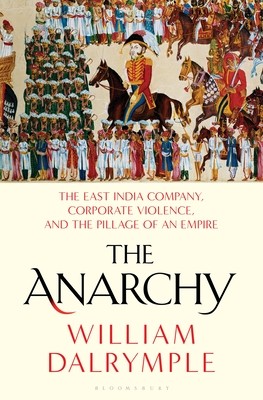
The Anarchy
Bloomsbury Publishing · 2019 · 576 pages
ISBN: 9781635573954
Review Editor
Thomas Calloway
In the spring of 1757, a private company with about two thousand soldiers defeated the Nawab of Bengal’s army of fifty thousand on the banks of a river called Plassey. The Nawab controlled the richest province of the Mughal Empire; the company was a trading outfit chartered in London in 1599 to sell spices and cloth. Within fifty years of that battle, the company owned most of the Indian subcontinent. The Anarchy: The Relentless Rise of the East India Company is William Dalrymple’s attempt to explain exactly how that happened, and why it matters that a private corporation, not a government, did the conquering.
Dalrymple is one of Britain’s most accomplished narrative historians of India, and this is the book he has been building toward for most of his career. It covers roughly half a century, from the Battle of Plassey in 1757 to the Company’s march into Delhi in 1803, when Mughal Emperor Shah Alam II found himself living in the ruins of his own palace under British “protection.” The backdrop is the collapse of the Mughal Empire after the catastrophic Third Battle of Panipat in 1761, when Afghan invaders shattered the last force capable of holding India together. Into that vacuum, a corporation with shareholders in London filled the space that emperors once occupied. Dalrymple draws on Persian chronicles, previously untranslated Mughal court documents like the Shah Alam Nama, French military diaries, and Company correspondence to put flesh on a story that most Western readers know, if they know it at all, only in outline.
The title has two meanings. One is literal: the decades after Panipat were genuinely anarchic, a time of shifting alliances, warlords carving out fiefdoms, and constant low-grade warfare across the subcontinent. The other is pointed: what replaced that anarchy was a different kind of chaos, corporate and systematic, with no accountability to the people it governed and no obligation beyond quarterly returns. That second kind of anarchy, Dalrymple argues, was the more destructive one.
Character Arcs and Development
This is narrative history, not biography, but Dalrymple centers every chapter on particular people, and he is very good at the ones who cut across the simple villain-and-victim frame. Shah Alam II, the Mughal Emperor who appears throughout the book, is its most affecting presence. He enters the story as a prince in exile, wandering across India for years trying to reclaim a throne his father could not protect. He forms alliances, makes military decisions, negotiates with the Company, and ultimately accepts its “protection” in terms that amount to surrender. By the end, he is an old blind man sitting in a gutted palace while Company officials conduct his foreign policy. Dalrymple tracks him with genuine empathy and without condescension; Shah Alam is a capable man brought down by forces larger than any individual miscalculation.
Robert Clive, the Company’s decisive figure in the Bengal campaign, is rendered with similar complexity. He arrived in India as a clerk’s assistant, discovered that he had a talent for warfare, and built himself into the most powerful man in the subcontinent through a combination of reckless physical courage and cold calculation. The sequence around the Battle of Plassey is the book’s most cinematic stretch: Clive’s army is outnumbered roughly twenty-five to one, but he already knows through secret negotiations that several of the Nawab’s key generals have been bribed to stand down. The battle unfolds as a kind of theater, with thousands of soldiers on both sides performing motions whose outcome has already been fixed in back-room deals. Clive does not come across as a hero, but you understand how someone like him could thrive in the specific chaos of the time.
Warren Hastings, who follows Clive as the Company’s dominant figure in India, is the book’s most genuinely complicated portrait. Hastings was intellectually curious about Indian civilization in ways that Clive never was; he learned Persian, supported the translation of Sanskrit texts, and genuinely admired aspects of the culture he was helping to dismantle. Yet he also presided over tax policies in Bengal so brutal that they contributed to a famine in 1770 that killed somewhere between one-third and one-half of the province’s population. Dalrymple does not resolve this contradiction because it genuinely resists resolution. The same man who cared deeply about India as a place helped to destroy it as a functioning society, and that paradox is one of the book’s most durable contributions.
Pacing
At 576 pages, The Anarchy does not move fast everywhere. The middle sections, which track the shifting coalitions among the Maratha Confederacy, the Company, the sultans of Mysore, and half a dozen other regional powers, can feel overwhelming if you are coming to Indian history for the first time. Dalrymple provides maps and a cast of characters at the front, and you will want both. The chapters on Hyder Ali and his son Tipu Sultan’s resistance in Mysore are compelling reading, but they require you to hold a lot of competing actors in mind simultaneously.
The book compensates with a strong opening and an accelerating final quarter. The Plassey chapters hit hard, partly because Dalrymple makes the financial scale concrete and appalling: the Company extracted somewhere between five and ten million pounds from Bengal in the years immediately after its victory, at a time when the entire annual revenue of the British state was about eight million pounds. The final push toward Delhi moves quickly, and the scenes in which Company forces effectively take custody of the Emperor himself carry genuine weight. Whatever the book’s middle-section density, the overall arc is satisfying.
Deeper Thematic Exploration
The Anarchy‘s most original contribution to the literature on colonialism is its sustained attention to the Company as a corporation rather than as a surrogate for British imperial ambition. The directors in London were not ideological imperialists; they were businessmen trying to meet their dividend obligations. Territory was not the goal. Territory was what happened when commerce generated conflicts that required military solutions, and those military solutions required more territory to secure them, and so on. Dalrymple captures this logic without letting the directors off the hook: indifference to consequences at scale is its own form of violence.
The book also challenges a comfortable version of the story in which British colonialism succeeded by imposing itself on passive victims. Indian rulers were active participants who tried to use the Company for their own ends. The Nawab of Bengal sought Company support against his own enemies before Clive turned on him. Maratha leaders negotiated protection treaties they believed they could control. Tipu Sultan’s resistance was fierce and sustained, and it failed not because he was outmatched in any simple sense but because the Company was better at building coalitions and had nearly unlimited credit from London banks. The picture that emerges is one of catastrophic miscalculation across multiple actors, not a simple story of powerful and powerless.
There is also a thread running through the book about what happens when an entity with enormous power has no effective accountability. The Company controlled its own army, ran its own courts, set its own tax rates, and answered to shareholders who were thousands of miles away and primarily interested in quarterly returns. The British government tried on several occasions to impose oversight through acts of Parliament; the Company’s directors found ways around each one. Dalrymple is careful not to be heavy-handed about the contemporary resonances, but they do not need to be spelled out. A private entity that is too powerful to regulate and too profitable to shut down is not an 18th-century problem.
Style and Voice
Dalrymple is a narrative historian in the tradition of writers who believe that argument works best when it is embedded in character and scene. His prose moves well through the transitions between sweeping overview and close-up texture; he can describe the full scope of the Company’s territorial ambitions in one paragraph and then drop you into a specific skirmish or a tense diplomatic exchange in the next. The research is deep without making the book feel academic; he cites Persian and French sources alongside Company records in ways that give the Indian perspective genuine weight, which is rarer than it should be in histories of this period.
He also has a light touch with irony. A passage describing the Company’s London board receiving increasingly alarming dispatches from Bengal and responding with a kind of bureaucratic bemusement captures the absurdity of running an empire by correspondence from a small office in the City of London. The prose never calls attention to itself, but it is alive throughout, and Dalrymple earns his reputation as one of the most readable popular historians working in English today.
Verdict
If you want a single book that explains how a trading company became an empire and why that history resonates beyond the 18th century, The Anarchy is the one to read. It is best suited to readers with patience for geopolitical complexity and large casts of characters; you will lose the thread occasionally in the middle sections, and that is probably unavoidable given the material. Readers who come in with some background in Indian or British colonial history will move faster; those starting from scratch should expect a rewarding but demanding read.
What the book does better than almost anything else in the field is force you to take the “corporation” part seriously. This was not a government that colonized India. It was a company with shareholders. The people who ran it were not empire-builders by ideology; they were businessmen by training who discovered that conquest was profitable. That reframing does not shrink the moral weight of what happened. It makes it heavier, because it shows how ordinary commercial incentives, operating without meaningful oversight, can produce results indistinguishable from deliberate atrocity. You will finish the book thinking differently about where corporate power comes from and what it costs the people on the receiving end of it, and that is exactly what history at its best should do.
Frequently Asked Questions about The Anarchy by William Dalrymple
What is The Anarchy by William Dalrymple about?
The Anarchy tells the story of how the British East India Company, a private trading corporation, conquered the Indian subcontinent between roughly 1757 and 1803. Beginning with the Battle of Plassey and ending with the Company’s effective takeover of Delhi, the book traces how a shareholder-owned business replaced one of the world’s great empires without any formal government mandate to do so. Dalrymple draws on previously untranslated Persian and Mughal sources alongside Company archives to tell the story from multiple perspectives, including those of the Indian rulers who tried to resist.
Is The Anarchy a difficult book to read for someone who doesn’t know Indian history?
It requires some patience. The cast of characters is large, the alliances shift frequently, and the middle sections dealing with the Maratha Confederacy and the Mysore sultans can feel dense without prior context. Dalrymple includes maps and a character list at the front, and using them makes a real difference. If you have read anything on British India before, you will find the book very accessible; if you are starting from scratch, expect to go slowly at first and pick up speed as the main threads become familiar.
What are the main themes in The Anarchy?
Four themes run through the whole book. The first is corporate power and its consequences when it operates without accountability. The second is the agency of Indian rulers, who were not passive victims but active participants who misjudged the Company’s long-term intentions. The third is how financial incentives rather than ideological imperialism drove British expansion in India. The fourth is the human cost of Company governance, most visibly in the Bengal Famine of 1770, which Dalrymple treats as a direct consequence of extractive tax policy rather than a natural disaster.
How long is The Anarchy and is it a challenging read?
The main text runs to 576 pages, with extensive notes and bibliography beyond that. For most readers, expect 15 to 20 hours of reading time. The prose is clear and the chapters are organized around specific events and figures rather than abstract argument, so the difficulty comes from the volume of names and places rather than from dense theoretical writing. It reads more like a well-researched work of narrative journalism than like an academic history.
Is there a TV adaptation of The Anarchy?
Yes, an adaptation is in development. Screenwriter Jeremy Brock, who wrote The Last King of Scotland, has been attached to script a three-part television series based on the book. The production is a collaboration between Wiip and Roy Kapur Films, planned as an international co-production across India, the United Kingdom, and the United States, with Dalrymple serving as a creative consultant.
Did The Anarchy win any awards?
The book received significant recognition. It was longlisted for the Baillie Gifford Prize for Non-Fiction in 2019 and was a finalist for the Cundill History Prize. It was shortlisted for the Duke of Wellington Medal for Military History, the Tata Book of the Year, and the Historical Writers Association Book Award 2020. It also won the Arthur Ross Bronze Medal from the US Council on Foreign Relations in 2020. President Barack Obama included it in his list of favorite books of 2019, and it was named a best book of the year by the Wall Street Journal, Financial Times, and Observer.
How does The Anarchy compare to Dalrymple’s other books on India?
Dalrymple has written extensively about India, including White Mughals, which focuses on cultural exchange between British officials and Indian society in the early colonial period, and The Last Mughal, which covers the 1857 uprising and the destruction of the Mughal court. The Anarchy is the broadest in scope of the three: it covers more territory, more time, and more actors. Readers who found The Last Mughal compelling will find The Anarchy similarly structured but larger in ambition; those new to Dalrymple might find White Mughals a more intimate entry point into his work.
Should I read The Anarchy and is it worth the time?
Yes, if you have any interest in how empires actually get built, how corporations accumulate power, or how the modern relationship between Britain and India was shaped. The Anarchy is not a light read, but it rewards the investment. If you find the middle sections heavy going, push through to the Tipu Sultan chapters and the final march on Delhi; the book’s last hundred pages are among its strongest. You will finish it with a sharper understanding of where corporate power comes from and what it costs the people who end up on the receiving end of it.
Book Details
- Title
- The Anarchy
- Author
- William Dalrymple
- Genre
- History
- Publisher
- Bloomsbury Publishing
- Year Published
- 2019
- Pages
- 576
- ISBN
- 9781635573954
- WritersReview Rating
- 4.3 / 5