
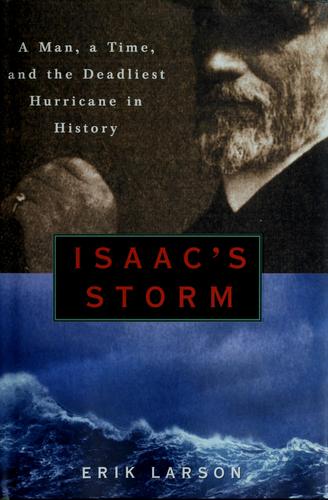
Isaac’s Storm
Crown Publishers · 1999 · 323 pages
ISBN: 9780609602331
Review Editor
Thomas Calloway
On September 8, 1900, the deadliest natural disaster in American history struck Galveston, Texas, with almost no warning. A hurricane of immense force drove a storm surge across the low-lying barrier island, leveling thousands of structures and killing somewhere between 6,000 and 12,000 people in a single night. Erik Larson’s Isaac’s Storm, published in 1999, reconstructs that catastrophe through the lens of one man: Isaac Monroe Cline, the chief meteorologist at the U.S. Weather Bureau’s Galveston office, who spent the morning of September 8 reassuring himself and others that nothing catastrophic was coming.
Larson draws on journals, personal letters, survivor testimony, and the institutional records of the Weather Bureau to tell a story that operates on two levels at once. On the surface, it is the account of a storm, the largest ever to strike the continental United States at that point in recorded history. Beneath that surface, it is about a particular kind of certainty that the late nineteenth century loved: the certainty born of instruments, professional credentials, and a boundless faith in the power of modern science to categorize, predict, and therefore tame the natural world.
What elevates the book beyond a straightforward disaster narrative is Isaac Cline himself. Nine years before the storm, Cline published an article arguing that Texas geography made a catastrophic hurricane essentially impossible. He held that position when the first warning signs appeared on September 7, and he maintained it through the early hours of September 8, when barometric pressure was already in sharp decline. This is not a story about a villain. It is something more uncomfortable: the story of a competent, well-trained man who was catastrophically wrong in ways that cannot be separated from his confidence in being right.
Character Arcs and Development
Isaac Cline is the moral and narrative center of the book, and Larson treats him with a complexity that could easily have become simple condemnation. Cline was not negligent. He was one of the most rigorously trained meteorologists in the country, methodical and ambitious, a man who genuinely believed in the mission of the Weather Bureau and in his own ability to read the sky. His overconfidence in his analysis of the Galveston situation was not born of laziness but of a professional conviction assembled over years of diligent work. That is precisely what makes his catastrophic misjudgment harder to absorb than mere incompetence would have been. You understand how he got there. That understanding doesn’t make it less devastating.
The more quietly devastating figure is Isaac’s brother Joseph, who also worked at the Galveston weather station. While Isaac spent the morning of September 8 noting the rising tide without significant alarm, Joseph reached a different conclusion from the same data. He went out on horseback and rode through the streets urging residents to move to higher ground, making a judgment call his brother refused to make. Larson never fully resolves the question of what Joseph understood that Isaac missed, and that unresolved ambiguity is part of what gives the book its lasting discomfort. The brothers shared training, shared an office, shared a household. They looked at the same storm. One of them was right.
Beyond the Cline brothers, Larson weaves in a chorus of Galveston residents whose stories give the disaster its human scale: the physician treating patients in a hospital that would be destroyed before nightfall, families on the beach marveling at the unusual surf, a young woman who survived by clinging to wreckage for hours in the dark. Larson resists turning any of them into symbols of suffering. They are recognizable people going about an ordinary Saturday morning who happen to be standing on the wrong piece of land at the wrong moment in history. Their specificity is the book’s way of insisting that the death toll was not an abstraction.
Pacing
Larson structures the book with a storm chaser’s sense of timing. The early chapters spend extended time in Galveston before the storm, establishing the city’s prosperity, its complacency, and its peculiar geographic vulnerability as a barrier island barely above sea level. The book also traces the storm’s journey from its origins off the West African coast through Cuba and across the Gulf of Mexico, giving readers a sense of the meteorological mechanics while keeping the science anchored in human observation. These passages resist the temptation to be merely technical.
The approach works, though readers expecting a purely action-driven narrative may find the middle sections slower than they anticipate. Larson devotes considerable space to Weather Bureau politics and the long-standing rivalry between American meteorologists and their Cuban counterparts, who had actually tried to issue warnings that the U.S. Bureau suppressed for institutional and nationalistic reasons. Those sections require readers to stay invested in the machinery of nineteenth-century bureaucracy, which not everyone will find effortlessly absorbing. But they reward patience. The bureaucratic maneuvering directly explains why Galveston received inadequate warning when warning could have saved thousands of lives. The final third, covering the actual landfall and its immediate aftermath, is relentless. Larson cuts between different streets and different families as the surge rises, and the result reads less like history than like a sequence from a well-made film.
Deeper Thematic Exploration
At its core, the book explores what happens when human certainty meets a reality it was never designed to accommodate. Isaac Cline did not fail Galveston through carelessness. He failed because the intellectual framework he carried, built from everything the Weather Bureau had trained him to believe, could not register what was actually happening. The Bureau had classified and codified hurricane behavior. Cline had contributed to that body of knowledge. The storm that arrived did not fit the classification, and rather than revising the classification, Cline revised his reading of the storm. This is not a character flaw unique to him. It is a description of how trained expertise can become its own obstacle to clear perception.
Larson is particularly sharp on the role of institutional authority in compounding individual error. The Weather Bureau in 1900 had a culture that was skeptical of outside warnings by default, and especially skeptical of the Cuban weather service, which was a product partly of colonial condescension. When Cuban meteorologists raised serious alarms about the storm’s likely track, American Bureau officials in Washington dismissed them, in part because they could not accept the idea that a Cuban station might know something the federal service did not. That dismissal was not incidental to the catastrophe. It was a contributing mechanism.
There is also a quieter arc running through the book about Galveston itself as a place. In 1900, the city was one of the wealthiest and most ambitious in Texas, a thriving port with genuine aspirations to rival New Orleans as the commercial hub of the Gulf South. The storm ended those aspirations permanently. Houston, inland and spared, would absorb Galveston’s commercial future over the following decades. Larson does not belabor this historical irony, but it hums beneath the narrative as a reminder that catastrophe does not only kill people: it rearranges the future, often in ways no one at the time can fully see.
Style and Voice
Larson’s method here is the approach he would refine across later books: meticulous archival research assembled into prose that moves with the momentum of fiction. He reconstructs scenes using contemporary diaries, Weather Bureau telegrams, survivor accounts, and the meteorological record itself. He is careful to signal where he is inferring versus quoting, and that transparency does not undercut the reading experience. If anything, knowing that the barometric readings and survivor testimony are real makes the story press harder against the reader.
The prose runs lean and purposeful. Larson does not slow down to admire his own sentences. When he describes the pressure readings falling through the morning of September 8, hour by hour, he makes those numbers carry emotional weight in a way that no amount of purely lyrical description could. The technical information is not supplementary to the narrative. In Larson’s hands, it is the narrative. If there is a weakness in the voice, it is that the book’s final sections occasionally tip past urgency into a kind of relentless accumulation that leaves little room to breathe. A few more moments of stillness among the wreckage would have made the devastation land harder by contrast.
Verdict
Read this if you have any interest in the intersection of human overconfidence and natural disaster, or in how institutions fail not through malice but through the compounding weight of unchallenged assumptions. It is also a genuinely compelling introduction to Erik Larson’s narrative method. If you have never read him before, this is a fine place to start. If you came to him through Dead Wake or The Splendid and the Vile, you will recognize his tools here in an earlier, leaner form.
The one honest caveat is the book’s final accounting of Isaac Cline and his legacy. Larson is careful and fair, but the epilogue’s refusal to render a clean verdict may frustrate readers who want history to arrive at a lesson. What you get instead is something more honest: a situation that resists being resolved into a simple parable about hubris. That restraint is intellectually correct. It is also, for some readers, a little unsatisfying. Everyone else will find it one of the book’s genuine virtues.
Frequently Asked Questions about Isaac’s Storm
What is Isaac’s Storm by Erik Larson about?
Isaac’s Storm tells the true story of the Great Galveston Hurricane of September 8, 1900, the deadliest natural disaster in American history. The book centers on Isaac Cline, the chief meteorologist for the U.S. Weather Bureau in Galveston, who had publicly argued years earlier that a major hurricane could not devastate the Texas coast. Larson reconstructs the storm, the warning failures, and the catastrophic human cost through diaries, survivor accounts, and meteorological records.
Is Isaac’s Storm based on a true story?
Yes, completely. Erik Larson wrote Isaac’s Storm as narrative non-fiction, meaning the events, people, and dialogue all come from primary sources including journals, official Weather Bureau records, newspaper accounts, and survivor testimony. The Galveston hurricane of 1900 was real, Isaac Cline was a real figure, and the deaths of approximately 6,000 to 12,000 people are historical fact. Larson uses novelistic pacing and scene reconstruction, but every element of the story is documented.
What are the main themes in Isaac’s Storm by Erik Larson?
The book explores human overconfidence in the face of incomplete knowledge, particularly the danger of expert certainty that becomes closed to new information. It also examines institutional failure, specifically how the U.S. Weather Bureau’s culture of dismissing outside warnings contributed to the death toll. A related theme is the collision between Gilded Age American confidence in science and technology and the raw power of the natural world. Larson also traces how a single night of catastrophe redirected the economic and political history of the Texas Gulf Coast.
How long is Isaac’s Storm and is it a difficult read?
The book runs 323 pages in its hardcover edition and is written for a general audience, not specialists. Larson includes some meteorological and technical detail about hurricane mechanics and late nineteenth-century weather science, but he integrates this smoothly into the narrative so it never feels like a digression. Most readers with an interest in history or narrative non-fiction will find it accessible and engaging. The pacing accelerates considerably in the final third, which covers the storm’s landfall.
How does Isaac’s Storm compare to Erik Larson’s other books?
Isaac’s Storm was among Larson’s earlier major works, predating Devil in the White City, Dead Wake, and The Splendid and the Vile. It is somewhat leaner and more tightly focused than those later books, which tend to braid multiple points of view across longer narratives. Readers who prefer a single controlling narrative thread may actually prefer Isaac’s Storm to some of Larson’s bigger projects. His core method, combining archival research with novelistic scene construction, is fully present here and working well.
Who was Isaac Cline and why does he matter in Isaac’s Storm?
Isaac Monroe Cline was the chief meteorologist for the U.S. Weather Bureau’s Galveston office in 1900. He had published an article in 1891 arguing that a devastating hurricane could not strike the Texas coast. When the 1900 storm arrived, his prior certainty shaped how he interpreted the warning signs, and he failed to issue the kind of urgent alarm that might have prompted a mass evacuation. His younger brother Joseph, also a meteorologist in the same office, reached the opposite conclusion and rode through the streets warning residents. Larson uses Isaac as a lens for exploring how professional confidence can become a liability.
Did anyone survive the Galveston hurricane of 1900?
Yes, many thousands of people survived, including Isaac Cline and his brother Joseph. The storm killed somewhere between 6,000 and 12,000 people (estimates vary because records were incomplete), but the city of roughly 37,000 residents was not entirely destroyed. Larson includes several survivor accounts in the book, including a woman who spent hours clinging to wreckage in the flood. After the storm, Galveston rebuilt and constructed a massive seawall to protect against future hurricanes, though the city never regained its prewar commercial prominence.
Should I read Isaac’s Storm and is it worth it?
Yes, especially if you are drawn to narrative non-fiction that takes historical disasters seriously as human stories rather than just spectacles. Larson is a skilled writer who makes the technical aspects of meteorology and Weather Bureau politics genuinely interesting, and the book’s central question about how a trained expert can be so badly wrong has a relevance that extends well beyond the 1900 hurricane. Readers who are particularly sensitive to accounts of mass death should know the final third is harrowing, but the book handles the material with restraint and genuine respect for the people who died.
Book Details
- Title
- Isaac’s Storm
- Author
- Erik Larson
- Genre
- History
- Publisher
- Crown Publishers
- Year Published
- 1999
- Pages
- 323
- ISBN
- 9780609602331
- WritersReview Rating
- 4.2 / 5