
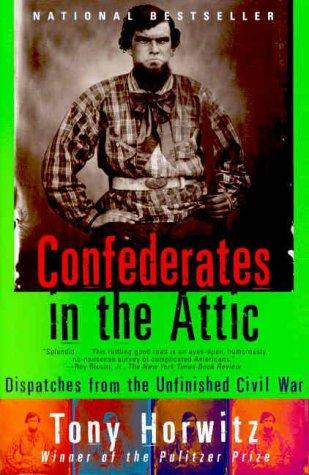
Confederates in the Attic
Vintage · 1998 · 432 pages
ISBN: 9780679758334
Review Editor
Thomas Calloway
Tony Horwitz grew up in northern Virginia, close enough to Antietam and Bull Run to absorb the Civil War through his pores. As a kid, he staged battles with plastic soldiers on his bedroom floor and devoured histories of the conflict. When he returned to the American South in the mid-1990s as a Pulitzer Prize-winning journalist, he brought that lifelong obsession with him and turned it into a question: why, more than 130 years after Appomattox, does the Civil War still feel unfinished to so many Americans?
Published in 1998, Confederates in the Attic: Dispatches from the Unfinished Civil War chronicles Horwitz’s yearlong journey through Virginia, the Carolinas, Tennessee, Mississippi, Alabama, and Georgia. The book is part road trip, part social history, and part portrait of a country that cannot agree on what its most catastrophic conflict meant. Horwitz attends Confederate memorial ceremonies, visits Civil War reenactors, tours Gettysburg and Vicksburg, sits in conversation with historian Shelby Foote, and finds himself at the aftermath of a murder in Kentucky where a Confederate flag was the precipitating factor. He is always the curious outsider-insider: Northern, Jewish, obsessed with a war fought to preserve an institution that would have enslaved his neighbors had they lived a century earlier.
The book’s principal companion for much of the journey is Robert Lee Hodge, a waiter from Virginia who represents the extreme edge of the reenactor world. Hodge is what the community calls a “hardcore”: he fasts before events to achieve the hollow-eyed look of soldiers in battlefield photographs, sleeps on the actual ground of former battlefields, and considers modern amenities an affront to historical accuracy. Hodge becomes Horwitz’s guide through the underworld of Confederate nostalgia, a man who is simultaneously funny, devoted, and deeply unsettling as a symbol of how completely a conflict can colonize a person’s inner life.
Character Arcs and Development
This is a book of character sketches more than a conventional narrative arc, and Horwitz is a generous portrait painter without being a soft one. Robert Lee Hodge dominates the opening and recurs throughout. He is a compelling subject: not a racist, not a fool, but a man who has constructed an alternative life inside the nineteenth century because the present offers him insufficient purpose. Horwitz clearly likes him. The scenes where Hodge debates the proper way to tie a period-accurate knapsack, or where he explains what he calls “period rush” (the near-mystical sense of connection to the past that comes from marching across an actual battlefield at dawn) are funny and touching at the same time. They are also slightly disturbing in what they suggest about the nature of nostalgia and what some people need from it.
The historical figures Horwitz encounters along the road are drawn in brief but precise strokes. Shelby Foote, by the mid-1990s famous nationwide for his long Mississippi drawl in Ken Burns’s Civil War documentary, sits in his Memphis study surrounded by towers of books and defends the Confederate cause with the mannered conviction of a gentleman scholar. He is charming and wrong, and Horwitz holds both truths at once. Alberta Martin, widely believed at the time to be the last surviving widow of a Confederate veteran, lives in an Alabama nursing home in her nineties, a woman who married a very old man for his pension decades after the war ended. She is a literal human link to the conflict, and her account of her life is unsentimental and quietly extraordinary.
The richest material comes from the people who do not make the history books. A high school student in Selma, Alabama, tries to articulate what it means to grow up honoring Confederate heritage in the city where Bloody Sunday happened. A Black woman in Kingstree, South Carolina, explains what it feels like to pass a Confederate monument on the courthouse lawn every day on her way to work. These brief conversations accumulate into something no textbook provides: the actual experience of people still living inside this history, on opposing sides of a grief that has never been collective.
Pacing
Horwitz structures the book as a series of journeys within a journey, each chapter a self-contained dispatch from a different corner of the South. The opening “Civil Wargasm” sequence, in which Horwitz and Hodge spend a week driving from battlefield to battlefield in period kit, sleeping on the ground and fasting, has the kinetic energy of a great magazine feature. It pulls you straight into the obsession. Later chapters on Selma, on the Kentucky murder, and on Vicksburg slow deliberately, matching the heavier, more unresolved quality of the history they describe.
There is a stretch in the middle third when the book visits several Confederate heritage events in close succession, and the scenes begin to blur despite Horwitz’s skill at finding individual details. Readers without their own attachment to the period may feel briefly oversaturated with reenactors and memorial ceremonies. It is a limited complaint. The book recovers fully in its final hundred pages, where Horwitz pushes past white Southern nostalgia into the more difficult territory of racial division and asks the question the book has been circling all along: what does “heritage” actually cost, and who pays?
Deeper Thematic Exploration
The book’s central argument, never stated bluntly but present on every page, is that the Civil War was never resolved. The Union won on the battlefield, but the interpretive war continued. By the 1990s, the Lost Cause mythology (the reading of the Confederacy as fighting for “states’ rights” and “Southern heritage” rather than for the preservation of slavery) had fully penetrated school curricula in parts of the South, Civil War museums, heritage organizations, and the everyday self-understanding of millions of white Southerners. Horwitz documents this mythology without condescending to the people who hold it. He is deeply curious about what emotional need this particular myth serves, and for whom, and when that question gets answered honestly in the text it lands with real weight.
Race is the book’s constant second subject, and Horwitz’s refusal to treat it as separable from the heritage debate gives the book its moral seriousness. The Confederate flag controversy, the persistence of monuments to Confederate generals in majority-Black cities, the ways in which local school curricula minimize or excise slavery from the war’s causes: none of this can be detached from the ongoing economic and social inequalities between white and Black communities in former slave states. Published in 1998, the book reads as prescient in the years since the Charleston church shooting, the Charlottesville rally, and the national reckoning over Confederate monuments. The debates it chronicles have not resolved. If anything, they have grown louder.
Beneath the political analysis, Horwitz is also writing about American nostalgia more broadly. The reenactors, heritage society members, and Civil War obsessives he meets are not all racists. Many are people who find the present thin and the past, filtered through romanticism and selective history, more vivid and more purposeful. Horwitz extends this observation beyond the Mason-Dixon Line: Americans everywhere tend to locate their better selves in some idealized past that did not require them to actually live in it. The Civil War is an extreme case of a general condition. That generosity of analysis, that refusal to reduce Southern nostalgia to mere bigotry while never obscuring the bigotry that is embedded in it, is the book’s most significant achievement.
Style and Voice
Horwitz writes with the precision of a reporter and the warmth of someone who clearly likes the people he reports on, even when he disagrees with them. His sentences are clean and his humor is dry. He is particularly good at the revealing detail: the reenactor who carefully applies grime and simulated blood to his uniform in the morning, then just as carefully steams out the wrinkles before the battle. The absurdity of the moment captures something essential about the nature of historical fantasy without any authorial commentary at all. He trusts you to see it.
The book also demonstrates Horwitz’s gift for self-implication. He does not stand above the Civil War obsession he chronicles. He confesses his own childhood fascination with the conflict, his own tendency to romanticize its battles, his own pleasure in the mythology. This honesty saves the book from the condescension that tends to attach itself to journalism about people with unfashionable beliefs. He is not a tourist at the Confederate fair. He is a participant with reservations, which is both more honest and more interesting.
Verdict
Confederates in the Attic belongs on any short list of essential books for understanding the fractures in contemporary American life. Horwitz wrote it more than twenty-five years ago, but the country it describes has not gone away. If you want to understand why debates over Confederate monuments and Civil War memory feel so intractable, this book will explain more than almost any other single source. The connections between a Lost Cause mythology constructed in the 1880s and the culture wars of the twenty-first century become, by the last chapter, surprisingly clear.
Not every reader will find it comfortable. If you prefer your history settled and your political conclusions tidy, Horwitz’s genuine curiosity about people whose views you may find repugnant will frustrate you. But if you can follow him into the attic, what you find there is not comfortable, not simple, and not finished. That’s why you should read it.
Frequently Asked Questions about Confederates in the Attic
What is Confederates in the Attic by Tony Horwitz about?
Confederates in the Attic is a work of narrative nonfiction in which journalist Tony Horwitz spends a year traveling through the American South investigating why the Civil War remains such a live and contested topic more than 130 years after its end. He visits reenactors, Confederate heritage ceremonies, Civil War battlefields, and communities still divided over race and memory, asking what it means for a nation to be haunted by a war it has never fully agreed to interpret.
Is Confederates in the Attic a fair or biased account of the South?
Most readers and critics have found Horwitz’s approach unusually fair for a book on such a contested subject. He is a Northern journalist and his own perspective is clear, but he is deeply curious about the people he meets and resists easy condemnation. He gives sympathetic space to Confederate heritage enthusiasts while never obscuring the racial dimensions of their beliefs. Reviewers from across the political spectrum praised the book’s balance when it was published in 1998.
What are the main themes in Confederates in the Attic by Tony Horwitz?
The book explores several intertwined themes: the persistence of the Lost Cause mythology, the relationship between historical memory and racial injustice, the nature of nostalgia and why people seek refuge in idealized versions of the past, the gap between how the Civil War is officially commemorated and how ordinary people actually experience its legacy, and the way that unresolved national trauma expresses itself across generations. Race and memory are the two threads that run through every chapter.
How long is Confederates in the Attic and is it a difficult read?
The book is 432 pages and written in the accessible prose of a skilled magazine journalist. It reads faster than its page count suggests. There are no academic arguments or extended footnotes, and each chapter functions as a self-contained dispatch. Readers with no prior knowledge of Civil War history will follow it easily, though some background knowledge of the conflict adds texture to Horwitz’s observations.
Is there a movie or TV adaptation of Confederates in the Attic?
As of this review, no film or television adaptation of Confederates in the Attic has been produced. The book has remained in print continuously since its 1999 Vintage paperback edition and has been assigned in university courses across the country, but it has not crossed over into screen adaptations the way some comparable works of narrative history have.
Who was Tony Horwitz and what happened to him?
Tony Horwitz was a Wall Street Journal journalist who won the Pulitzer Prize for National Reporting in 1995 for his coverage of low-wage workers. He went on to write several books of narrative history including Baghdad Without a Map, Blue Latitudes, and Spying on the South. Horwitz died suddenly of a heart attack in May 2019 at age 60, while on a publicity tour for his final book. Confederates in the Attic remains the work he is most widely read for.
How does Confederates in the Attic compare to other books about Civil War memory?
Among books that examine Civil War memory and the Lost Cause, Horwitz’s work stands out for its personal, journalistic approach and its focus on ordinary people rather than scholarly argument. David Blight’s Race and Reunion covers similar ground with more historical rigor but is a denser academic text. Karen Cox’s Dixie’s Daughters examines how the United Daughters of the Confederacy shaped Lost Cause mythology. For general readers, Horwitz offers the most accessible and human entry point into the subject.
Is Confederates in the Attic worth reading in 2024 and beyond?
Yes, arguably more than when it was first published. The debates Horwitz documented in 1998 about Confederate monuments, flags, school curricula, and the meaning of Civil War heritage became national controversies in the 2010s and 2020s. Reading the book now gives those more recent arguments historical depth and helps explain how they developed. If you want to understand why American arguments about race and history feel so intractable, this is one of the most useful starting points available.
Book Details
- Title
- Confederates in the Attic
- Author
- Tony Horwitz
- Genre
- History
- Publisher
- Vintage
- Year Published
- 1998
- Pages
- 432
- ISBN
- 9780679758334
- WritersReview Rating
- 4.3 / 5