
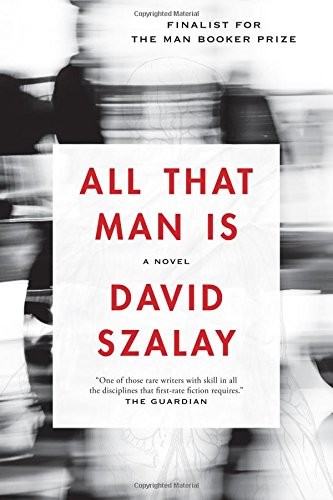
All That Man Is
🏆 Shortlisted for the 2016 Man Booker Prize
Winner, 2016 Gordon Burn Prize
Winner, 2016 Paris Review Plimpton Prize for Fiction
New York Times 100 Notable Books of 2016
Review Editor
Eleanor Marsh
David Szalay’s All That Man Is, published in 2016 by Graywolf Press, is a novel built from nine interconnected stories that follow nine men across Europe, each one older than the last. The youngest is seventeen, backpacking on a shoestring with a friend through the hostels and train stations of Central Europe. The oldest is seventy-three, a retired government minister holed up in a damp Italian cottage, counting his infirmities. Between them, Szalay maps the full arc of a male life: ambition and confusion in youth, compromise and quiet desperation in middle age, loneliness and physical decline at the end.
The book was shortlisted for the 2016 Man Booker Prize and won both the Gordon Burn Prize and the Paris Review’s Plimpton Prize for Fiction. It was also named one of the New York Times’ 100 Notable Books of 2016. Szalay, a British-Canadian novelist who has since won the 2025 Booker Prize for his novel Flesh, wrote All That Man Is as something between a story collection and a novel, with each section set in a different European country and named for the month in which it takes place, running from April to December.
The men in these pages are, without exception, away from home. A French backpacker drifts through Greece looking for sex and something less definable. A Danish tabloid journalist chases a politician’s scandal while nursing his own hypocrisy. A medieval studies academic ignores the fact that his girlfriend is pregnant while obsessing over a conference paper. A real estate agent in the south of France feels trapped by his own success. A middle-aged English expat in Croatia watches his marriage, finances, and self-respect collapse simultaneously. A Hungarian bodyguard falls for the jet-setting escort he’s been hired to protect. A Russian oligarch sees his empire of money, marriage, and mythology start to crack. And then there is the old minister in Italy, alone with his aches and his memories, wondering what any of it amounted to.
Character Arcs and Development
Because each man occupies only a single section of roughly forty pages, Szalay does not develop his characters through the slow accumulation that a traditional novel allows. Instead, he works in compression. You meet each man in the middle of something: a trip, a crisis, a transaction, a reckoning. The portrait builds fast, through behavior and interior monologue rather than backstory, and by the time the section ends, you feel you have seen something essential about him.
The seventeen-year-old Simon, traveling with his bolder friend Ferdinand, is perhaps the most sympathetic figure. His awkwardness around women, his half-formed opinions about art and meaning, his desperate wish to seem worldly while feeling entirely lost: Szalay nails the texture of being young and uncertain with painful precision. At the other end, the retired minister is equally vivid, shuffling through his cottage, thinking about a political career that consumed decades and left him with nothing he can hold. Between these two poles, the men are harder to like but no less convincingly drawn. The Danish journalist, Karel, is a particular standout: sanctimonious in public, chaotic in private, convinced of his own importance while being visibly ridiculous to everyone around him.
The women in these stories exist almost entirely in relation to the men. Some critics have read this as a limitation, but it reads more like a deliberate formal choice. Szalay is cataloging a particular kind of male solipsism, and the narrow lens is the point. These men do not see the women in their lives fully, and the book does not pretend otherwise.
Pacing
The structure, nine discrete stories arranged chronologically by the protagonist’s age, gives All That Man Is an unusual rhythm. Each section starts fresh: new country, new man, new set of problems. This means the book never sags in the middle the way a conventional novel might, because you are essentially beginning again every forty pages. But it also means you never get to settle in. Just as you start to care about one man’s situation, Szalay moves on to the next.
Within each section, the pacing is tight. Szalay writes with great economy, and his scenes tend to run on tension rather than event. A conversation about nothing in particular will carry the weight of an unspoken conflict. A man driving along a highway will think himself into a corner. Some readers may find the later sections, particularly the oligarch’s story and the minister’s solitary decline, slower going. The energy of youth gives way to the inertia of age, and the book mirrors that shift in its own tempo. This is clearly intentional, but it does mean the final third asks more patience of you than the first.
Deeper Thematic Exploration
Beneath the surface of each individual story, Szalay is building an argument about masculinity, time, and the European project. His men are all citizens of a borderless continent, free to move wherever they want, and none of them knows where he belongs. The freedom of the EU becomes, in Szalay’s hands, a kind of spiritual homelessness. These men cross borders with ease but cannot cross the distances inside their own lives.
The book is also preoccupied with legacy. Nearly every character worries, in some form, about what he will leave behind. The young men assume they will do something significant. The middle-aged men begin to suspect they will not. The old men know it. This progression gives the book its cumulative power. Individually, the stories are sharp and accomplished. Read together, they become something more bleak and more honest: a record of how ambition curdles into regret, how desire outlasts the ability to act on it, and how even the most privileged lives can feel, from the inside, like a series of missed connections.
There is also a thread about the body. Szalay writes physical experience with unusual attentiveness: the sweat of a Greek summer, the soreness of a long drive, the particular humiliation of a middle-aged man’s declining fitness. As the protagonists age, the body becomes less an instrument of pleasure and more a source of betrayal. The final section, in which the minister catalogs his ailments with clinical detachment, brings this theme to its logical, uncomfortable conclusion.
What Szalay avoids, notably, is sentiment. He does not console his characters or offer them redemption arcs. No one has an epiphany that changes everything. No one learns a lesson. The book’s refusal to provide these familiar comforts is both its greatest strength and the thing most likely to frustrate readers who want fiction to offer hope alongside honesty.
Style and Voice
Szalay writes in the present tense throughout, and his prose is cool, precise, and deliberately unshowy. The comparison most often made is to J. M. Coetzee, and it is apt: both writers use restraint as a form of intensity, letting the weight of what goes unsaid do much of the emotional work. Szalay’s sentences are short and clean, moving between close third-person interiority and flat, almost clinical description of physical surroundings.
The effect is distinctive. Szalay can make a hotel breakfast buffet feel ominous, or a drive through the Croatian countryside feel like a slow-motion disaster. He has what the critic James Wood has called a gift for “thisness,” the ability to land on the one specific, banal detail that makes a scene feel completely real. A man notices the brand name on a faucet. Another stares at the pattern of light on a ceiling. These small observations accumulate into something larger than any single one of them suggests.
The dialogue is also worth noting. Szalay’s characters speak in the clipped, slightly evasive way that people actually talk when they are trying not to say what they mean. Conversations trail off. Questions go unanswered. Someone changes the subject at exactly the wrong moment. It is ruthlessly observed, and often very funny in a dry, uncomfortable way.
Verdict
All That Man Is is a cold book, and it knows it. Szalay offers no warmth, no redemption, no reassuring message about the human spirit. What he offers instead is precision: nine lives observed with such clarity and economy that you finish the book feeling like you have looked at something true, even if what you saw was not especially comforting. The architecture is ambitious and the execution is assured. This is the work of a writer who trusts his readers to sit with discomfort.
If you are drawn to writers like Coetzee, Rachel Cusk, or Teju Cole, you will find a lot to admire here. If you prefer fiction that builds deep attachment to a single set of characters, the fragmented structure may feel unsatisfying. And if you want women to exist as full human beings in the fiction you read, you should know going in that Szalay is writing about men who do not see women clearly, and the book reflects that blindness without always challenging it. But as a portrait of contemporary European masculinity in all its confusion, vanity, and quiet despair, All That Man Is is one of the most precisely observed novels of the last decade.
Frequently Asked Questions about All That Man Is
What is All That Man Is by David Szalay about?
All That Man Is follows nine men across Europe, each at a different stage of life, from a seventeen-year-old backpacker to a seventy-three-year-old retired politician. The stories trace a single arc from youth to old age, exploring themes of masculinity, loneliness, desire, and what it means to live in a globalized, borderless Europe. Each man is away from home, adrift in some essential way.
Is All That Man Is a novel or a short story collection?
It sits deliberately between the two. Szalay has described it as a novel, and the nine sections are designed to be read as parts of a single work, with each protagonist older than the last. But each section also stands alone as a self-contained narrative with its own setting, characters, and resolution. Think of it as a novel-in-stories, a form that has become increasingly popular in contemporary literary fiction.
What are the main themes in All That Man Is?
The book explores masculinity and how men define themselves through sex, power, and ambition. It examines aging and the body’s gradual betrayal. It looks at legacy and whether individual lives leave any lasting mark. And it uses the European Union as both a literal setting and a metaphor for freedom that fails to produce belonging.
How long is All That Man Is and is it a difficult read?
The book is 384 pages in the Graywolf Press hardcover edition. The prose is spare and direct, so despite its length, individual sections move quickly. However, the present-tense narration and deliberately unsentimental tone may feel challenging to readers who prefer more emotionally accessible fiction. Each section runs about forty pages, making it easy to read in focused sittings.
Is there a movie or TV adaptation of All That Man Is?
As of 2026, there is no film or television adaptation of All That Man Is. David Szalay’s subsequent novel Flesh, which won the 2025 Booker Prize, has been optioned for a film adaptation by House Productions, but All That Man Is has not been adapted for the screen.
What age group or reading level is All That Man Is for?
This is adult literary fiction, best suited for readers eighteen and older. The book contains sexual content, mature themes, and unflinching portrayals of morally complicated characters. It is written at a literary level but is not difficult in terms of vocabulary or sentence structure. College-level readers and above will find it accessible.
How does All That Man Is compare to David Szalay’s other books?
All That Man Is shares DNA with Szalay’s later work Turbulence (2019), which uses a similar structure of interconnected stories set across global locations. His 2025 Booker Prize winner, Flesh, also examines masculinity and the body but through a more sustained single narrative. All That Man Is is often considered the book that established Szalay’s international reputation and remains his most formally inventive work.
Should I read All That Man Is and is it worth it?
If you value precision in prose and are interested in how contemporary fiction handles questions of gender, identity, and European life, this book rewards your time. Readers who enjoy cold, observational writing in the tradition of Coetzee or Cusk will find it compelling. If you need to feel warmly toward the characters you spend time with, or if you prefer a single sustained plot, you may find it frustrating. It is not a comforting book, but it is an unusually honest one.
Book Details
- Title
- All That Man Is
- Genre
- Literary Fiction
- Awards
- 🏆 Shortlisted for the 2016 Man Booker Prize Winner, 2016 Gordon Burn Prize Winner, 2016 Paris Review Plimpton Prize for Fiction New York Times 100 Notable Books of 2016
- WritersReview Rating
- 4.9 / 5