
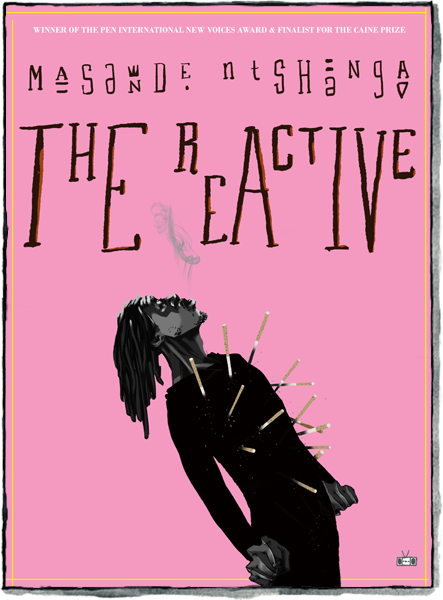
The Reactive
🏆 Betty Trask Award (2018)
Sunday Times Barry Ronge Fiction Prize Finalist (2015)
Etisalat Prize for Literature Longlist (2015)
Review Editor
Eleanor Marsh
The Reactive, published in South Africa in 2014 by Umuzi and brought to North American readers by Two Dollar Radio in June 2016, is Masande Ntshanga’s debut novel and one of the most arresting literary debuts to emerge from the continent in years. Ntshanga, born in East London in 1986 and trained as a writer at the University of Cape Town, sets his story in the early 2000s, a period that sits at a specific and painful intersection in South African history: the presidency of Thabo Mbeki, when the government publicly denied the scientific consensus linking HIV to AIDS, and when tens of thousands of people died while the antiretroviral drugs that could have kept them alive remained unavailable through official channels. This is not a historical footnote to the novel; it is the condition that makes the novel possible.
At the center of the story is Lindanathi, known as Nathi, a young Black man in his mid-twenties living in Cape Town. He is HIV-positive, which in the years before ARVs became broadly distributed shapes his life in practical ways he manages daily. More immediately, though, Nathi carries grief: the death of his younger brother Luthando, a loss he feels responsible for in ways he has not yet been able to face. He lives alongside two friends, Cecelia (Cissie) and Ruan, and the three form a small, close unit. They work low-paying jobs, sell their surplus antiretrovirals on the black market (a real feature of the era, not a fictional invention), huff glue, drift through parties, and move through Cape Town observing a city of jarring contrasts. They are not without intelligence or tenderness; they are people whose circumstances have narrowed around them, and who have organized their survival accordingly.
Into this stasis comes pressure: a man wearing a mask approaches Nathi and his friends with an offer to buy their entire supply of ARVs at a price that could meaningfully change things for them. The offer is also a demand of sorts, one that sets in motion a confrontation Nathi has been avoiding for years. What this mysterious figure represents is deliberately left open by Ntshanga, but his arrival organizes the novel’s second half and gives it direction without converting the story into something closer to genre fiction.
Character Arcs and Development
Ntshanga builds Nathi with care and with an understanding of how grief actually functions in a person over time. Nathi does not move through the novel toward clear resolution; he moves toward a willingness to look at what he has been avoiding, and the difference matters enormously. The arc is subtle enough that readers who expect legible transformation may miss it, but it is genuinely there, embedded in small moments of clarity and in the way the book’s final pages handle everything that has accumulated before them. Ntshanga trusts his readers to track a character’s inner movement without it being announced, and his confidence in the reader is part of what makes the novel feel like a serious literary act.
Cissie is the novel’s most vivid secondary character, sharp-tongued and grounded in a way that cuts through the drift the group generates around itself. She cares about Nathi and Ruan with a practiced, undemonstrative attention, and she is the one most likely to say something that actually lands. Ruan is quieter and gentler, carrying his own damaged history that the novel gestures at without spelling out. The friendship between the three has the texture of long familiarity, the shorthand and low-level irritation and deep loyalty of people who have been close enough that they have stopped performing closeness for each other. This friendship is one of the novel’s genuine achievements; it feels earned and specific rather than asserted.
The masked man stays opaque throughout, and this is a deliberate artistic choice that will not satisfy every reader. He functions as something between a plot engine and a symbol, a figure who represents the possibility of escape and the necessity of reckoning at the same time. Ntshanga does not resolve the ambiguity, and in not resolving it he takes a real risk. Some readers will feel the storyline is underworked; others will find the opacity appropriate to the novel’s dream-like quality. Where you land on this question will tell you a great deal about whether the book is for you.
Pacing
The novel moves slowly, and it moves that way on purpose. Ntshanga is not writing a book about what happens; he is writing a book about what it feels like to inhabit a particular kind of time, a present that has been corroded by the past and has not yet found its shape. The middle section follows the three friends through an accumulation of nights and conversations and encounters, and it can feel repetitive or circular at the surface level. Beneath that surface, something is compressing: the novel builds toward its ending by saturating the reader with the specific weight of this life, so that when Nathi is finally forced to move, the movement carries everything that preceded it.
Patience is required, and not everyone will want to give it. If you read primarily for plot momentum, The Reactive will test you. If you are comfortable with a novel that earns its ending through accumulation rather than acceleration, you will find the pacing rewarding rather than frustrating. The opening pages are immediate and involving, the closing section is consistently strong, and the stretch between them will hold readers who are willing to stay with it without demanding urgency at every turn.
Deeper Thematic Exploration
The political dimension of The Reactive is specific and serious. The Mbeki government’s denial of the link between HIV and AIDS is not backdrop but structural condition: the ARVs that Nathi and his friends sell to survive are also the drugs keeping Nathi alive, and their presence on the black market is a direct consequence of official policy. Ntshanga does not spell this out as argument; he shows it as fact, embedded in the daily logistics of his characters’ lives. The effect is far more powerful than any explicit statement could be. You understand the policy through its consequences, through what it has done to these specific people in this specific place at this specific time.
Post-apartheid South Africa arrives in the novel as a partially redeemed promise. Nathi’s generation inherited the rhetoric of liberation and found the material realities much more complicated and much more unequal than the rhetoric suggested. The wealth visible in certain Cape Town neighborhoods, the distance between what freedom was supposed to mean and what daily life actually looks like for Nathi and his friends, the sense of being on the wrong side of a city that is beautiful and unjust simultaneously: all of this runs through the novel as atmosphere rather than argument. Ntshanga understands that fiction works by specificity, and he keeps his political engagement rooted in what Nathi actually sees and touches and breathes.
Grief sits at the center of the personal story in the same way that the AIDS crisis sits at the center of the political one, and Ntshanga handles both with comparable restraint. Nathi’s guilt about Luthando is not explained early or explained cleanly. It surfaces in fragments, in what Nathi avoids thinking about and then cannot stop thinking about, and the novel gives you the shape of the loss before it gives you the facts. Grief does not arrive as information; it arrives as a change in how everything else feels. Ntshanga knows this, and the novel demonstrates it without needing to say so.
Style and Voice
Ntshanga’s prose is the novel’s most consistent pleasure and its strongest argument for itself. He writes in a first person that is close, lyrical, and occasionally elliptical, full of precise attention to Cape Town’s streets and beaches and interiors, to what light looks like at particular times of day and what people sound like when they are not performing for each other. There is a quality of alertness in his sentences that feels earned rather than decorative, as if he is paying close attention not just to what is described but to the exact verbal texture that makes description feel necessary rather than ornamental.
The novel is built as much from mood and image as from event, and this could become self-indulgent in less disciplined hands. Ntshanga keeps it grounded by staying close to the sensory particularity of Nathi’s experience. The political and the personal emerge from that particularity rather than being imposed on it from outside. The publisher’s comparison to James Baldwin and Irvine Welsh captures something true about the moral intensity on one side and the proximity to self-destruction on the other, but Ntshanga’s voice is finally his own. He writes with an alertness to language that few debut novelists achieve, and with a tenderness for his characters that keeps the book from slipping into stylized despair.
Verdict
The Reactive is the kind of debut that announces a writer rather than just a book. It is not without limitations: the masked-man storyline is provocative but perhaps not fully resolved, and readers who want to know more about Cissie and Ruan than the novel offers will have to accept that its center of gravity is Nathi’s interior life. The slow pacing is a feature of Ntshanga’s vision rather than an oversight, but it will not work for every reader.
What the novel achieves is nonetheless substantial. It gives an account of a specific historical moment in South Africa that is felt rather than argued. It builds a small circle of characters whose friendship is convincing and whose lives matter. And it does all of this in 174 pages, with the confidence of a writer who knows what he is doing and resists the temptation to do more than the material requires. Read it if you are drawn to literary fiction with real political stakes. Read it if you want a novel about grief and survival that does not soften either. Read it if you are interested in where South African fiction is going. Ntshanga’s second novel, Triangulum, is worth seeking out next. The Reactive is the place to start.
Frequently Asked Questions about The Reactive
What is The Reactive by Masande Ntshanga about?
The Reactive follows Lindanathi, a young HIV-positive man in early 2000s Cape Town, South Africa, who is carrying guilt over his younger brother’s death. Together with his close friends Cissie and Ruan, he works odd jobs and sells antiretroviral drugs on the black market during the period before ARVs were widely available through official channels. When a mysterious masked man offers to buy their entire supply, Nathi is forced toward a reckoning with his past that he has spent years avoiding.
Is The Reactive based on real events in South Africa?
The novel is fiction, but it is grounded in a real and devastating historical context: the Thabo Mbeki government’s denial of the link between HIV and AIDS in the early 2000s, which left many South Africans without access to life-saving medication through official channels. The informal trade in ARVs that Ntshanga depicts was an actual feature of life during this period. The novel uses these historical conditions with accuracy and seriousness, even as its characters and events are invented.
What are the main themes in The Reactive by Masande Ntshanga?
The novel works across several overlapping concerns. It examines the HIV and AIDS crisis in South Africa and the political failures that shaped it. It explores grief and guilt, and the particular difficulty of facing a loss you feel responsible for. It takes seriously the post-apartheid disillusionment of a generation that inherited promises of liberation and found the material realities complicated and unequal. And it is deeply interested in friendship as a form of survival, in what it means to care for people when the structures around you have failed.
How long is The Reactive and is it a difficult read?
The novel is 174 pages, short by literary fiction standards. The language is not difficult, but the book is deliberately atmospheric and slow-paced rather than plot-driven, which asks for patience from readers more accustomed to momentum-driven narratives. The prose is lyrical and precise, and the story builds through accumulation. Readers comfortable with character-driven literary fiction will find it approachable; readers who read primarily for plot will need to adjust their expectations going in.
What awards did The Reactive win?
The Reactive won the Betty Trask Award in 2018, becoming the first South African publication to receive the prize. It was also shortlisted for the Sunday Times Barry Ronge Fiction Prize and longlisted for the Etisalat Prize for Literature. In 2016, its year of North American publication, it appeared on year-end best-of lists from Men’s Journal, Flavorwire, and multiple South African outlets. Ntshanga himself had already won the inaugural PEN International New Voices Award in 2013, before this novel appeared.
Is there a movie or TV adaptation of The Reactive?
There is no known film or television adaptation of The Reactive. The novel’s elliptical, mood-driven style and interior narrative would make it a demanding adaptation, and the subject matter of the Mbeki-era AIDS crisis in Cape Town has not received significant English-language screen treatment. If an adaptation is ever announced, it would need to make substantial structural choices to carry the novel’s atmosphere into a visual medium.
How does The Reactive compare to Masande Ntshanga’s other books?
Ntshanga’s second novel, Triangulum (Two Dollar Radio, 2019), is more structurally ambitious and draws on science fiction, following a young woman in South Africa who investigates a childhood encounter with a possible UFO across multiple timelines. It shares The Reactive’s lyrical prose and its interest in young Black South Africans navigating a country whose promises to them remain only partially kept. The two novels are different enough in form that Triangulum may surprise readers expecting a close follow-up in spirit, though the voice is recognizably the same.
Should I read The Reactive and is it worth it?
Yes, if you are drawn to literary fiction with political substance, precise prose, and a close portrait of a specific community and place. The Reactive is a carefully built, emotionally serious debut that takes its subject as seriously as it takes its sentences. It will not suit every reader: it is slow, it resists conventional satisfactions, and it asks you to sit with ambiguity. For the reader it is written for, though, it is one of the more rewarding South African debuts in recent memory, and it introduces a writer who has only gotten more interesting since.
Book Details
- Title
- The Reactive
- Genre
- Literary Fiction
- Awards
- 🏆 Betty Trask Award (2018) Sunday Times Barry Ronge Fiction Prize Finalist (2015) Etisalat Prize for Literature Longlist (2015)
- WritersReview Rating
- 4.9 / 5