
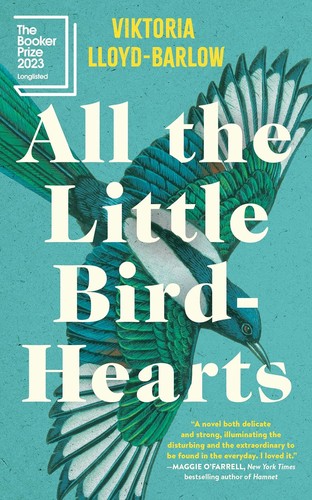
All the Little Bird-Hearts
🏆 Booker Prize 2023 (Longlisted)
Authors' Club Best First Novel Award 2024 (Winner)
Review Editor
Eleanor Marsh
Viktoria Lloyd-Barlow’s debut novel, All the Little Bird-Hearts, is set in England’s Lake District in 1988 and narrated by Sunday Forrester, an autistic single mother whose carefully structured world begins to unravel when a glamorous couple moves in next door. Published in 2023 and longlisted for the Booker Prize that same year, the novel is a quietly devastating story about motherhood, manipulation, and the fierce effort it takes to belong in a world that was not built with you in mind.
Sunday does things more carefully than most people. On certain days she eats only white food. She drinks only carbonated beverages. She avoids clocks. These are not quirks played for laughs; they are the scaffolding that holds her days together. She works at her former in-laws’ garden shop, raises her sixteen-year-old daughter Dolly alone, and navigates every social encounter with the wariness of someone who has learned, through hard experience, that other people’s faces are unreliable maps. Into this painstakingly maintained order step Vita and Rollo, a childless couple whose warmth and spontaneity feel, at first, like a gift.
But Vita wants something Sunday has. She wants Dolly. And what begins as neighborly friendship gradually becomes something more predatory, as Vita charms and flatters and slowly pries mother and daughter apart. The novel tracks one summer and its aftermath, building toward a confrontation that redefines every relationship in Sunday’s life.
Character Arcs and Development
Sunday Forrester is one of the most memorable narrators in recent literary fiction. Lloyd-Barlow writes her from the inside out, and the result is a character who feels utterly real rather than a collection of diagnostic criteria. Sunday is funny, perceptive in ways that catch you off guard, and sometimes painfully wrong about the people around her. She consults two unlikely sources for guidance: a book of Sicilian folk wisdom inherited from her father and a volume called Etiquette for Ladies, which dispenses advice she follows with a devotion that is both endearing and heartbreaking. Her observations land with unexpected force. When she introduces herself to Vita and takes an involuntary step backward, she reflects that she is “constantly reversing away from people; the whole world is a revolving series of rooms I have walked into by mistake.”
Dolly, at sixteen, is headstrong and restless, embarrassed by her mother’s differences in the way that teenagers can be embarrassed by anything. Her defection to Vita feels both inevitable and wrenching. Lloyd-Barlow does not vilify Dolly for this; she captures the cruelty of adolescence with precision, showing how a teenager desperate for sophistication can be weaponized by an adult who knows exactly what to offer. Vita herself is drawn with more nuance than you might expect from a manipulative antagonist. She is needy, impulsive, and genuinely lonely, and Lloyd-Barlow lets us see her childishness for what it is: not calculated evil but a kind of emotional immaturity that does real damage because nobody ever calls it what it is.
The secondary characters carry weight, too. David, Sunday’s colleague at the plant nursery, is deaf and occupies a parallel position of social exclusion. Their friendship is one of the novel’s warmest threads, built on mutual recognition rather than pity. Sunday’s mother, who favored her other daughter and could not tolerate Sunday’s differences, haunts the narrative. Sunday’s reckoning with that maternal rejection is delivered in a single devastating passage about realizing that her mother could have loved her, if she had chosen to.
Pacing
The novel moves at a deliberate pace, and that is both its strength and its occasional weakness. The first half is absorbing because we are learning how Sunday sees the world, and every detail feels fresh and necessary. The slow infiltration of Vita into Sunday’s life is handled with the kind of incremental tension that makes you uneasy without being able to pinpoint exactly when things shifted. You keep turning pages because you sense what is coming but cannot quite see it yet.
The middle section, where Vita’s influence on Dolly deepens and Sunday’s isolation grows, sometimes circles the same emotional territory more than once. Sunday’s internal processing is richly rendered, but a few passages repeat observations about her loneliness and confusion that the reader has already absorbed. The novel could have trimmed ten or fifteen pages from this stretch without losing anything essential. The final act, however, earns its payoff. Lloyd-Barlow handles the rupture between mother and daughter with restraint, and the aftermath carries real emotional weight. The pacing finds its footing again when the stakes become concrete rather than atmospheric.
Deeper Thematic Exploration
Beneath its domestic surface, All the Little Bird-Hearts is asking a fundamental question: who gets to define what a good mother looks like? Sunday is devoted, responsible, and fiercely protective. She has held a job, raised a child alone, and built a functioning life out of materials that other people dismiss as odd. Yet the people around her, including her own daughter, treat her as less capable than Vita, a woman who has never shouldered responsibility for anyone and approaches life with the heedlessness of a child playing dress-up. The novel makes this double standard visible without ever lecturing about it.
Lloyd-Barlow also explores the peculiar cruelty of being tolerated rather than accepted. Sunday’s in-laws employ her out of obligation to their granddaughter. Her neighbors accommodate her rituals with a politeness that shades, over time, into mockery. Even Vita’s initial warmth is a form of collecting, of finding Sunday amusing in a way that requires Sunday to stay in the role of charming oddity. The novel is sharp on how neurotypical society rewards compliance and punishes the people who cannot perform its codes fluently enough.
There is also a thread about class and aspiration running through the story. Vita and Rollo represent a world of taste, leisure, and ease that Dolly craves and Sunday cannot provide. The garden party thrown by Dolly’s wealthy grandparents becomes the setting for the novel’s most painful scene, where class and ableism converge. Lloyd-Barlow makes clear that Sunday’s exclusion is not simply about her autism; it is about a society that uses difference as a sorting mechanism and then pretends the sorting was natural.
The Sicilian folk wisdom that Sunday carries with her functions as more than a character detail. It connects her to her father, the one person who seemed to love her without condition, and it offers an alternative framework for understanding the world, one in which birds in the house bring the Evil Eye and love is expressed through superstition and food. The title itself draws from this tradition, and Lloyd-Barlow uses it to distinguish between the little bird-hearts, people who bring chaos disguised as charm, and the quieter, steadier forms of devotion that Sunday embodies.
Style and Voice
Lloyd-Barlow’s prose is clean, precise, and deceptively simple. Sunday’s narration has a quality of careful observation that mirrors the character’s relationship with the world: she notices everything, but she does not always know what it means. This creates a distinctive reading experience where the reader often understands more than the narrator, without ever feeling superior to her. The irony is gentle, never cruel.
The voice is also genuinely funny in places. Sunday’s reliance on Etiquette for Ladies produces moments of dry comedy, and her literal interpretations of social conventions reveal how absurd those conventions are when examined from the outside. Lloyd-Barlow writes sensory experience with particular skill. Sunday’s sensitivity to smell, texture, and the physical presence of other people is conveyed so vividly that you begin to feel the world pressing in on you, too. The novel is set in the 1980s, and the period detail is handled lightly, present in the background rather than paraded for nostalgic effect. There is a restraint to the prose that suits Sunday perfectly: she does not embroider or exaggerate, and neither does Lloyd-Barlow. The result is a voice that earns your trust early and keeps it throughout.
Verdict
All the Little Bird-Hearts is a remarkable debut that earns its Booker Prize longlist recognition. It offers something genuinely rare in literary fiction: an autistic narrator who is not a puzzle to be solved or a lesson to be learned from, but a fully realized person whose inner life is rendered with warmth, humor, and unflinching honesty. If you are drawn to novels about the complicated mechanics of family, about women who build their lives on terms that the world refuses to respect, or about what it costs to be different in a society that rewards sameness, this book will stay with you.
It is not without flaws. The middle section repeats itself, and Vita and Rollo remain somewhat opaque as characters, their motivations sketched rather than fully explored. But these are minor complaints about a novel that does something difficult and does it well: it places you inside a mind that processes the world differently and makes that experience feel not exotic or pitiful, but recognizable. Sunday Forrester is a character you will think about long after you close the book, and Lloyd-Barlow has announced herself as a writer worth following closely.
Frequently Asked Questions about All the Little Bird-Hearts
What is All the Little Bird-Hearts by Viktoria Lloyd-Barlow about?
All the Little Bird-Hearts follows Sunday Forrester, an autistic single mother living in England’s Lake District in 1988, whose carefully ordered world is disrupted when a charming couple, Vita and Rollo, move in next door. The novel explores how Vita gradually manipulates Sunday’s relationship with her teenage daughter Dolly, and examines themes of motherhood, neurodiversity, class, and belonging.
Is All the Little Bird-Hearts based on a true story?
The novel is fiction, but it draws on the author’s own experience. Viktoria Lloyd-Barlow is herself autistic and has a PhD in creative writing with a focus on autism and literary narrative. She set the novel in the 1980s deliberately, before autism was widely diagnosed, to give her protagonist more autonomy of expression. While the characters and plot are invented, Sunday’s interior experience reflects Lloyd-Barlow’s understanding of autism from the inside.
What are the main themes in All the Little Bird-Hearts?
The novel explores motherhood and the question of who society considers a “fit” parent. It examines neurodiversity and self-acceptance, showing how autistic people navigate a world built for neurotypical norms. Class and social aspiration drive much of the conflict, as does the difference between genuine friendship and manipulative charm. The book also addresses intergenerational relationships and the painful process of a teenager separating from a parent.
How long is All the Little Bird-Hearts and is it a difficult read?
The novel is approximately 304 pages in the US edition. It is not a difficult read in terms of language or structure; Lloyd-Barlow’s prose is clear and accessible. The emotional content can be intense, particularly the scenes depicting Sunday’s isolation and the breakdown of her relationship with her daughter. The narrative moves at a measured pace, so readers who prefer fast-paced plots should be prepared for a more contemplative experience.
Is there a movie or TV adaptation of All the Little Bird-Hearts?
As of 2026, there is no movie or TV adaptation of All the Little Bird-Hearts. Given its Booker Prize longlist recognition and the richness of its central character, it would lend itself well to a screen adaptation, but none has been announced.
What age group or reading level is All the Little Bird-Hearts for?
All the Little Bird-Hearts is written for adult readers. The novel deals with themes of manipulation, parental rejection, divorce, and emotional abuse that require a mature perspective. It would be suitable for readers aged 16 and up, and would be particularly meaningful for anyone with personal or professional connections to autism, or for readers interested in stories about unconventional family dynamics.
How does All the Little Bird-Hearts compare to other novels about autism?
Unlike books such as The Curious Incident of the Dog in the Night-Time, which presents autism from an external, diagnostic perspective, All the Little Bird-Hearts never uses the word “autistic” in relation to its narrator. Lloyd-Barlow, who is autistic herself, writes Sunday’s experience from the inside, focusing on how she processes the world rather than labeling her condition. This makes it feel more intimate and less clinical than most novels featuring neurodivergent characters, and closer in spirit to the own-voices movement in contemporary fiction.
Should I read All the Little Bird-Hearts and is it worth it?
If you enjoy character-driven literary fiction with a distinctive narrative voice, All the Little Bird-Hearts is well worth your time. Readers who loved Eleanor Oliphant Is Completely Fine or Elizabeth Is Missing will find a similar pleasure in inhabiting an unexpected perspective. The novel is strongest when it immerses you in Sunday’s way of seeing, and weakest when it circles the same emotional ground. Overall, it is a confident, moving debut that offers a view of the world you are unlikely to find elsewhere.
Book Details
- Title
- All the Little Bird-Hearts
- Genre
- Literary Fiction
- Awards
- 🏆 Booker Prize 2023 (Longlisted) Authors' Club Best First Novel Award 2024 (Winner)
- WritersReview Rating
- 4.9 / 5