
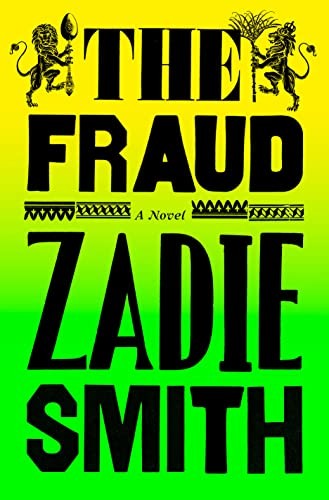
The Fraud
🏆 New York Times 10 Best Books of the Year (2023)
NPR Best Books of the Year (2023)
Publishers Weekly Best Books of the Year (2023)
BookPage Best Books of the Year (2023)
Oprah Daily Best Novels of 2023
Shortlisted for Waterstones Book of the Year (2023)
Longlisted for Walter Scott Prize for Historical Fiction (2024)
Shortlisted for Writers' Prize for Fiction (2024)
Review Editor
Eleanor Marsh
Zadie Smith has spent a career writing about modern, multicultural London. So when she announced her first historical novel, set in Victorian England and centered on an obscure 1870s fraud trial, the question was fair: why this, why now? The answer, as it turns out, runs hundreds of years deep. The Fraud, published by Penguin Press in September 2023, takes the real-life Tichborne case as its scaffolding and builds something far more ambitious around it: a novel about who gets to claim an identity, who gets believed, and whose stories vanish from the record entirely.
The Tichborne affair was one of Victorian England’s great spectacles. Arthur Orton, a cockney butcher who had been living in Australia, returned to England claiming to be Sir Roger Tichborne, the long-lost heir to a baronetcy and a fortune. The trial that followed consumed the public for years. Smith drops us into this circus through the eyes of Eliza Touchet, a Scottish, Catholic widow who serves as cousin, housekeeper, and intellectual companion to William Harrison Ainsworth, a once-famous novelist now watching his reputation crumble. Through Eliza, Smith weaves together three storylines: the Tichborne trial itself, the fading literary world of Ainsworth, and the life of Andrew Bogle, a formerly enslaved Jamaican man who becomes the trial’s most compelling witness.
At 464 pages, this is Smith’s longest novel and her most structurally daring. It spans decades, continents, and social strata. It is also, unmistakably, a book about England and the lies England tells itself.
Character Arcs and Development
Eliza Touchet is one of Smith’s finest creations. She is sharp, underestimated, and quietly furious. Married young and abandoned by her husband, she has spent decades managing Ainsworth’s household, raising children who are not hers, and reading voraciously while the men around her fail to notice her mind. She holds abolitionist convictions that put her at odds with the comfortable Victorian parlor she inhabits. As the Tichborne trial unfolds, Eliza becomes increasingly drawn to Andrew Bogle’s testimony, recognizing in him a fellow outsider whose truth the establishment would rather ignore. Her arc is not a dramatic transformation but a slow accumulation of clarity. By the novel’s end, she understands what she has always half-known: that the men she has served, loved, and tolerated have been performing their own frauds all along.
William Harrison Ainsworth functions as both comic relief and quiet tragedy. He was once a genuine rival to Dickens; now he churns out novels nobody reads, each one landing with less impact than the last. Smith treats him with real tenderness even as she skewers his vanity. His obsession with literary status, his inability to see Eliza as anything more than a domestic fixture, his casual racism dressed up as genteel concern: these are not exaggerated for effect. They feel observed. Ainsworth never has a grand reckoning. He simply fades, which is exactly the point.
Andrew Bogle is the novel’s moral center, though Smith wisely avoids turning him into a saint. Born into slavery on a Jamaican sugar plantation, Bogle lived through horrors that the English characters can barely imagine and certainly never ask about. His decision to testify on behalf of the Tichborne Claimant is complex: is he telling the truth? Is he performing loyalty to a family that once owned him? Smith refuses to simplify his motivations, and the novel is richer for it. Bogle’s chapters, set in Jamaica and tracing his life from childhood through emancipation, are the book’s most emotionally devastating passages.
Pacing
This is where The Fraud will divide readers, and it is worth being honest about it. The novel is built from very short chapters, many only a page or two long, which gives it a fragmentary, mosaic quality. Smith jumps between timelines, locations, and perspectives with confidence, and the individual pieces are almost always sharp and well-crafted. But the accumulation can feel slow, particularly in the novel’s middle third, where the Tichborne trial proceedings pile up and the courtroom scenes begin to blur together.
The courtroom scenes, in particular, can feel repetitive: witness after witness testifying about whether the Claimant has the right birthmark or remembers the right childhood detail. Smith is faithful to the absurdity of the real trial, but faithfulness to history sometimes costs narrative energy. If you come to this book expecting the momentum of White Teeth or the emotional propulsion of NW, you will need to recalibrate. The Fraud moves at the pace of a Victorian novel, which is deliberate but occasionally taxing. The payoff comes in the final hundred pages, where Smith draws her threads together with real force. The Jamaican sections, scattered throughout, provide necessary urgency and emotional weight. Still, some readers will feel that 464 pages is more real estate than the story needs.
Deeper Thematic Exploration
The title is not a label for the Tichborne Claimant alone. Smith’s argument, developed across dozens of characters and subplots, is that fraud is the operating principle of Victorian England, and perhaps of England altogether. Ainsworth commits fraud every time he publishes another mediocre novel and expects praise. The literary establishment commits fraud by elevating certain voices (white, male, connected) and erasing others. The British Empire committed fraud on a civilizational scale, building its wealth on enslaved labor while preaching liberty and progress. Even the courtroom, supposedly the place where truth prevails, becomes a theater of performance where the verdict depends less on evidence than on who the jury finds more believable, more English, more deserving of sympathy.
What makes this more than a thesis paper dressed as fiction is that Smith finds the theme in the textures of daily life. Eliza’s position in Ainsworth’s household is itself a kind of fraud: she is family but not family, essential but invisible, intellectually superior to most of the men around her but denied any platform to show it. The domestic arrangements of Victorian England, Smith suggests, relied on the same willful blindness that powered the plantation system. The distance between a London parlor and a Jamaican sugar field is shorter than anyone wants to admit.
Smith also takes aim at the novel itself as a form. Ainsworth’s career serves as a case study in how fiction can distort reality, how the desire to entertain can shade into the desire to deceive. There is a running tension between Smith’s obvious love of the Victorian novel tradition and her suspicion that storytelling, at its worst, is just another confidence game. This self-awareness never becomes paralyzing. Smith is too good a storyteller to let the meta-commentary swallow the story. But it adds a layer of intellectual honesty that distinguishes The Fraud from more straightforward historical fiction.
Style and Voice
Smith writes in a close third person that shifts between characters, and she modulates her prose to match each perspective. Eliza’s chapters are precise and observational, with a dry wit that feels distinctly Scottish. Ainsworth’s are more florid, gently parodying his own literary style. Bogle’s are the plainest and the most powerful, stripped of ornament in a way that makes the horror of what he describes land harder. The tonal range is impressive: Smith can be wickedly funny in one chapter and quietly heartbreaking in the next, sometimes within the same page.
The short chapter structure deserves special mention. At its best, it creates a rhythm that feels almost musical: a quick scene in a London drawing room, then a flash to a Jamaican plantation, then a courtroom exchange, each one casting new light on the others. Smith trusts the reader to hold multiple timelines and tonal registers simultaneously, and the effect, when it works, is genuinely thrilling. Her sentences are clean and controlled, with occasional moments of startling beauty, particularly in the passages about the Jamaican landscape and the physical reality of plantation labor. There is a restraint here that serves the material well. Smith never reaches for the emotional crescendo when a quiet observation will do more work, and the result is prose that earns its emotional moments rather than manufacturing them.
Verdict
This is a novel that asks a lot of its reader and gives back generously, though not always on the reader’s schedule. It is Smith’s most ambitious book, and ambition, by definition, means reaching for something you might not fully grasp. The Tichborne trial sections occasionally feel like they are serving the theme rather than the story, and the novel’s length will test the patience of readers who prefer tighter construction. But the Eliza chapters are superb, the Bogle chapters are devastating, and Smith’s central argument, that fraud is not the exception but the rule, lands with real force.
If you are a reader who values intelligence, moral seriousness, and prose that rewards close attention, The Fraud belongs on your list. If you love Victorian fiction and want to see a contemporary master wrestle with the form, this is essential reading. Readers who need strong plot momentum or a single driving narrative may find the mosaic structure frustrating. But for those willing to meet it on its own terms, The Fraud is one of the most thought-provoking novels of recent years, a book that uses the past to ask questions about the present that nobody has satisfactorily answered.
Frequently Asked Questions about The Fraud
What is The Fraud by Zadie Smith about?
The Fraud is a historical novel set in Victorian England, centered on the real-life Tichborne trial of the 1870s, in which a cockney butcher claimed to be a missing aristocrat. The story is told primarily through Eliza Touchet, the housekeeper and cousin of fading novelist William Harrison Ainsworth, and Andrew Bogle, a formerly enslaved Jamaican man who becomes the trial’s star witness. Smith uses the case to explore themes of identity, authenticity, and the legacies of slavery and colonialism.
Is The Fraud by Zadie Smith based on a true story?
Yes, the novel is rooted in the real Tichborne case, one of the longest and most sensational trials in Victorian England. Arthur Orton claimed to be Sir Roger Tichborne, the presumed-dead heir to a fortune, and Andrew Bogle was a real person who testified in the trial. Smith conducted extensive historical research, though she takes creative liberties with certain characters and timelines, particularly with the fictional elements of Eliza Touchet’s inner life.
What are the main themes in The Fraud by Zadie Smith?
The novel explores several interconnected themes: the nature of fraud and authenticity (who gets to claim an identity, and who decides what is real); the lasting damage of the British slave trade and colonialism; the silencing of women in intellectual and domestic life; and the relationship between fiction and truth, particularly whether novelists are themselves a kind of fraud. Smith ties these together through the Tichborne trial, which functions as a metaphor for the larger deceptions of Victorian society.
How long is The Fraud and is it a difficult read?
The Fraud is 464 pages in hardcover. The prose is clear and accessible, written in very short chapters that make it easy to pick up and put down. However, the novel’s fragmented structure, multiple timelines, and large cast of characters require sustained attention. Readers comfortable with Victorian fiction or literary novels with non-linear storytelling will find it manageable. Those who prefer fast-paced plots may find the middle section slow.
Is there a movie or TV adaptation of The Fraud by Zadie Smith?
As of 2026, there is no announced movie or television adaptation of The Fraud. Given the novel’s historical setting, large cast, and thematic complexity, a limited series format would likely suit it best. Smith’s earlier novel White Teeth was adapted for Channel 4 in 2002, and NW was adapted by the BBC in 2016, so future adaptation remains possible.
What age group or reading level is The Fraud appropriate for?
The Fraud is written for adult readers. It contains depictions of slavery, including physical violence on plantations, as well as references to sexual relationships and colonial brutality. The vocabulary and historical context make it best suited for readers aged 16 and older with some familiarity with British history. It is not a young adult novel, but mature teen readers with an interest in historical fiction could handle it.
How does The Fraud compare to Zadie Smith’s other novels?
The Fraud is Smith’s first historical novel, which sets it apart from the contemporary London settings of White Teeth, NW, and On Beauty. It is her longest and most structurally experimental book, built from dozens of very short chapters that jump between timelines and continents. Readers who loved the sprawling energy of White Teeth will find a similar ambition here, though the tone is more measured. Those who preferred the tighter focus of On Beauty may find The Fraud overly expansive.
Should I read The Fraud by Zadie Smith and is it worth it?
If you value ambitious literary fiction that rewards patience and close reading, yes. The Fraud is one of Smith’s most intellectually rich novels, with three distinct storylines that converge around questions of truth, identity, and historical justice. It demands more time and attention than a typical novel, and the pacing can lag in the trial sections. But the writing is consistently excellent, the characters are deeply human, and the themes feel urgent despite the Victorian setting. It is especially rewarding for readers interested in colonial history and the politics of storytelling.
Book Details
- Title
- The Fraud
- Awards
- 🏆 New York Times 10 Best Books of the Year (2023) NPR Best Books of the Year (2023) Publishers Weekly Best Books of the Year (2023) BookPage Best Books of the Year (2023) Oprah Daily Best Novels of 2023 Shortlisted for Waterstones Book of the Year (2023) Longlisted for Walter Scott Prize for Historical Fiction (2024) Shortlisted for Writers' Prize for Fiction (2024)
- WritersReview Rating
- 4.9 / 5