
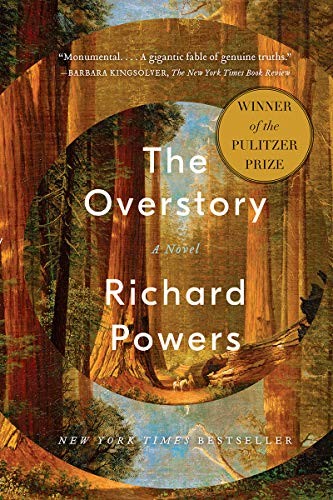
The Overstory
🏆 Pulitzer Prize for Fiction (2019)
William Dean Howells Medal (2020)
Man Booker Prize Shortlist (2018)
Review Editor
Eleanor Marsh
Richard Powers published The Overstory in 2018, and it promptly won the Pulitzer Prize for Fiction the following year. The novel runs 512 pages and follows nine Americans whose lives are shaped, redirected, and in some cases destroyed by their relationships with trees. That description makes it sound like a nature book with characters attached, but Powers pulls off something more unusual: he wrote a genuine ensemble novel where the ensemble includes both people and forests, and he treats both with equal seriousness.
The book opens with a section called “Roots,” which introduces each character through standalone origin stories spanning generations. A family photographs the same chestnut tree for a century. A young woman inherits a jade ring and a mulberry scroll from her Chinese immigrant father. A Vietnam veteran falls from a plane into a canopy that saves his life. A lonely botanist discovers that trees communicate through underground fungal networks and gets laughed out of her field for saying so. These opening stories work as self-contained pieces of fiction, each one building a specific human life around a specific tree. By the time the “Trunk” section begins weaving these lives together, you have spent enough time with each person to care about where they end up.
The premise, boiled down, is this: what if trees matter as much as people, and what happens to the humans who start believing that?
Character Arcs and Development
Nine protagonists is a lot of weight for any novel to carry, and Powers distributes it unevenly, by design. The characters who bear the most narrative pressure are Patricia Westerford, the reclusive dendrologist whose research on tree communication anticipates real-world discoveries about mycorrhizal networks; Nick Hoel, the failed artist who inherits a century of family photographs of a single chestnut tree; and Olivia Vandergriff, a careless college student who dies from electrocution, comes back to life, and reinvents herself as a radical environmental activist. These three carry the novel’s central argument: Patricia through science, Nick through art, Olivia through direct action.
The remaining six characters orbit this core with varying degrees of gravitational pull. Mimi Ma, the daughter of a Chinese engineer, brings cultural memory and inherited grief to the story. Adam Appich, a psychology student, embeds himself in the activist movement to study it and winds up transformed by it. Douglas Pavlicek, the veteran who survived by falling into trees, becomes a committed foot soldier for the cause. Ray Brinkman and Dorothy Cazaly, a married couple who plant trees on Arbor Day as a shared ritual, watch their relationship hollow out as the trees keep growing. Neelay Mehta, a programmer paralyzed in a childhood fall from an oak, builds virtual worlds that eventually circle back to the real forests he can no longer walk through.
Not every character lands with equal force. Ray and Dorothy function more as thematic counterpoint than as fully developed people; their marriage stands in for the way most humans relate to nature, which is to say distractedly and with diminishing attention. Neelay operates at a remove from the central action, and his Silicon Valley storyline can feel like it belongs in a different book. But Patricia, Nick, and Olivia are drawn with real depth. Patricia’s decades-long struggle between scientific caution and moral urgency is the novel’s emotional spine, and Powers writes her loneliness with a specificity that earns every difficult decision she makes in the final act.
Pacing
The Overstory asks you to read at the speed of trees, which is both its greatest formal achievement and its most significant demand on the reader. The “Roots” section moves briskly, cycling through nine origin stories with the energy of a short story collection. The “Trunk” section, where characters converge on the Pacific Northwest timber wars, builds genuine tension as a group of activists occupies an ancient redwood and faces escalating consequences. This is the novel at its most propulsive, and if Powers had written the whole book at this pace, it would be half as long and twice as conventional.
Instead, the “Crown” section slows deliberately, following the characters through years of aftermath: prison, isolation, compromise, disillusionment. Some readers will feel the drag here, and they are not wrong to notice it. Powers is asking you to sit with the consequences of idealism, and consequences are rarely as exciting as the idealism itself. The final section, “Seeds,” resolves individual stories with quiet, sometimes ambiguous endings that plant questions rather than answer them. If you can surrender to the novel’s own sense of time, the pacing works. If you need plot momentum to sustain 500 pages, the back half will test your patience.
Deeper Thematic Exploration
Beneath the activism plot and the character studies, The Overstory is a novel about scale. Trees operate on timelines that make human lifespans look like camera flashes, and Powers uses this fact to interrogate what we mean by “progress,” “property,” and “individual.” The chestnut tree that Nick Hoel’s family photographs for a hundred years outlasts marriages, careers, wars, and economic booms. It reduces every human drama around it to a footnote. This is not a comforting observation, and Powers does not try to make it one.
The novel also grapples honestly with the limits of activism. The characters who take direct action to save old-growth forests pay enormous personal costs, and the forests fall anyway. Powers refuses to write a story where good intentions produce good outcomes. Instead, he asks whether the effort itself has value even when it fails, whether the act of seeing something clearly (even something as ordinary as a tree) constitutes a meaningful form of resistance. This is where the novel earns its philosophical weight. It is not enough for Powers to say “trees are important.” He wants to investigate why humans cannot seem to act on knowledge they already possess, why the gap between understanding and behavior is so wide and so durable.
Patricia Westerford’s research arc carries this theme most directly. She publishes findings about tree communication decades before the scientific establishment is ready to accept them. She watches her work get dismissed, then gradually vindicated, then commodified. Her story captures something true about how human institutions process inconvenient knowledge: slowly, reluctantly, and usually too late. The parallel to climate science is obvious, and Powers trusts the reader to make the connection without underlining it.
There is also a quieter thread running through the novel about what constitutes a meaningful life. The characters who devote themselves to trees lose careers, relationships, and freedom. The characters who live conventional lives (Ray and Dorothy, Neelay in his corporate success) gain comfort but not purpose. Powers does not stack the deck entirely in favor of the activists, but he makes clear that proximity to the natural world offers something that human institutions cannot replicate: a sense of participating in a story larger than yourself.
Style and Voice
Powers writes in a close third person that shifts register to match each character. Patricia’s sections are precise and observational, full of botanical detail rendered with a scientist’s care. Nick’s sections lean toward the visual and spatial, as befits an artist. Olivia’s carry an almost mystical intensity that reflects her near-death transformation. This chameleonic approach keeps the prose from settling into a single groove across 500 pages, though it occasionally produces unevenness; the Neelay sections strain for profundity in ways the quieter storylines do not.
At its best, Powers writes about trees with a vividness that retrains your attention. He describes root systems negotiating with fungi, canopy structures redistributing light, chemical signals traveling between trunks. These passages are not ornamental. They function as arguments, each one building the case that the natural world is doing something complex and purposeful that humans have been too self-absorbed to notice. The prose is dense but rarely obscure, and Powers has a gift for making scientific processes feel like narrative events. A seed germinating becomes as suspenseful as any human confrontation in the book.
Verdict
The Overstory is a novel that will change what you notice when you walk outside. It is also, at times, a novel that asks more patience than some readers will want to give. The back half is slower than the front half, and not every character justifies their place in an already crowded story. Ray and Dorothy feel underdeveloped. Neelay’s sections occasionally drift. The argument can tip toward the didactic, particularly in the “Crown” section, where characters sometimes voice positions that feel more like thesis statements than dialogue.
But the ambition here is real, and so is the execution where it counts. Patricia Westerford is one of the most fully realized scientist characters in recent fiction. The “Roots” section is a standalone achievement in structure and storytelling. And the central question Powers raises (can humans learn to value something that operates on a timescale they will never experience?) is one that only grows more urgent with each passing year. If you care about the natural world, or about what fiction can do when it refuses to keep humans at the center of every story, this is a book you should read. If you prefer tight plots and brisk pacing over philosophical breadth, you may want to commit to 200 pages before deciding whether to stay.
Frequently Asked Questions about The Overstory
What is The Overstory by Richard Powers about?
The Overstory follows nine Americans whose lives are connected to trees in profound ways. Their stories, told across four sections named after parts of a tree (Roots, Trunk, Crown, Seeds), gradually interweave as several characters become involved in radical environmental activism to protect old-growth forests in the Pacific Northwest. The novel explores humanity’s relationship with the natural world and asks whether trees deserve the same moral consideration as people.
Did The Overstory win the Pulitzer Prize?
Yes, The Overstory won the 2019 Pulitzer Prize for Fiction. It also won the 2020 William Dean Howells Medal, which is awarded every five years for the most distinguished American novel. The book was shortlisted for the 2018 Man Booker Prize and appeared on The New York Times’ list of the 100 Best Books of the 21st Century.
What are the main themes in The Overstory by Richard Powers?
The novel explores four major themes: the interconnectedness of all living things, particularly through underground fungal networks that link trees; the moral and practical limits of environmental activism; the tension between human timescales and the much longer timescales on which forests operate; and the difficulty of translating scientific knowledge into collective action. Powers also examines how individual transformation can occur when people pay sustained attention to the nonhuman world.
How long is The Overstory and is it a difficult read?
The Overstory is 512 pages in paperback. It is a moderately challenging read, not because the language is obscure, but because of its unconventional structure (nine interwoven storylines) and its deliberate pacing, particularly in the second half. The opening “Roots” section reads like a compelling short story collection and is very accessible. Readers comfortable with literary fiction and willing to invest in a long narrative arc will find it rewarding.
Is there a movie or TV adaptation of The Overstory?
Netflix announced a television adaptation in February 2021, with David Benioff and D.B. Weiss (the creators of Game of Thrones) and Hugh Jackman serving as executive producers. Richard Robbins wrote the pilot script. As of mid-2026, no release date has been confirmed and the project remains in development.
What age group or reading level is The Overstory appropriate for?
The Overstory is written for adult readers and is best suited for ages 16 and up. It contains some violence related to environmental protests, brief sexual content, and mature themes about mortality and ecological destruction. The scientific and philosophical content is accessible to general readers but may be most appreciated by those with some interest in ecology, environmental science, or literary fiction.
How does The Overstory compare to Richard Powers’ other novels?
The Overstory is widely considered Powers’ most accessible and emotionally engaging novel. His earlier works, such as The Gold Bug Variations and The Echo Maker, share his interest in science and complex narrative structures but can feel more intellectually demanding. His follow-up novel Bewilderment (2021) covers related ground on a smaller scale, focusing on a single father and son rather than nine characters. Readers who enjoy The Overstory often move to Bewilderment next, while those wanting a deeper challenge try The Echo Maker.
Should I read The Overstory and is it worth it?
If you enjoy ambitious literary fiction that challenges your perspective on the world, The Overstory is absolutely worth the investment. Readers who love character-driven storytelling combined with big ideas (in the vein of David Mitchell or Barbara Kingsolver) will find a lot here. If you prefer fast-paced plots or find extended nature writing tedious, the second half may try your patience. Most readers who push through the slower sections find that the ending reframes the entire experience in a way that justifies the commitment.
Book Details
- Title
- The Overstory
- Awards
- 🏆 Pulitzer Prize for Fiction (2019) William Dean Howells Medal (2020) Man Booker Prize Shortlist (2018)
- WritersReview Rating
- 4.9 / 5