Richard Powers
Richard Powers is an American novelist celebrated for his extraordinary synthesis of scientific knowledge and literary ambition, producing novels that ask readers to reckon with biology, technology, consciousness, and the ethical demands of living on a damaged planet. Born in 1957 in Evanston, Illinois, Powers grew up in Thailand and the American Midwest before studying physics at the University of Illinois at Urbana-Champaign, later switching to English literature and earning both his bachelor’s and master’s degrees there. A chance encounter with a photograph in a Boston museum—August Sander’s portrait of three farm boys on their way to a dance—inspired him to abandon a career in computer programming and write his debut novel. He has been writing extraordinary fiction ever since.
Powers’s early novels—Three Farmers on Their Way to a Dance (1985), Prisoner’s Dilemma (1988), The Gold Bug Variations (1991)—established his reputation as an intellectually dazzling novelist who used scientific and historical research as structural material rather than mere backdrop. His work has consistently explored how technology transforms human consciousness, how memory shapes identity, and how we understand the relationship between the individual and systems larger than ourselves. The Echo Maker (2006), a novel about a rare neurological disorder following a car crash, won the National Book Award. Orfeo (2014) wove together music, genetics, and the national security state into a propulsive and moving narrative.
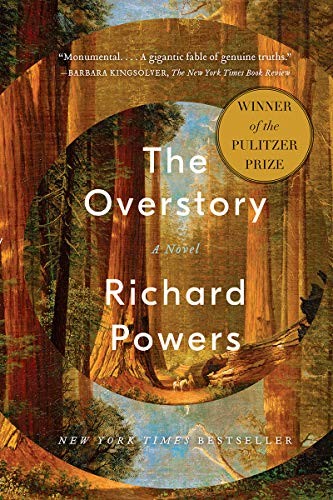
The Overstory (2018), featured on WritersReview, is widely considered Powers’s masterpiece and one of the most important American novels of the twenty-first century. A vast, interlocking narrative about nine characters whose lives are transformed by trees and the fight to protect them, the novel is simultaneously a thriller, a meditation on ecological crisis, and a philosophical argument for expanding our moral circle beyond the human. It won the Pulitzer Prize for Fiction, was longlisted for the Man Booker Prize, and has been credited with shifting public consciousness about deforestation and environmental activism. Its ambition—to give narrative form to nonhuman timescales—is matched by its emotional power.
Powers’s prose style is dense, allusive, and scientifically precise without ever becoming arid. He is a novelist of ideas in the deepest sense: ideas do not ornament his fiction but generate it, driving plot and character in ways that feel inevitable in retrospect. He has taught at the University of Illinois, Stanford University, and other institutions, and was awarded a MacArthur Fellowship in 1989.
His subsequent novel, Bewilderment (2021), continued his engagement with ecology and neuroscience, following an astrobiologist and his neurodivergent son through a near-future America in ecological collapse. Powers lives in the Great Smoky Mountains and remains one of the most ambitious and necessary novelists working in English, a writer who consistently insists that fiction can expand not just empathy but understanding—of science, of systems, of the living world.