
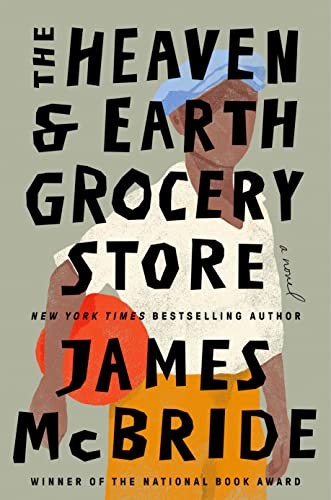
The Heaven & Earth Grocery Store
🏆 Kirkus Prize for Fiction (2023)
Amazon Book of the Year (2023)
Barnes & Noble Book of the Year (2023)
Library of Congress Prize for American Fiction (2024)
Review Editor
Eleanor Marsh
In 1972, construction workers in Pottstown, Pennsylvania dig up a skeleton from the bottom of a well in a neighborhood called Chicken Hill. A few curious items sit near the bones, including a mezuzah. Before anyone can piece together what happened, Hurricane Agnes sweeps through and washes the evidence away. James McBride opens The Heaven & Earth Grocery Store with this unsolved mystery, then pulls readers back four decades to show them exactly how that body ended up there.
The real story belongs to the 1920s and 1930s, when Chicken Hill was home to a patchwork community of Black families, Jewish immigrants, and anyone else the rest of Pottstown considered expendable. At the center stands the Heaven & Earth Grocery Store, a ramshackle shop run by Chona Ludlow, a Jewish immigrant whose childhood bout with polio left her with a limp and a stubborn refusal to accept pity. Her husband Moshe runs a theater and dance hall nearby. Around them orbits a sprawling cast: Nate Timblin, a Black laborer who becomes the Ludlows’ trusted friend and ally; Paper, a numbers runner carrying a complicated conscience; Big Soap, a moonshine supplier with a gentleness that catches you off guard; and dozens of neighbors whose lives bump against each other in the way only close-knit communities allow.
The plot crystallizes when a ten-year-old deaf Black orphan named Dodo faces commitment to Pennhurst State School, a real Pennsylvania institution notorious for its abuse of disabled residents. A local doctor with ties to the Ku Klux Klan pushes for Dodo’s removal, treating the boy as a problem to be solved rather than a child to be protected. What follows is a slow, messy, deeply human effort by the residents of Chicken Hill to keep one child out of the machinery of a system that considers him disposable. Published by Riverhead Books in August 2023, the novel became a million-copy bestseller and one of the most celebrated works of fiction that year.
Character Arcs and Development
McBride fills Chicken Hill with so many people that you might need a few chapters to keep them all straight. That crowded quality is the point. This is a neighborhood novel, and neighborhoods do not have two or three important residents. They have dozens, each carrying a history that matters to someone.
Chona Ludlow is the book’s emotional center. She arrives in Pottstown as a bride, skeptical of her arranged marriage to Moshe, and grows into a woman who channels her frustration with her own physical limitations into fierce advocacy for others. Her relationship with the store’s Black customers begins as transactional and becomes something closer to kinship, though McBride never sentimentalizes this shift. Chona can be sharp, bossy, and unreasonable in the same breath. She earns the reader’s respect not because she is saintly but because she is specific: a particular person making particular choices in difficult circumstances. Her stubbornness, which annoys Moshe and bewilders her neighbors, turns out to be the quality that holds the community’s fragile resistance together when it matters most.
Nate Timblin carries the novel’s quieter emotional weight. Where Chona acts boldly, Nate calculates. He understands what it costs a Black man in 1930s Pennsylvania to stick his neck out, and he does it anyway, but carefully, measuring each risk against the safety of his family. Dodo himself says almost nothing; he communicates through signs that only a few characters understand, yet his vulnerability drives every major decision in the book’s second half. Moshe, meanwhile, undergoes his own transformation from a man who married for practical reasons into someone who recognizes that his wife’s instinct to protect strangers is not naivete but a form of moral clarity he lacks. The secondary characters blur and overlap by design. McBride wants you to feel the density of a community, to understand that no single hero saves anything. Protection is collective, or it does not happen at all.
Pacing
The first hundred pages demand patience. McBride introduces character after character, layering backstories and side plots that seem unrelated to the skeleton in the well. Readers who want a tight, linear thriller will feel restless here. McBride is building a world, not a plot, and world-building takes time. He circles through the neighborhood at a leisurely pace, stopping to tell you about the history of a particular house, or the way a certain character got his nickname, or how a debt from twenty years ago still shapes a friendship. These digressions feel loose in the moment. Many of them turn out to be load-bearing later.
Once Dodo’s crisis takes shape around the halfway mark, the novel tightens considerably. The last third moves with real urgency as the various strands McBride planted early begin to converge. Scenes you thought were tangential reveal themselves as structural. That slow first half pays off, but only if you trust the process. Some readers will not, and their frustration is understandable. The novel asks for a particular kind of faith in its author, the kind McBride earned with Deacon King Kong and The Good Lord Bird, where similar structural patience led to devastating payoffs.
Deeper Thematic Exploration
At its core, The Heaven & Earth Grocery Store is about what happens when people who have nothing decide to share it. McBride sets his novel in a specific historical moment when Black and Jewish Americans occupied overlapping positions of precariousness in small-town America. They were neighbors not by choice but by exclusion, pushed to the same hill because the rest of town did not want them. Out of that forced proximity, something real grew. Not utopia, not perfect harmony, but a working arrangement built on mutual recognition: we are all that each of us has.
What interests McBride most is the messy, contingent solidarity that grows from shared vulnerability. He does not pretend the relationship between Black and Jewish residents of Chicken Hill was simple or free of tension. Chona’s store charges too much. Some Jewish residents look down on their Black neighbors. Some Black residents resent Jewish merchants who profit from their need. McBride maps these frictions honestly, then shows how, when a genuine crisis arrives, they matter less than the shared understanding that the world outside Chicken Hill will not save any of them. The solidarity in this novel is not idealized; it is negotiated, grudging, and real.
The novel also confronts institutional cruelty toward disabled people with an anger that sits close to the surface. Pennhurst State School was a real place, and its documented abuses included overcrowding, neglect, and violence against residents. McBride uses Dodo’s story to ask what kind of society warehouses its most vulnerable citizens, and what kind of community refuses to let it happen. He does not soften this question or make it abstract. You feel the weight of Dodo’s danger in every scene where the doctor circles closer. The book’s moral argument is clear and personal: you protect the people next to you, or you share responsibility for what happens to them.
Style and Voice
McBride writes with a roving, omniscient narration that swoops between characters like a neighborhood storyteller who knows everyone’s business and is not above editorializing. The prose shifts from sharp humor to real tenderness within the space of a sentence. He loves long, stacking clauses that pile detail on detail, then punctuates them with something blunt and funny. The dialogue crackles, particularly among the Black characters, where McBride’s ear for rhythm and idiom is exceptional. You can hear these people talking. Their voices stay with you after you put the book down.
The voice recalls Dickens in its scope and its affection for outsized characters, but McBride’s sensibility is distinctly American and distinctly musical. You can feel the influence of jazz in his sentence structure: the way he riffs on an idea, circles back to it from a new angle, and lands somewhere you did not expect. His narrator can be wry, furious, and tender within a single paragraph. Not every digression earns its length. A few subplots involving minor characters feel like they belong in a different novel entirely, and McBride’s habit of introducing a character with three pages of backstory only to never mention them again can test your patience. But the overall effect is of a writer who trusts his instincts and has earned the right to take those risks.
Verdict
The Heaven & Earth Grocery Store is a big, generous, sometimes unwieldy novel about the way communities hold together under pressure. It will reward readers who enjoy character-driven historical fiction, who do not mind keeping track of a large cast, and who value moral clarity without moral simplicity. If you loved McBride’s Deacon King Kong or The Good Lord Bird, this novel operates in the same register: boisterous, humane, and fundamentally hopeful without being naive about the costs of that hope.
It is not a perfect book. The early chapters scatter their attention too broadly, and some secondary characters never develop past their introductions. The sheer number of people on Chicken Hill can feel overwhelming, particularly in the first act, and readers who prefer tightly plotted narratives may struggle with McBride’s expansive, digressive approach. But when the novel hits its stride, it achieves something rare: a story about injustice that feels alive rather than instructive, populated by people you would actually want to know. Read it for Chona. Read it for the neighborhood. Read it because fiction this warm and this angry at the same time does not come along every year.
Frequently Asked Questions about The Heaven & Earth Grocery Store
What is The Heaven & Earth Grocery Store by James McBride about?
The Heaven & Earth Grocery Store is a historical novel set in the Chicken Hill neighborhood of Pottstown, Pennsylvania during the 1920s and 1930s. It follows the intertwined lives of Black and Jewish residents who unite to protect a deaf ten-year-old orphan named Dodo from being sent to the notorious Pennhurst State School. The novel opens with the discovery of a skeleton in 1972, then traces how the community’s bonds formed and were tested decades earlier.
Is The Heaven & Earth Grocery Store based on a true story?
The novel is fiction, but McBride draws on real history. Pennhurst State School was a real institution in Pennsylvania, and its abuses of disabled residents are well documented. The town of Pottstown is real, and McBride has spoken about being inspired by the kinds of mixed, working-class neighborhoods that existed in small American towns during this era. The characters and plot are invented, but the historical backdrop is grounded in fact.
What are the main themes in The Heaven & Earth Grocery Store?
The novel explores four primary themes. First, interracial solidarity between marginalized communities, specifically Black and Jewish Americans in the pre-Civil Rights era. Second, institutional cruelty toward disabled people, centered on the real Pennhurst State School. Third, the power of community resistance against unjust authority. Fourth, how proximity and shared vulnerability can build bonds across cultural differences, even when those bonds are imperfect and strained.
How long is The Heaven & Earth Grocery Store and is it a difficult read?
The hardcover edition runs 385 pages. The novel is not difficult in terms of vocabulary or prose style. McBride writes in a warm, accessible voice with plenty of humor. The challenge is the large cast of characters, particularly in the first hundred pages, where McBride introduces many people and backstories before the central plot takes shape. If you can get through the opening act, the rest of the book moves quickly.
Is there a movie or TV adaptation of The Heaven & Earth Grocery Store?
A24 and Steven Spielberg’s Amblin Entertainment announced in 2024 that they are developing a film adaptation of the novel. Spielberg is attached as a producer, not a director, and the project was described as being in very early development. No release date, cast, or director had been announced as of early 2025.
What age group or reading level is The Heaven & Earth Grocery Store for?
This is an adult novel best suited for readers aged 16 and older. It deals with racism, institutional abuse, disability, and violence in historically honest terms. The language is clean and the violence is not graphic, but the subject matter carries real emotional weight. Mature high school readers studying American history or civil rights would find it valuable and accessible.
How does The Heaven & Earth Grocery Store compare to James McBride’s other books?
Readers who loved Deacon King Kong will find familiar territory here: a large, lively cast in a tight-knit community, sharp dialogue, and a plot that rewards patience. The Heaven & Earth Grocery Store is more historically grounded than Deacon King Kong and broader in scope than The Good Lord Bird. It shares McBride’s signature mix of humor and moral seriousness, though some readers feel it tries to juggle more characters than even McBride can fully develop. His memoir The Color of Water remains his most personal work, while this novel may be his most ambitious.
Should I read The Heaven & Earth Grocery Store and is it worth it?
If you enjoy character-driven historical fiction with a strong moral compass, yes. The novel won the 2023 Kirkus Prize and was named Book of the Year by both Amazon and Barnes & Noble. It is best for readers who like sprawling, community-centered stories and can tolerate a slow build. If you prefer tightly plotted novels with a small cast, you may find the first half frustrating. For everyone else, this is one of the most rewarding American novels of the past several years.
Book Details
- Title
- The Heaven & Earth Grocery Store
- Awards
- 🏆 Kirkus Prize for Fiction (2023) Amazon Book of the Year (2023) Barnes & Noble Book of the Year (2023) Library of Congress Prize for American Fiction (2024)
- WritersReview Rating
- 4.9 / 5