
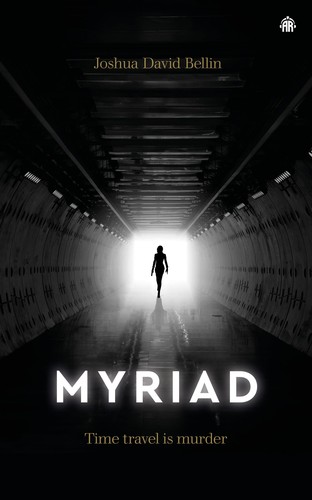
Myriad
Angry Robot Books · 2023 · 328 pages
ISBN: 9781915202468
Review Editor
Marcus Webb
Miriam Randle has a job that most people would consider science fiction. She works as a “travel agent” for LifeTime, a private law enforcement company that sends its agents back in time to prevent murders before they happen. For Miriam, the job is personal: when she was six years old, she watched her twin brother Jeremy get murdered, and no one ever caught who did it. Twenty years later, she thinks of herself as Myriad, a name she gave herself to acknowledge all the fractured versions of herself scattered across the timelines she has visited. She is a woman built from loss, operating at the intersection of grief and purpose.
Joshua David Bellin published Myriad in May 2023 through Angry Robot Books, his first novel aimed at adult readers after a career in young adult science fiction with the Survival Colony series. The book wears its influences openly: there are shades of Minority Report in its premise, traces of noir in its first-person narration, and the structure of a thriller running underneath everything. Bellin is not trying to hide where he got his ideas. He is trying to do something interesting with them.
The story kicks off when a routine assignment falls apart in ways Miriam cannot explain. A murder she was supposed to prevent happens anyway, and within hours her partner Vax is shot by what appears to be a rogue LifeTime agent. Miriam is left holding the weapon. Her handler, already suspicious of her judgment, fires her seconds before the killer strikes again, which leaves her looking like the prime suspect. She and Vax, wounded but mobile, go on the run into the past in search of whatever conspiracy has upended their lives. And then, twenty years to the day after Jeremy died, his killer resurfaces.
Character Arcs and Development
Miriam is not an easy protagonist to spend 328 pages with, and that is partly the point. She uses humor as a shield, deflects with sarcasm, and makes decisions that read as reckless until you understand what she is carrying. She operates out of a deep conviction that if she had been faster, smarter, more alert the day Jeremy died, she could have saved him. Twenty years of time-traveling law enforcement have not softened that belief; if anything, they have calcified it. She has seen herself fail in too many timelines to trust that success is possible.
What makes her compelling is the way Bellin roots her dysfunction in something recognizable. She does not carry vague literary damage. She has PTSD with specific triggers and specific coping strategies, and the novel treats those with genuine care. When she freezes at critical moments, you understand why. When she picks fights with people trying to help her, you can trace the logic back through her history. The relationship with Vax, her partner, carries real weight because you can see both of them protecting themselves and reaching toward each other at the same time. Bellin gives us a romance that feels earned without being sentimental, built on the particular intimacy of people who have saved each other’s lives in multiple timelines.
The secondary characters are thinner. Vax functions primarily as a mirror for Miriam’s emotional state and as a mechanism for the conspiracy. He has a few good scenes of his own, including a confrontation early in the novel where he tells Miriam that her self-destruction has stopped being interesting, but for the most part he exists in relation to her rather than for himself. The antagonist gets a motivation that makes sense in the final act but feels retrofitted to fit the resolution rather than grown from the beginning. Supporting LifeTime agents blur together. The book belongs to Miriam completely, which is a deliberate choice rather than an oversight, but it does mean the world around her never fully solidifies into something three-dimensional. You get a city, a company, a timeline, and Miriam. The rest is furniture.
Pacing
The first two thirds of Myriad move well. Bellin keeps the chase tight and the revelations arriving at regular intervals, and the time-jumping structure generates genuine momentum. You never quite know exactly when you are in the story: Miriam narrates from multiple points in the timeline simultaneously, and Bellin handles the resulting complexity better than most writers would. The slipstream of past and present keeps you off balance in a way that feels purposeful rather than accidental.
The book slows in the third act as it accumulates the machinery needed to close out its conspiracy plot. Revelations arrive in clusters, and several require characters to explain backstory that would have landed better planted earlier. The book wants to surprise you, but it earns some of those surprises by withholding information rather than by laying breadcrumbs where an attentive reader could find them. Readers who approach Myriad primarily as a thriller may find this frustrating. Readers who come at it as science fiction, more accustomed to retrospective sense-making, will likely find the final payoff satisfying.
Deeper Thematic Exploration
The title carries a double meaning that Bellin unpacks gradually. “Myriad” is what Miriam calls herself because she has lived so many versions of her own past, inhabiting timelines where she made different choices and watching how those choices rippled outward. But it also points toward something the novel takes seriously as a philosophical question: what is identity when self-continuity is negotiable? Miriam is not quite the same person in every timeline she visits. Small differences accumulate. The version of herself that prevented a murder in one year is not the same version that failed to prevent one in another. Which Miriam is the real one?
The novel does not resolve this question, which is the right call. What it does instead is use the question to examine grief in an unusual register. Most stories about loss give their characters the comfort of finality: the person is gone, and you learn to live with that. Myriad denies Miriam this comfort. Jeremy’s death is not a fixed point on her personal timeline. She can go back and watch it happen again and again, and she can visit him alive, and neither option brings relief. The past is accessible but not alterable, at least not in ways that hold. The novel argues, quietly and consistently, that access to loss does not soften it. It just gives you more chances to carry it.
There is also a thread about institutional corruption running through the conspiracy plot. LifeTime has discovered it can profit from controlling information about the past, and the novel is honest about how that kind of power operates. The agents are not cartoonish villains; most of them are people who have rationalized their way into compromised positions step by step. This theme is the least developed in the book, but it gives the thriller mechanics something to press against and keeps the story from collapsing into pure personal drama.
Style and Voice
Bellin writes Myriad in first person, and Miriam’s voice is the book’s clearest strength. It is informal, sardonic, and occasionally very funny in the way people are funny when they are managing pain rather than feeling it directly. The prose does not reach for elegance, and it does not need to: the story moves fast enough that you want clarity over ornamentation, and Bellin provides it. The time-jumps in the narration, which could easily become confusing, stay mostly legible because Miriam’s emotional register shifts noticeably between timelines, and you can often feel when you have landed somewhere new before she tells you.
The dialogue is crisp and the action sequences are well-choreographed. Where the writing gets shakier is in the expository passages of the third act, where characters explain what happened and the voice flattens a little under the weight of information delivery. This reads like a confident first adult novel: it knows what it is trying to do and mostly pulls it off, with the rough edges you would expect from a writer still calibrating to a new readership.
Verdict
Myriad is a solid, energetic science fiction thriller with a protagonist worth following. If you like time travel stories that take their own mechanics seriously, or if you are drawn to fiction that uses genre machinery to reach something true about trauma and survival, this book delivers. Miriam Randle is the kind of protagonist you root for not because she is admirable but because she is real: flawed in ways that make sense, striving in ways that cost her something.
The book is not without frustrations. The conspiracy plot leans on genre conventions more than it should, and the final act asks you to accept some shortcuts in how the mystery resolves. Readers who want their puzzles fairly laid out will feel the solution was rigged. But if you go in knowing this is primarily a character study wearing thriller clothes, and if you let yourself settle into Miriam’s voice early, Myriad earns a recommendation. It is a reminder of what science fiction does best: take an outlandish premise, make it feel lived-in, and use it to say something that could not be said any other way.
Frequently Asked Questions about Myriad
What is Myriad by Joshua David Bellin about?
Myriad follows Miriam Randle, a “travel agent” who works for LifeTime, a private law enforcement agency that sends agents back in time to prevent murders before they happen. When a routine mission goes wrong and she commits a murder she was supposed to avert, Miriam is thrown into a conspiracy that reaches the highest levels of LifeTime. The story is also, at its core, about Miriam’s long grief over her twin brother, who was murdered when she was six years old.
Is Myriad a standalone novel or does it have a sequel?
Myriad is a standalone novel. Joshua David Bellin resolves the central mystery and Miriam’s personal arc within the book, and there is no announced sequel or series continuation as of 2026. The story has a complete beginning, middle, and end, so you do not need to worry about committing to an ongoing series.
What are the main themes in Myriad by Joshua David Bellin?
The central themes are grief and trauma, particularly the way unresolved loss distorts a person’s sense of self and purpose. The novel also explores identity through the lens of time travel, asking what continuity of self means when you can revisit and partially revise your past. A secondary thread examines institutional power and how organizations use information control to protect themselves rather than the people they serve.
How does the time travel work in Myriad and is it confusing?
LifeTime agents make short-term backward jumps to prevent specific crimes before they happen. The system allows changes to the recent past but does not permit large-scale alterations to history. Bellin handles the mechanics clearly enough that the story stays coherent, though the narration does jump between different points on Miriam’s personal timeline, which requires some attention early on. Most readers find it manageable rather than confusing once they settle into the rhythm of the novel.
Is there a movie or TV adaptation of Myriad by Joshua David Bellin?
As of 2026, there is no announced film or television adaptation of Myriad. The book has drawn comparisons to Minority Report and Mission: Impossible for its blend of time travel mechanics and thriller pacing, so fans of those properties are likely to enjoy the novel while they wait to see if an adaptation materializes.
How long is Myriad and is it a difficult read?
Myriad is 328 pages long, published as a paperback by Angry Robot Books. The reading level is accessible rather than demanding: Bellin writes in a fast-paced, first-person voice that moves quickly and does not require specialist knowledge of science fiction. Most readers who enjoy thrillers or crime fiction will find the pacing familiar, even if the time travel element is new territory.
How does Myriad compare to Joshua David Bellin’s other books like the Survival Colony series?
Myriad is Bellin’s first adult novel; his previous work, including the Survival Colony series and Freefall, was aimed at young adult readers. Myriad is notably darker in tone and deals with more explicitly adult themes including PTSD, grief, and institutional corruption. Fans of his YA work will find the same propulsive plotting and character-driven focus, but the emotional register here is heavier and the subject matter more mature.
Should I read Myriad by Joshua David Bellin and is it worth it?
Yes, if you enjoy science fiction thrillers with strong character work at their center. Myriad works best for readers who come to it as a story about Miriam first and a time-travel mystery second. If you need your mysteries fairly-clued and your reveals telegraphed in advance, the third act may frustrate you. But if you are willing to ride alongside a complicated, genuinely affecting protagonist and trust the author to bring things together, this is a rewarding and fast read.
Book Details
- Title
- Myriad
- Author
- Joshua David Bellin
- Publisher
- Angry Robot Books
- Year Published
- 2023
- Pages
- 328
- ISBN
- 9781915202468
- WritersReview Rating
- 3.8 / 5