
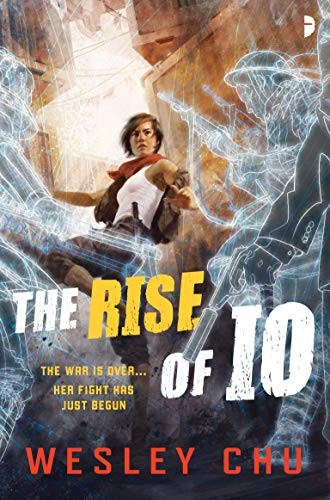
The Rise of Io
Angry Robot · 2016 · 352 pages
ISBN: 9780857665829
Review Editor
Marcus Webb
Wesley Chu’s The Rise of Io arrived in October 2016 as the first book in a new duology set in the same universe as his Tao trilogy, and it came with one of the most appealing premises in recent SF: a habitual loser, both human and alien, thrown together by accident and forced to figure out how to become something better than either of them has managed alone. Chu won the Astounding Award for Best New Writer in 2015, and this book showed exactly why that recognition was warranted. It pulls off a trick that looks easy but isn’t: taking a familiar concept and making it feel wholly original through the force of its characters.
The world Chu has built across both series runs on a distinctive idea. Millions of years ago, an alien ship crashed on Earth. The beings aboard, called the Quasing, found they couldn’t survive in our atmosphere without a host, so they moved inside living creatures. By the time humans came along, the Quasing had been parasitically present through all of recorded history. Some nudged their hosts toward discovery and progress; others toward conquest and ruin. Over the centuries, the Quasing split into two factions. The Prophus want to find a way home without destroying humanity in the process. The Genjix are willing to tear the planet apart if that’s what it takes. The result is a centuries-long cold war fought through human proxies, a secret conflict that shaped everything from the Roman Empire to the Industrial Revolution.
The Rise of Io begins after an open conflict between the factions has ended in a fragile ceasefire, leaving sections of cities designated as demilitarized zones. Ella Patel lives in one of them: Crate Town, a slum in the Indian port city of Surat built from repurposed shipping containers. She’s nineteen, clever, and entirely self-made in the way people become self-made when the world hasn’t offered them much. She steals, she cons, she survives. One night, she witnesses a dying Prophus operative and, through a combination of terrible timing and chance, ends up the involuntary host of Io, a low-ranking Quasing with a spectacular track record of failure. Io has backed more historical losers than any other Quasing alive. She picked the wrong Roman legions, supported the wrong pretenders to the Byzantine throne, and has an almost perfect gift for choosing the side that doesn’t win. Now she’s in Ella’s head, and neither of them is pleased about it.
Character Arcs and Development
Ella Patel is one of the finest SF protagonists to appear in the genre in recent years. Where Chu’s earlier hero, Roen Tan of the Tao series, was a soft, aimless programmer who needed prodding out of his own inertia, Ella arrives on the page already fully operational. She doesn’t need a mentor to tell her she’s capable; she needs a world that will stop treating capability like a problem to be managed. She’s suspicious of authority by instinct and by hard experience, fiercely attached to the people she grew up alongside in Crate Town, and entirely uninterested in an alien civil war that has nothing to do with her. She is also, crucially, funny: sardonic, quick with a comeback, and bracingly free of the awe that usually greets protagonists when they discover their world is more complicated than they thought.
Io is the book’s secret weapon. She doesn’t arrive as the confident mentor figure that Tao was for Roen. She is insecure, prickly, and genuinely uncertain whether she’s capable of making the right call after so many centuries of making the wrong one. When she lectures Ella on tactics and history, she does it with the defensiveness of someone who knows her credentials are weak. The friction between them is the engine of the entire novel: two beings who don’t trust each other, who snipe at each other across the interior of Ella’s own skull, and who slowly, grudgingly, begin to recognize what the other is actually worth. Watching Io’s facade crack and something like protectiveness emerge in her is one of the quiet pleasures of the book.
The secondary cast is thinner. Nabin and Wuxa, the Prophus operatives assigned to train Ella, are effective functionally rather than as fully drawn people. Wuxa in particular has a satisfying arc as someone who underestimates Ella early and pays for it, but the book doesn’t linger long enough with either character to make them memorable beyond their role. The Genjix antagonists serve more as a threat than a presence. This is a book that concentrates its characterization energy on the central pair, and that’s the right choice, even if it means the surrounding cast feels a little sparse.
Pacing
Chu writes action the way a good thriller director frames a chase: short, decisive, forward-moving. The book opens in motion and rarely stops. A fight sequence in a marketplace, a training session that turns dangerous, a covert operation that goes sideways in three consecutive ways: each set piece builds on the tension of the last, and Chu knows how to keep the stakes legible without drowning the reader in logistics.
The middle section, where Ella submits to Prophus training and the investigation into a Genjix project called the Bio Comm Array starts to take shape, is somewhat slower. Chu uses this breathing room well to develop the Ella/Io relationship, but the conspiracy plot stays murky for longer than it should. Readers who need a clear sense of what the enemy is building and why may find themselves a little lost in the operational details. The resolution clarifies things, but the journey to get there asks for some patience. Call it a slow second act rather than a failed one; the book recovers fully by the final third.
Deeper Thematic Exploration
The Rise of Io is, at its core, about whose knowledge counts. The Prophus treat Ella as a problem to be managed. She doesn’t have the training, the discipline, or the ideological commitment they expect from an operative. What she has is something the trained operatives lack entirely: an intimate understanding of how people in desperate situations actually behave, how an economy built on scarcity shapes every decision, and how to move through a world that has never offered her any safety net. The narrative spends much of its energy arguing that this knowledge is not lesser than tactical training. It is different, and in Crate Town, it’s more useful.
Chu has also built a world where the Genjix have historically favored hosts from positions of power: generals, emperors, industrialists, financiers. The Prophus have done much the same. Io arriving in Ella’s body represents a rupture in that pattern, and the book takes quiet pleasure in the discomfort this causes. A being who spent centuries attaching herself to rulers and scholars now inhabits a teenage street thief. The Prophus hierarchy doesn’t quite know what to do with this. Their uncertainty reflects something Chu seems genuinely interested in examining: the assumption, built so deep it goes unexamined, that power and credibility belong to the same kinds of people.
There is also a sharper, less comfortable theme running through the book around consent and autonomy. Ella never agreed to have Io inside her consciousness. Her resistance to Io’s guidance in the early chapters isn’t stubbornness or stupidity; it’s the entirely reasonable reaction of a person whose interior life has been invaded without her permission. The book doesn’t resolve this tension so much as live inside it. Ella’s insistence on making her own choices, even as she comes to value Io’s tactical expertise, is a consistent argument throughout the novel: access to someone’s mind doesn’t mean ownership of their decisions.
Finally, the Surat setting carries more weight than simple exotic backdrop. Crate Town, and Ella’s attachment to it, give the book a social texture that pure action SF often lacks. Her people are not props in her story. She cares about them specifically: individual faces, specific histories. When the Prophus ask her to leave them behind for the greater mission, the conflict is genuine because Chu has taken the time to make the community real.
Style and Voice
The book stays tight to Ella’s perspective throughout, which is the right structural choice and the source of much of its energy. Her voice is sardonic, alert, and quicker to act than to explain. The internal exchanges between Ella and Io are the best prose in the book: fast, layered, funny without undercutting the genuine friction between the two. When Io offers historical precedent for a tactical choice and Ella responds with something like a pointed comment about the track record behind that advice, the book earns its laughs without deflating its stakes.
The prose is functional rather than decorative. Chu is interested in momentum, not atmosphere. This suits the genre but does mean the Surat setting feels efficient rather than immersive at times. A reader who wants to inhabit the sensory texture of a port city slum will need to supply some of that themselves. The trade-off is a narrative that never stalls or lingers when it should be moving, which is the right bargain for this kind of book.
Verdict
If you enjoy science fiction that prioritizes character dynamics and kinetic plotting, The Rise of Io is exactly the book for you. Ella Patel is the kind of protagonist the genre produces rarely and should produce more often: competent on her own terms, funny without being cute about it, and genuinely changed by events without losing what made her compelling to begin with. The Ella/Io relationship is strong enough to carry the whole structure, even when the conspiracy plot around the Bio Comm Array gets murky. Readers who came for the Tao series will find this an excellent expansion of a world they already love. Readers arriving fresh will find a complete and satisfying story with no required prerequisites.
It’s not a book with lofty literary ambitions, and it doesn’t pretend to be. What it does, it does with real skill: it creates an odd couple worth spending time with, puts them in genuine danger, and resolves things in a way that feels earned. The sequel, The Fall of Io, is worth following immediately. You’ll want to know what happens next to both of them.
Frequently Asked Questions about The Rise of Io
What is The Rise of Io by Wesley Chu about?
The Rise of Io follows Ella Patel, a street-smart con artist living in a slum in Surat, India, who accidentally becomes the host of Io, a low-ranking alien consciousness called a Quasing. Io has spent centuries making poor decisions and backing the wrong side in an ancient alien civil war. Together, a reluctant Ella and the insecure Io must investigate a dangerous enemy plot while learning whether they can actually trust each other.
Do I need to read the Tao series before reading The Rise of Io?
No prior reading is required. The Rise of Io is set in the same universe as Wesley Chu’s Tao trilogy (The Lives of Tao, The Deaths of Tao, The Rebirths of Tao) but follows entirely new characters and tells a self-contained story. Readers familiar with the Tao books will enjoy spotting references and returning characters, but newcomers will find everything they need within this novel.
What are the main themes in The Rise of Io?
The book explores class and social inequality, examining whose knowledge and expertise the world chooses to recognize. It also deals with autonomy and consent through the unsettling premise of an alien inhabiting a host’s mind without permission. A third thread runs through the relationship between Ella and Io: two underestimated beings learning to trust each other, and what it costs to ask for help from someone you resent needing.
How long is The Rise of Io and is it a difficult read?
The novel is 352 pages and reads quickly. Chu writes fast-paced action scenes and tight dialogue, and the book moves at a thriller’s pace throughout. It’s accessible to readers without deep SF background knowledge; the alien world-building is delivered through context and banter rather than extended exposition. Most readers will find it a smooth, rapid read rather than a demanding one.
Is there a sequel to The Rise of Io?
Yes. The Fall of Io, published in 2019 by Angry Robot, is the second and final book in the Io duology. It continues Ella and Io’s story as the conflict with the Genjix escalates. Both books together form a complete narrative, and readers who finish The Rise of Io will want to follow it immediately with the sequel.
Is there a movie or TV adaptation of The Rise of Io?
As of this writing, no film or television adaptation of The Rise of Io has been produced. Given the book’s cinematic pacing and what several reviewers have described as a summer-blockbuster energy, it has drawn frequent comparisons to existing action properties, but no official adaptation project has been announced.
How does The Rise of Io compare to Wesley Chu’s Tao series?
Many readers consider The Rise of Io to be Chu’s strongest character work. The Tao trilogy follows Roen Tan, an ordinary man gradually shaped into a competent operative, while this book opens with a protagonist who is already highly capable on her own terms. Ella Patel is more immediately engaging than Roen, and the Ella/Io dynamic has more friction and humor than the Roen/Tao relationship. Fans of the Tao books tend to rate this at least as highly, and some prefer it.
Should I read The Rise of Io, and who is it best suited for?
If you enjoy action-driven SF with strong central relationships, social texture, and sharp dialogue, this book is worth your time. It suits readers who love the work of John Scalzi or James S.A. Corey: fast, smart, character-focused genre fiction with real stakes. Readers who prefer slower, more atmospheric SF, or who want deep literary introspection, may find it slight. For its target audience, it delivers exactly what it promises and delivers it well.
Book Details
- Title
- The Rise of Io
- Author
- Wesley Chu
- Genre
- Science Fiction
- Publisher
- Angry Robot
- Year Published
- 2016
- Pages
- 352
- ISBN
- 9780857665829
- WritersReview Rating
- 4.0 / 5