
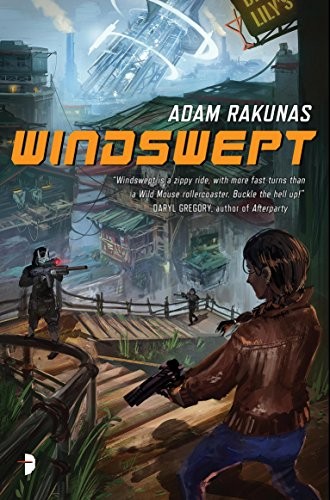
Windswept
Angry Robot · 2015 · 399 pages
ISBN: 9780857664785
Review Editor
Marcus Webb
What happens when you take a union organizer, drop her on a distant planet smelling of fermented sugarcane, and then tell her she has a matter of hours to find a shuttle full of missing workers before her corporate enemies close the curtain on everything she has built? You get Windswept, the debut novel by Adam Rakunas, published by Angry Robot in 2015. It is a book that manages to be simultaneously a labor-rights manifesto, a planetary mystery, and a sharply comic romp through one of science fiction’s more inventively imagined worlds.
Padmavati “Padma” Mehta is a union organizer on Santee, a backwater colony planet whose entire economy revolves around cane sugar production and the distillation of rum. The planet has exactly one thing going for it: it is one of the few places in the settled galaxy where workers have some leverage against the Big Three, the megacorporations that control most of human civilization through indenture contracts. Padma works for the Santee Unionistas, signing up workers who have breached their indenture contracts and fled corporate control. Every new recruit earns her a bounty and moves her closer to her real dream: retiring and running a small rum distillery of her own.
When a shuttle full of potential recruits crashes on arrival, Padma finds herself scrambling to locate the survivors before the corporations do. At the same time, someone is systematically sabotaging rum batches across the planet, threatening the livelihoods of every distiller on Santee. As these two crises collide, Padma realizes they are connected, and that the conspiracy runs far deeper than anyone imagined. Rakunas described the novel in interviews as a “David and Goliath” story with rum at the center, and Publishers Weekly agreed, calling it “wildly fun” and “frequently funny” in its September 2015 review.
Character Arcs and Development
Padma is the kind of protagonist you spend the entire book rooting for partly because she is good at her job and partly because she keeps making things harder for herself. She cares about the people she is supposed to be recruiting in ways that go well beyond her quota obligations, and that care keeps pulling her into situations she has no business being in. The novel opens with her already behind schedule, already juggling more competing obligations than any sensible person would accept, and already compromising her better judgment in ways that will cause problems later. Her arc is not a transformation from flawed to perfect but something more interesting: a gradual discovery of what she actually values when everything she thought she was working toward gets stripped away.
Her history as a former corporate employee gives her real texture. Padma once worked inside the same system she now fights against, and that background shapes how she negotiates with corporate representatives, how she second-guesses her own instincts, and how she looks at people still trapped inside indenture contracts. The novel handles this without collapsing into constant self-recrimination, which would exhaust the reader quickly. Instead, her corporate past functions as a lens: she understands how the machine thinks, which makes her better at fighting it, but also gives her moments of uncomfortable recognition that complicate her moral confidence.
The supporting cast is thinner than Padma deserves. Her coworkers, fellow unionistas, and various allies are present and functional, but few of them develop much beyond their roles in the plot. The antagonists are vivid enough to be entertaining without being especially nuanced. This is one of the novel’s genuine weaknesses: the world Rakunas has built is detailed enough to support more complex secondary characters, and the book would be richer for them. But the plot’s pace rarely lets anyone other than Padma draw a full breath.
Pacing
Windswept moves fast. The first third of the novel barely stops, which is both its strength and the setup for a minor problem. The breakneck opening keeps you reading eagerly, but when the plot enters its more complicated middle section and needs some exposition to untangle the conspiracy’s layers, the gears grind slightly. Not badly, and Rakunas recovers well, but there are stretches where the book feels like it is doing administrative work rather than building tension. The final act snaps back into motion and delivers a satisfying conclusion, but readers who want absolutely consistent momentum from first page to last should expect a brief dip in the middle third.
That said, the pacing issue is partly a symptom of ambition. Rakunas is juggling multiple plot threads at once, and most of them land cleanly. A slower book might have smoothed out those middle stretches but also lost the density that makes Santee feel like a real place with genuine stakes. The novel’s energy is earned rather than manufactured.
Deeper Thematic Exploration
The labor politics in Windswept are not background flavor. They are the architecture. Rakunas understands that union organizing is not just about wages and working conditions but about power: who gets to define what a fair deal looks like, who controls the terms of negotiation, and how difficult it is to fight a system you once trusted. Padma’s work is rendered with specificity that suggests the author has read his labor history. The quotas, the bureaucratic obstruction, the way corporate representatives talk about fairness while structuring every agreement to extract maximum value from the people they claim to serve: all of it feels observed rather than invented.
But the book is careful not to make the Santee Unionistas into uncomplicated heroes. The union has its own internal politics, its own turf disputes, and its own susceptibility to corruption. The conspiracy at the novel’s center involves people on both sides of the labor-management divide making choices that are understandable but ultimately damaging. This moral complexity is what elevates Windswept above a simple us-versus-them narrative. The Big Three are not cartoonishly evil. They are bureaucratic and indifferent and structurally harmful in ways that are far more plausible than villainy.
At its deepest level, the novel is about what you owe the community that gave you a second chance. Padma left the corporate world and the people of Santee took her in. Now, when the planet is threatened, the question the book keeps pressing is whether she will treat that community as a means to her own retirement or as something worth fighting for on its own terms. The rum distillery she dreams of running is not merely a symbol of personal freedom. It is Rakunas’s way of asking what it means to put down roots, to become genuinely responsible for a place and the people in it, rather than simply passing through.
Style and Voice
Rakunas writes in first-person present tense, a risky choice that mostly pays off. The immediacy keeps the urgency high, and Padma’s voice is one of the book’s genuine pleasures: dry, quick, self-deprecating, with a wit that lands more consistently than in most debut SF novels. The humor is woven into the fabric of the world rather than bolted on as relief from tension, which is harder than it sounds. Lines about the byzantine politics of rum licensing or the particular style of corporate obstruction carry a practiced ease that suggests Rakunas has been sitting with these jokes for a long time before setting them on paper.
The prose is not showy, but it does not need to be. Santee comes through in concrete details: the smell of fermented cane, the politics of distillery permits, the social texture of a small colony where everyone knows everyone’s arrangement. When the novel wants to be funny, it is funny. When it wants to be tense, the writing gets leaner and more direct. That flexibility is the mark of a writer with real instincts, even if this is only his first book.
Verdict
If you like your science fiction with political texture, sharp humor, and a protagonist who solves problems through organization and stubbornness rather than weapons or special abilities, Windswept deserves a place on your reading list. It is not a flawless novel: the secondary cast remains thin, and the middle section loses some of the opening energy. But Rakunas has built something genuinely original here, a planet you believe in and a conflict that feels grounded in how labor and capital actually function, not just in science-fictional abstraction. A sequel, Like a Boss, followed in 2016, so if Santee hooks you, there is more to read.
Readers who prefer plot-forward thrillers or who want consistent momentum throughout may find themselves impatient in the middle. But if you have ever wanted a science fiction novel that takes the actual mechanics of collective action seriously, that makes union organizing feel as urgent as any planetary threat, Windswept is the book you did not know existed. You might go looking for rum afterward.
Frequently Asked Questions about Windswept
What is Windswept by Adam Rakunas about?
Windswept follows Padma Mehta, a union organizer on the colony planet Santee, a world whose economy depends on sugarcane and rum production. When a shuttle carrying potential union recruits crashes on arrival, Padma races to find the survivors before the megacorporations that control most of human civilization get to them first. The investigation reveals a deeper conspiracy threatening the entire planet.
Is Windswept part of a series?
Yes. Windswept is the first book in a two-novel series. The sequel, Like a Boss, was published in 2016, also by Angry Robot. Both books follow Padma Mehta on Santee and can be read in order without needing any prior knowledge of the series.
What are the main themes in Windswept?
The novel’s central themes are labor rights and corporate power, community and belonging, and the cost of genuine commitment to a place and its people. Rakunas also explores identity, specifically how Padma’s past as a corporate employee complicates her role as a union organizer. Running through everything is a strand about what it means to fight for something larger than your own interests.
How long is Windswept and is it a difficult read?
Windswept is approximately 399 pages, a brisk length for a science fiction novel. The writing is accessible and fast-paced, written in first-person present tense, so it reads quickly. The labor politics are substantive but never dry or academic. Most readers will find it an easy and engaging read, even if some science fiction terminology requires brief adjustment early on.
Is there a movie or TV adaptation of Windswept?
As of 2026, there is no announced film or television adaptation of Windswept or the Padma Mehta series. The novel’s mix of labor politics, planetary world-building, and sharp comedy would translate well to screen, but no production has been confirmed.
What kind of reader will most enjoy Windswept?
The novel is ideal for readers who enjoy character-driven science fiction with political and economic themes, fans of authors like Charles Stross or Mur Lafferty, and anyone who appreciates SF that takes labor and class seriously. Readers who enjoy debut novels with a distinctive voice and a willingness to be funny will find plenty to like here.
How does Windswept compare to other science fiction labor novels?
Windswept occupies a fairly rare niche: literary SF that centers working-class characters and union organizing rather than treating labor as backdrop. It shares some DNA with Kim Stanley Robinson’s Mars trilogy in its interest in economic structures, but Rakunas’s novel is faster, funnier, and deliberately less epic in scope. The closest single comparison might be Mur Lafferty’s Station Eleven-adjacent work or the grittier end of the Angry Robot catalog.
Should I read Windswept?
Yes, particularly if you want science fiction that is doing something different. Windswept is a confident debut with a protagonist worth spending time with, a world that rewards attention, and a political argument that does not feel preachy because it is embedded in genuine plot and character. Its weaknesses, thin secondary characters and a slight midpoint sag, are real but do not undermine what makes the book work. If the premise of a rum-soaked union organizer in space sounds interesting to you, trust that instinct.
Book Details
- Title
- Windswept
- Author
- Adam Rakunas
- Genre
- Science Fiction
- Publisher
- Angry Robot
- Year Published
- 2015
- Pages
- 399
- ISBN
- 9780857664785
- WritersReview Rating
- 3.8 / 5