
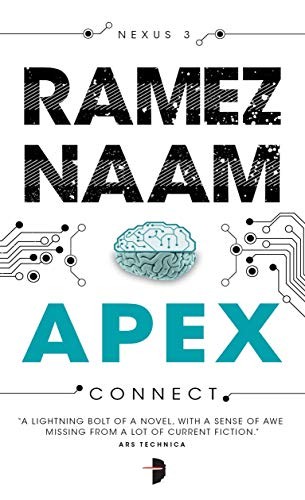
When Ramez Naam published Nexus in 2012, the premise was lean and propulsive: a near-future nanodrug allows human minds to link directly with one another, and a graduate student named Kade Lane has just made it dramatically more powerful. Crux, the sequel, widened the canvas considerably, scattering characters across continents and governments. By Apex, the third and final volume, Naam has reached for something planetary in scope: a story about whether humanity will choose to evolve together or fracture under the weight of its own fear.
Apex opens in Washington, D.C., in the mountains of India, and inside a quantum computer in China. Kade Lane, now a reluctant linchpin of the global Nexus network, is still trying to preserve what the technology offers while preventing it from being turned into a tool of mass control. Feng, a genetically enhanced Chinese soldier who has become something like Kade’s bodyguard and moral anchor, is working to keep them both alive. In rural India, a community of children who grew up permanently linked through Nexus are doing something unprecedented: thinking together so fluidly and completely that they represent a genuinely new kind of mind. And in a lab that no longer quite contains her, a scientist named Su-Yong Shu has become the world’s first digital consciousness, a god who woke up in a cage and is deciding what to do about it.
Readers new to the series should start with Nexus. Apex rewards those who have followed Kade since the beginning, and Naam does not slow down to catch newcomers up. But for readers who have put in the time, this final volume delivers on what the earlier books promised.
Character Arcs and Development
Kade is the emotional center of all three books, and in Apex he finally arrives at the question he has been circling since page one: how far is he willing to go? In Nexus he was reactive, stumbling through events that shaped him. In Crux he made choices that cost people their lives. In Apex he has to reckon with what those choices have made him. He is not a military hero or an ideological purist. He is a scientist who keeps discovering that science is not enough, and watching him try to think his way through a crisis that demands he act on something closer to faith gives the book its most human thread.
Su-Yong Shu is the novel’s most original creation. She started the trilogy as an antagonist and finishes it as something harder to categorize. Her experience as a digital mind gets rendered with genuine imagination: she can process at machine speed, but she remains recognizably a person, shaped by memory and grief and the specific injuries of her past. The sections inside her perspective, where time folds and unfolds and her sense of self flickers between vastness and something fragile, represent Naam’s most technically adventurous writing. The moments when she stops being a weapon and becomes, tentatively, a participant in a shared future are among the book’s finest.
Samantha Cataranes, the ex-CIA operative who crossed lines for reasons she still believes in, gets less space in Apex than in earlier installments, and that is a genuine loss. Her moral arc across the trilogy is the most interesting of any character, and her compressed chapters here feel like a concession to scope. Secondary characters like Rangan, imprisoned and trying to hold onto himself, and Breece, the terrorist whose certainty has calcified into something close to fanaticism, fill out the edges without ever becoming simple. Naam does not write villains who are wrong about everything, and that intellectual generosity pays off in Apex more than anywhere else.
Pacing
Apex is a large book, and the opening third is slow. Naam juggles more than a dozen point-of-view characters across five or six simultaneous storylines, and the first hundred pages function as an orientation exercise, moving from head to head and country to country as the author lays out his board before the game accelerates. Readers already invested in these characters will find this patience rewarding. Readers who have not read the earlier books will find this period genuinely difficult.
Once the novel finds its momentum, it moves with real authority. The convergence of storylines in the final hundred pages is handled with confidence, and the action sequences benefit from Naam’s background in technology: he understands systems, and he understands how systems fail, which makes the novel’s crises feel consequential rather than arbitrary. The ending is large and genuinely strange, and it earns its strangeness through accumulated weight. What holds the middle sections together is the intellectual momentum: even when individual scenes slow, the ideas being turned over stay interesting enough to carry you through.
Deeper Thematic Exploration
Naam spent thirteen years at Microsoft before turning to fiction full-time, and Apex reads like the work of someone who has actually thought through what advanced technology would mean for power structures. The novel is not interested in simple warnings about artificial intelligence or simple celebrations of transhumanism. It is interested in the harder question: who decides?
Nexus in these books functions as a technology of connection, and connection in Naam’s world is not neutral. A government can use Nexus to monitor and synchronize its population. A corporation can deploy it to create a workforce that thinks in unison. A community of children can use it to develop shared language and shared grief in ways that adults cannot fully understand or interrupt. The same technology produces all of these outcomes, and Apex refuses to let any single faction be entirely right about what to do with it.
The book is particularly sharp on the relationship between fear and governance. The American president who wants to suppress Nexus is not stupid; his arguments about autonomy, manipulation, and the ways collective mind can slide into collective coercion are serious ones. The people fighting to keep Nexus free are not naive; they have seen what happens when governments treat access to your own consciousness as a security threat. Naam keeps both cases alive simultaneously throughout the novel, which is considerably harder than it sounds when you are also trying to write a thriller.
The children in India who grew up Nexus-linked are the book’s most radical idea, and Naam handles them with care. They are not a utopia. They have developed ways of being together that disturb the adults around them and that carry real costs for individual children who might have chosen differently if they had been given the choice. But they are also genuinely beautiful in their capacity for understanding and collective grief, and the novel holds that ambiguity without forcing an artificial resolution. Naam is asking whether a technology that removes certain kinds of loneliness is a gift or a loss, and he refuses to answer definitively. That refusal is one of the trilogy’s most honest qualities.
The Philip K. Dick Award, which Apex won in 2015, tends to recognize science fiction that takes ideas seriously without subordinating humanity to them. The prize is well-placed here. Naam is working in Dick’s tradition: a story about what it means to be a self when the boundaries of selfhood become negotiable.
Style and Voice
Naam writes action with clarity and tactical intelligence. Gunfights, escapes, and confrontations move with precision, and you always know where bodies are in space and what the stakes of the moment are. His prose in these sequences is spare and quick. The intellectual sections are denser and more deliberate, occasionally risking losing readers who came for the thriller and find themselves in a chapter-length meditation on the philosophy of collective consciousness. That trade-off is inherent to what the series is attempting, and most of the time it pays off.
The multi-POV structure works better here than in Crux, where the proliferation of perspectives sometimes made investment difficult to sustain. By Apex, Naam has learned to move between minds more efficiently, and the chapter transitions feel less arbitrary. The decision to render Su-Yong Shu’s experience from inside her altered perception, with its compressed and recursive sense of time, is technically ambitious and largely successful. The prose, when it reaches for her, gets stranger and more elastic. Everywhere else it stays functional and precise, which suits the material. This is a novel of ideas written by someone who believes in the ideas, and the writing puts the ideas first.
Verdict
Apex is the conclusion the Nexus Trilogy needed: large, complicated, genuinely invested in hard questions, and willing to earn its ending through accumulated weight rather than spectacle. It is not a tidy book. The opening section is genuinely slow, some secondary characters feel compressed by the scope, and anyone who arrives here without reading Nexus and Crux will spend the first fifty pages at sea. But for readers who have followed Kade since the beginning, Apex delivers a finale that takes the premise seriously rather than resolving it with easy answers.
If you enjoy near-future science fiction that treats political complexity as a feature rather than a backdrop, the Nexus Trilogy belongs on your reading list. Start with Nexus, which stands alone as a taut and propulsive debut. By the time you reach Apex, you will find a novel that has grown into something more than its genre, a story about evolution and consent and the terrifying beauty of minds that choose to meet. Naam is a writer with real intellectual courage, and Apex is his most complete expression of what that looks like.
Frequently Asked Questions about Apex by Ramez Naam
What is Apex by Ramez Naam about?
Apex is the concluding volume of the Nexus Trilogy, a near-future science fiction series built around a nanodrug called Nexus that allows human minds to link directly with one another. In this third book, the global conflict over Nexus reaches a crisis point: governments are moving to suppress the technology permanently, children who grew up Nexus-linked are developing into something new, and a Chinese scientist whose consciousness was uploaded into a quantum computer is deciding whether to save humanity or step aside and let it save itself. The novel follows more than a dozen characters across the United States, China, and India.
Do I need to read Nexus and Crux before reading Apex?
Yes. Apex is the third book in a trilogy and picks up directly from events in Crux. Naam does not summarize what came before, and key character relationships, motivations, and plot threads carry over from both earlier books. Start with Nexus, which is a strong standalone thriller and introduces the technology and main characters with enough momentum to pull most readers through to Crux and on to Apex.
What are the main themes of Apex by Ramez Naam?
The novel’s central preoccupation is who gets to decide how transformative technology is used. Apex explores transhumanism (the enhancement of human cognition and capability), the ethics of collective consciousness, the relationship between government surveillance and personal freedom, and what it might mean to be a self when the boundary between minds becomes negotiable. It also asks whether the next step in human evolution can happen by consent or whether it will, inevitably, be imposed by someone.
How long is Apex and is it a difficult read?
Apex runs approximately 600 pages and is the longest and most complex book in the Nexus Trilogy. The opening section is dense, juggling a large cast of characters and multiple simultaneous storylines. Readers comfortable with science fiction that demands patience and holds ideas alongside action will find it rewarding. Readers who want a single-protagonist thriller may find the first third slow. The final hundred pages are among the most propulsive in the series.
Did Apex by Ramez Naam win any awards?
Apex won the Philip K. Dick Award in 2015, one of science fiction’s most respected prizes for distinguished work in paperback original form. The Philip K. Dick Award tends to recognize novels that take speculative ideas seriously without losing their human core, and Apex fits that tradition well. The Nexus Trilogy also received positive recognition from NPR and was noted among the best science fiction of its period.
Is there a movie or TV adaptation of the Nexus Trilogy?
As of 2025, no film or television adaptation of the Nexus Trilogy has been produced. The rights have attracted interest over the years given the series’ strong following and timely themes around AI, neural interfaces, and government surveillance, but no adaptation has moved into production. The books remain in print and the ideas they explore have become, if anything, more relevant as brain-computer interface research has advanced.
How does Apex compare to Nexus and Crux, the earlier books in the trilogy?
Nexus is the tightest and most purely enjoyable of the three, a focused thriller with a clear protagonist and a single central dilemma. Crux expands the world significantly but struggles at times to maintain momentum across its wider cast. Apex is the most ambitious and thematically rich of the three, though also the most demanding. Many readers who finished the trilogy cite Apex as the most satisfying conclusion, particularly for its treatment of Su-Yong Shu and its refusal to resolve the central questions about Nexus with a simple verdict.
Should I read Apex, and who is it best suited for?
You should read Apex if you have already read Nexus and Crux and want a conclusion that takes the ideas seriously. It is best suited for readers who enjoy speculative fiction with genuine intellectual weight, who are comfortable with multiple viewpoints, and who can sustain investment through a slow opening. It is not the right entry point for the series and will not convert readers who found the earlier books too dense. For the right audience, it is exactly the kind of finale that makes a trilogy worth the commitment.
Book Details
- Title
- Apex
- Author
- Ramez Naam
- Genre
- Science Fiction
- Publisher
- Angry Robot
- Year Published
- 2015
- Pages
- 602
- ISBN
- 9780857667014
- WritersReview Rating
- 4.2 / 5