
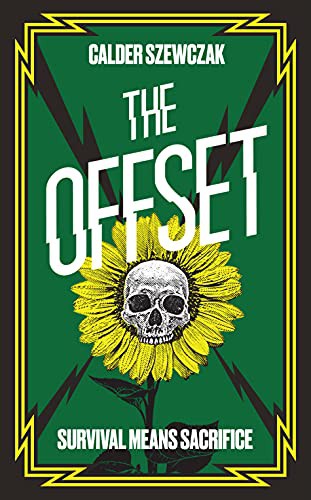
The Offset
Angry Robot · 2021 · 232 pages
ISBN: 9780857669155
Review Editor
Marcus Webb
Calder Szewczak is the pen name of writing duo Natasha C. Calder and Emma Szewczak, who met while studying at Cambridge. Their debut novel, The Offset, arrived from Angry Robot in September 2021 with a premise that hits like a slap: in a near-future world wrecked by environmental collapse, a policy called the Offset mandates that for every birth, one parent must be executed. The child chooses which parent dies. On their eighteenth birthday.
The story splits between two perspectives. Miri, approaching her eighteenth birthday, has been living as a runaway for years, rejecting the world her parents brought her into. She is a committed anti-natalist who believes that having children on a dying planet is a moral crime. When authorities drag her back home, she must face the impossible choice between her two mothers: Professor Jac Boltanski, a scientist leading Project Salix (a last-ditch effort to reforest radioactive Greenland with genetically modified willow trees), and Alix, a medic who raised Miri with tenderness and who Miri actually loves.
In a parallel narrative, Jac travels to a remote research site to investigate discrepancies in her data. Someone may have sabotaged Project Salix, and with potentially only days left to live, Jac needs to know whether her life’s work amounts to anything. The two storylines run separately, converging only in Miri’s memories and in the reader’s growing awareness of what this family has cost each of its members.
Character Arcs and Development
Miri is not the sulky teenager you might expect from this premise. She ran away from home well before the novel begins, building survival skills, street knowledge, and a mature philosophical framework for her anti-natalism along the way. She did not pick up this belief as adolescent rebellion; she arrived at it through genuine intellectual engagement with the state of the world. This makes her more interesting than a character who simply resents her parents for having her. Miri resents them, certainly, but she has reasoned her way to that resentment, and the novel respects the logic even as it shows how logic alone cannot resolve a question this intimate.
Jac is the more difficult character to write sympathetically, and Szewczak handles her with care. She has built her entire identity around saving the world, and that mission has consumed the space where family relationships might have lived. She is not cruel. She is simply elsewhere, always turned toward the larger problem, and the novel captures how that kind of intellectual devotion registers as abandonment to the people left behind. Jac’s sections are quieter, more inward, and the mystery of the sabotaged data gives her storyline a propulsive quality that counterbalances the emotional weight of Miri’s chapters.
Alix appears primarily through Miri’s memories and through the gaps in the story. She is the parent who was present, the one who did the daily work of care, and her position in the Offset ceremony is the novel’s cruelest irony: the parent who loved best is also the one most likely to be spared by a daughter who cannot separate love from obligation. Szewczak keeps Alix deliberately elusive, allowing the reader to construct her from the fragments Miri carries. This approach gives Alix an emotional weight that a more fully dramatized character might not achieve. You feel her absence the way Miri does, which is the point.
Pacing
At around 232 pages, The Offset moves with purpose. Szewczak alternates between Miri’s and Jac’s perspectives at a rhythm that builds tension without ever feeling mechanical. The worldbuilding arrives in layers rather than exposition dumps, and you piece together the state of this ruined planet through details: the humidity, the failed crops, the casual presence of radiation in everyday life. Some readers will find the scientific passages in Jac’s sections occasionally dense, particularly the material about Project Salix and genetic modification. These sections are brief, though, and they serve the narrative rather than stalling it.
The novel earns its ending. The final pages land with force precisely because Szewczak has built toward them without tipping the story’s hand. If you read closely, you can feel the machinery working, but the emotional impact survives that awareness. The structural control here is striking for a debut. The authors keep the two narratives separate so that the reader knows things the characters do not, and that dramatic irony tightens with every chapter until the conclusion, which several reviewers have described as a mic drop. It is not a comfortable landing, but it is the right one.
Deeper Thematic Exploration
Anti-natalism has appeared in fiction before, but The Offset may be the first novel to place it at the absolute center of the story. The philosopher David Benatar, one of the most prominent anti-natalist thinkers, endorsed the book and observed that it shows how “even views aimed at reducing suffering can increase it if fanatics seize control.” That observation captures the novel’s most important insight: the Offset is not presented as simply wrong. It is a policy that begins with a defensible premise (that bringing children into a dying world causes harm) and escalates into something monstrous. The horror is not that someone had the idea. The horror is that the idea worked, politically, because enough people found it reasonable.
Ken MacLeod compared the novel’s treatment of anti-natalism to what Nineteen Eighty-Four did for socialism and Brave New World did for eugenics: showing how an ideology can metastasize when power gets involved. The Offset does not argue against the philosophical position that reproduction on a dying planet is ethically complicated. It argues against handing that complexity over to a bureaucratic system that reduces it to a binary: one lives, one dies. A less careful novel would have made Miri’s anti-natalism a phase she grows out of. This one lets it stand as a genuine position while showing what happens when genuine positions become enforcement mechanisms. The nuance matters.
The climate backdrop is not decoration. The world of The Offset has passed the point of simple recovery, and the novel is honest about what that means for the people living in it. Project Salix, Jac’s attempt to regrow the world through genetically modified willows, is both scientific ambition and a monument to desperation. The question the novel poses through Jac’s storyline is whether saving the species justifies the cost, and the answer it offers is genuinely ambiguous. Neither position wins cleanly, which is the mark of a novel that trusts its readers to sit with uncertainty rather than resolving it for them.
Style and Voice
The prose is spare and controlled, closer to literary fiction than to the genre default for dystopian science fiction. Both writers have academic backgrounds (Natasha graduated from Clarion West 2018; Emma researches contemporary representations of the Holocaust), and that precision serves the material well. The sentences vary in length and rhythm, and the descriptive language evokes the ruined world with specificity rather than spectacle. There is no attempt to make the collapse beautiful. It is dirty, wet, and exhaustingly quotidian, which makes it more convincing than a more dramatic rendering would.
The dual narrative structure works because the two voices feel distinct without being showy about it. Miri’s sections carry more anger and forward motion; Jac’s carry more reflection and quiet dread. The flashbacks to Miri’s childhood unfold with restraint, revealing the family’s fractures through specific, small moments rather than dramatic confrontations. You can feel the ambition running ahead of the technique in a few places, but the ambition is substantial, and the technique catches up more often than it falls short.
Verdict
The Offset is a novel for readers who want their science fiction to sit with uncomfortable questions rather than resolve them. If you are drawn to climate fiction, to philosophical thought experiments with real emotional stakes, or to stories about family that refuse to sentimentalize either love or resentment, this book will stay with you. It is bleak in a way that earns its darkness through specificity and intelligence rather than mere atmosphere.
Readers who need action-driven pacing will find stretches that feel contemplative, and the scientific material in Jac’s sections may test the patience of those who prefer worldbuilding delivered entirely through character. But for anyone who has read The Handmaid’s Tale and wondered what an anti-natalist dystopia would look like, or anyone who has genuinely wrestled with the question of whether having children in this particular historical moment is an act of hope or complicity, you should read this. It will not comfort you. It will make you think harder than you expected, and the ending will follow you out of the book.
Frequently Asked Questions about The Offset
What is The Offset by Calder Szewczak about?
The Offset is a dystopian science fiction novel set in a near-future world devastated by climate change. In this world, a policy called the Offset requires that for every child born, one parent must be executed on the child’s eighteenth birthday, with the child choosing which parent dies. The story follows Miri as she approaches her ceremony and must decide between her two mothers: a famous scientist working to save the planet, and the parent who actually raised her.
Who is Calder Szewczak, and is The Offset based on a true story?
Calder Szewczak is the shared pen name of Natasha C. Calder and Emma Szewczak, who met while studying at Corpus Christi College, Cambridge. The Offset is not based on a true story, but it draws heavily on real-world debates about climate change, population ethics, and anti-natalism. The philosophical framework of the novel is grounded in actual ethical arguments about whether reproduction is morally justifiable on a planet facing environmental collapse.
What are the main themes in The Offset by Calder Szewczak?
The novel explores anti-natalism (the ethical view that humans should refrain from procreating), the consequences of climate change, the tension between individual love and collective survival, and how well-intentioned policies can become instruments of cruelty when enforced by systems of power. It also examines family relationships under extreme pressure, LGBTQ+ parenthood, and the ethics of scientific intervention in environmental crises.
How long is The Offset and is it a difficult read?
The Offset is approximately 232 pages, making it a relatively quick read. The prose is literary but accessible, and most readers can finish it in two or three sittings. Some passages involving genetic science may feel dense, but they are brief. The primary difficulty is emotional rather than intellectual: the subject matter is relentlessly bleak, and the ending is designed to unsettle. Readers who prefer hopeful conclusions should be aware of that going in.
Is there a movie or TV adaptation of The Offset?
As of 2026, there is no movie or TV adaptation of The Offset. The novel’s high-concept premise and contained scope would lend themselves well to a film adaptation, but no production has been announced. The book received positive critical attention from outlets including the Financial Times and SFX Magazine upon its 2021 release.
What age group or reading level is The Offset appropriate for?
The Offset is written for adult readers. While the protagonist is a teenager, the themes (state-sanctioned execution, anti-natalism, environmental despair) and the emotional intensity of the narrative place it firmly in the adult science fiction category. Mature readers aged sixteen and up who are comfortable with dark subject matter could handle it, but it is not a young adult novel. There is no graphic violence or sexual content, but the psychological weight is considerable.
How does The Offset compare to The Handmaid’s Tale and other dystopian novels?
Several reviewers and endorsers have drawn comparisons to The Handmaid’s Tale, noting that while Margaret Atwood’s dystopia is pro-natalist (forcing women to bear children), The Offset flips that premise by creating an anti-natalist dystopia where reproduction is punished. Author Jennifer Saint called it “a twisted reversal of The Handmaid’s Tale.” The novel also shares thematic ground with Never Let Me Go by Kazuo Ishiguro in its quiet, devastating treatment of institutionalized sacrifice.
Should I read The Offset and is it worth it?
If you enjoy thought-provoking science fiction that prioritizes ideas and emotional complexity over action, The Offset is absolutely worth your time. It is particularly recommended for readers interested in climate fiction, ethical philosophy, and stories that refuse easy answers. The writing is precise and the concept is original. If you prefer lighter fare or need your dystopias to offer a clear path toward redemption, this one may feel too heavy. But for readers willing to engage with genuinely difficult questions about parenthood, sacrifice, and survival, it is one of the most distinctive debut novels in recent science fiction.
Book Details
- Title
- The Offset
- Author
- Calder Szewczak
- Genre
- Science Fiction
- Publisher
- Angry Robot
- Year Published
- 2021
- Pages
- 232
- ISBN
- 9780857669155
- WritersReview Rating
- 4.0 / 5