
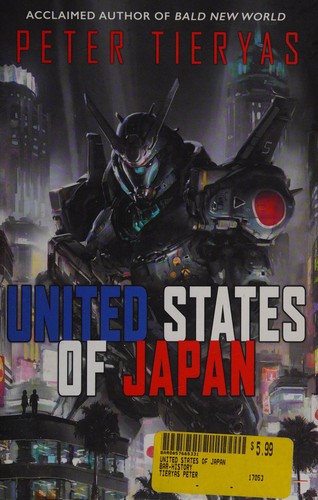
United States of Japan
Angry Robot · 2016 · 398 pages
ISBN: 9780857665331
Review Editor
Marcus Webb
In 1988, the western half of North America belongs to Japan. The war ended differently here: the Japanese Empire and Nazi Germany divided the globe between them, and the territory once called the United States became the United States of Japan, a colonial state where citizens are expected to worship a living Emperor, giant mechas patrol the highways, and dissent gets processed by the Tokko, a secret police force with wide latitude and minimal oversight. Peter Tieryas published this debut science fiction novel in March 2016 through Angry Robot, and it went on to win the 2017 Seiun Award for Best Foreign Novel in Japan, a fitting recognition for a book that reimagines American history through a distinctly non-Western lens.
The novel follows Beniko Ishimura, known as Ben, a video game censor for the Bureau of Defense. His job is to screen games for content that might undermine loyalty to the empire, and he is good at it without being especially interested in it. He is Japanese-American, the child of parents who died in an internment camp, and he has built his adult life on a certain trained incuriosity about the empire’s foundations. That equilibrium breaks when a subversive game begins circulating through the population: a historically impossible game that presents an alternate scenario in which the Allies won the war. The empire treats this as a genuine threat, not primarily because the game organizes resistance but because it demonstrates that history could have gone otherwise. Beniko is paired with Akiko Tsukino, a Tokko agent, to investigate who made the game and why. The investigation pulls them both into something they did not anticipate.
Tieryas has described his inspirations openly: Philip K. Dick’s The Man in the High Castle, Orwell’s Nineteen Eighty-Four, and the work of game designer Hideo Kojima, whose Metal Gear Solid series explores similar territory around propaganda and political memory. These are heavy antecedents, and United States of Japan wears them with enough originality to stand apart. The mechas are not a borrowed aesthetic; they are integral to the empire’s mythology, symbols of technological dominance that also require human pilots, meaning the empire’s most fearsome weapons are still dependent on the bodies and loyalties of people.
Character Arcs and Development
Ben is the novel’s moral center, which means the book is partly about how a person in a totalitarian society learns to function without examining too closely what they are functioning inside. He processes games that incite rebellion while working for the power that would suppress any actual rebellion. He is not a monster; he is not a hero. He is someone who has made peace with his situation in ways that required not looking too hard at certain things. When the investigation forces him to look, what he finds is both specific to this story and recognizable as a pattern in how people navigate complicity.
Akiko Tsukino is the more fascinating creation. She enters the narrative as an almost cartoonishly efficient agent of the state, and Tieryas gradually reveals the history behind her efficiency. She is deeply loyal to the empire and genuinely violent in its service, but that loyalty has been constructed over years inside imperial institutions, not discovered through honest conviction. Tieryas takes the time to show how ideological commitment forms in people shaped by systems from childhood, which is a harder and more honest thing to do than simply presenting zealotry as pathology. Secondary characters, including General Mutsuraga, are drawn with enough specificity to function as real presences rather than backdrop. Mutsuraga in particular has the quality of someone who has convinced himself that his brutality is a form of love for the empire, which is a genuinely disturbing combination to sit with.
Where the characterization falters is in some of the resistance figures, who are given too little space to develop before the plot needs them to matter. A few feel defined primarily by their function in the story rather than by inner life. This is a structural issue as much as a character issue: the novel is trying to sustain both a thriller plot and a more philosophical investigation of identity and loyalty, and the thriller occasionally crowds the other material out.
Pacing
The book opens at a strong clip. The video game setup is immediately engaging because Tieryas knows the medium intimately and writes about games with specificity rather than generic tech-culture signaling. The early scenes in the censor’s office, where Ben processes material designed to keep the population compliant, have a darkly comic efficiency that establishes the world fast. The investigation proper begins around a quarter of the way through and maintains good momentum into the midpoint.
The middle section, where Ben and Akiko move through different corners of the empire’s geography and encounter more of its infrastructure, is where the novel’s pace becomes more variable. Some chapters provide essential worldbuilding that pays dividends later; others feel like Tieryas could not find a reason to cut them. A few mecha battle sequences run longer than necessary, which is a minor complaint given that these scenes are genuinely well-rendered. The final third recovers the pace entirely and delivers on the book’s promises with a clarity that makes the slower middle sections feel worth it in retrospect.
Deeper Thematic Exploration
The subversive game at the heart of the mystery is Tieryas’s most elegant piece of construction. In a totalitarian state, the most dangerous idea is not a call to arms but a demonstration that the current order is not inevitable. The game presents an alternate history because alternate histories prove that history has alternatives. The empire cannot allow this, not because people who play the game will immediately join the resistance, but because the game introduces the possibility of imagining things differently. Once you can imagine it, the official version of reality becomes contestable. This is why governments have suppressed not just opposition movements but also the writers and artists who suggest that the present order is a choice rather than a fact of nature.
The novel also engages seriously with the question of identity under occupation, specifically Japanese-American identity in a Japan-occupied America. Ben occupies an ambiguous position: the empire that now runs the country where he was born is not the same as his own cultural heritage, but the empire makes use of racial categories in ways that put Japanese-Americans in a structurally complicated position relative to other occupied populations. His parents died in a camp, which means his family’s history is inseparable from the history of American internment, and the new empire runs its own camps for its own categories of threat. The machinery of confinement reproduces itself under different flags. Ben’s incuriosity about this is not stupidity; it is a survival strategy that the book eventually asks him to abandon.
Underneath both of these threads is a question about memory and testimony. What happens when the official record is actively falsified, and the people with personal memory of what actually happened are either dead, silenced, or discredited? Tieryas does not offer a tidy answer, but he insists on the question, and the novel arrives at a more definitive position on how individuals can respond to this problem than Philip K. Dick’s famously ambiguous ending managed.
Style and Voice
Tieryas writes with a visual sensibility that reflects his background in animation and film visual effects. He has worked on major studio productions, and that training shows: he builds scenes from the outside in, establishing physical space before filling it with action, which gives even the most kinetic sequences a groundedness that prevents them from becoming abstract. The alternate 1988 Los Angeles is not described exhaustively but described precisely, with enough specific details to feel like somewhere rather than somewhere invented.
The prose has a directness that suits the thriller elements and occasionally undersells the more philosophical passages. Tieryas is better at dramatizing ideas through action than at sustaining reflective interiority, which is partly a genre choice and partly a temperamental one. The novel reads quickly, and readers who want a book to press into the implications of its questions at length will find the pace occasionally frustrating. But Tieryas has a talent for the compressed image that carries weight beyond its few words, and the best moments land with real force precisely because he does not over-explain them.
Verdict
If you want an alternate history that treats its premise as more than a backdrop for adventure, United States of Japan is worth your time. Tieryas is genuinely interested in what it would mean for Japanese-American identity, for political memory, and for the mechanics of totalitarian legitimacy if this particular history had happened. He is not just gesturing at these questions; he builds them into the structure of the plot, which is the harder thing to do.
The novel has real limitations: some supporting characters are underdeveloped, the middle section meanders, and readers who find graphic violence difficult should know that Tieryas does not soften the empire’s cruelties. But the book earns its place in conversation with Dick’s Man in the High Castle not by imitating it but by asking adjacent questions with its own voice and arriving at more definitive conclusions. Science fiction readers who care about the genre’s capacity for political seriousness will find something here that most alternate history novels do not offer. And if you have ever wondered how the Pacific War might have looked from the other side of history, Tieryas makes that question feel genuinely urgent.
Frequently Asked Questions about United States of Japan
What is United States of Japan by Peter Tieryas about?
United States of Japan is an alternate history science fiction novel set in 1988, decades after Japan and Germany won the Second World War. Western America is occupied by the Japanese Empire. A video game censor named Beniko Ishimura and a secret police agent named Akiko Tsukino are assigned to track down the creators of a subversive game that presents an alternate scenario in which the Allies won the war. Their investigation uncovers a conspiracy that forces both characters to confront what they have accepted about the empire they serve. The novel blends thriller plotting with serious questions about propaganda, identity, and political memory.
How does United States of Japan by Peter Tieryas relate to The Man in the High Castle?
Both novels are set in an alternate postwar America occupied by Japan and Germany, and both center on an artifact (a book in Dick’s version, a video game in Tieryas’s) that imagines an alternate history in which the Allies won. Tieryas has acknowledged Philip K. Dick as a direct influence alongside Orwell and Hideo Kojima. The books are in genuine conversation but are not the same: Tieryas’s novel is more conventionally plotted, delivers a cleaner narrative resolution, and foregrounds Japanese-American identity in ways that Dick’s novel does not.
What are the main themes in United States of Japan?
The book explores four closely connected ideas: propaganda and how totalitarian regimes control not just behavior but the categories of imagination available to citizens; identity under occupation, specifically what it means to be Japanese-American in a Japan-occupied America where race is a political category with complicated implications; complicity and how ordinary people in unjust systems maintain their sense of themselves as decent; and political memory, what happens to historical truth in a society that actively falsifies the record and what individuals can do about it.
Is United States of Japan part of a series?
Yes. It is the first book in the Mecha Samurai Empire trilogy. The second book, Mecha Samurai Empire (2018), and the third, Cyber Shogun Revolution (2020), are set in the same alternate universe with different protagonists. Each book functions as a standalone novel, so you do not need to read them in sequence, but they share the world-building and the series becomes richer read in order. The latter two books were published by Ace Books.
How long is United States of Japan and is it a difficult read?
The book is 398 pages. The prose is clear and direct, aimed at a general science fiction readership. Most readers will finish it in four to six hours. The alternate history setting requires some orientation in the early chapters, but Tieryas builds the world through action rather than exposition, so the learning curve is gentle. The violence in some sections is unflinching; readers who find torture scenes and civilian brutality difficult should be aware that the empire’s cruelties are depicted without softening.
Is there a movie or TV adaptation of United States of Japan?
As of 2026, no film or television adaptation of the novel or the Mecha Samurai Empire series exists. The proximity to Amazon’s adaptation of The Man in the High Castle, which ran from 2015 to 2019 and explored similar territory, may have made studios cautious about commissioning a competing project. Tieryas has a background in visual effects work on major studio films, but nothing has been announced for this property specifically.
What does the video game subplot mean in United States of Japan?
The subversive game is Tieryas’s central metaphor for the power of counterfactual thinking in a society that has suppressed alternatives to the official history. The empire fears the game not because playing it will turn citizens into rebels but because it proves that history could have unfolded differently, and therefore the current order is a historical contingency rather than an inevitable outcome. The game subplot is also a vehicle for Tieryas’s genuine affection for the medium and what games can do that other forms of storytelling cannot, particularly their capacity to let a player inhabit an alternate reality directly.
Should I read United States of Japan by Peter Tieryas?
If you want an alternate history that commits more fully to its thriller plot and delivers a clearer ending than The Man in the High Castle, yes. If you are interested in science fiction that takes Japanese-American perspectives seriously and puts political memory at the center of the story, this is one of the few novels in the genre that does. Readers who want their science fiction primarily for spectacle, or who find graphic violence difficult, may find the book frustrating. But if you want your alternate histories to argue something real, Tieryas gives you something worth pushing back on.
Book Details
- Title
- United States of Japan
- Author
- Peter Tieryas
- Genre
- Science Fiction
- Publisher
- Angry Robot
- Year Published
- 2016
- Pages
- 398
- ISBN
- 9780857665331
- WritersReview Rating
- 3.8 / 5