
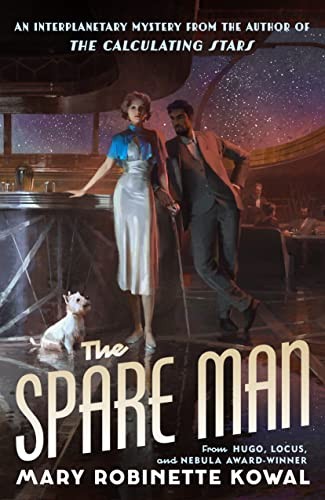
The Spare Man
Tor Books · 2022 · 384 pages
ISBN: 9781250237002
🏆 Hugo Award for Best Novel finalist (2023)
Locus Award for Best Science Fiction Novel finalist (2023)
Review Editor
Marcus Webb
If you have ever watched a screwball comedy where the husband and wife team banter their way through a murder investigation while maintaining perfect cocktail etiquette, you already have the emotional blueprint for The Spare Man. Mary Robinette Kowal’s 2022 novel is a loving, unapologetic tribute to Dashiell Hammett’s The Thin Man, transplanted onto a luxury spacecraft barreling toward Mars. The result is a book that does exactly what it promises and does it well: a cozy mystery with a beating heart, set in a future that feels lived-in without requiring an engineering degree to follow along.
Tesla Crane is the protagonist, and she is immediately someone you want to spend time with. A retired robotics engineer and wealthy heiress, she boards the LCSS Martlet on her honeymoon with her husband, Shal Steward. Tesla is also living with chronic pain and PTSD from a catastrophic accident that killed six of her crew. She walks with a cane. She has a service dog named Gimlet, a small, precisely trained Westie who responds to her physiological stress cues. And she is extraordinarily good at reading a room, which turns out to be the most important skill anyone can have when a body shows up outside your cabin door.
Shal, who spent years as a private investigator, believed this voyage would finally be his chance to rest. That plan dissolves when a woman is found stabbed near their cabin and Shal becomes the ship’s primary suspect. His fingerprints are on the murder weapon. A witness places him at the scene. Tesla knows he is innocent, and so the investigation falls to her. The ship is four days from Earth and weeks from Mars. There is no one coming to help.
Character Arcs and Development
Tesla carries the novel. Kowal refuses to flatten her disability into shorthand or inspiration: the pain is constant, the management requires planning and medication, and there is a running negotiation between what Tesla wants to do and what her body will allow at any given hour. When she investigates, she cannot sprint down corridors or climb things freely. She adapts. She delegates physical tasks to Gimlet or manages her energy carefully through each scene. This is not a character who overcomes her limitations through some climactic act of willpower. She lives with them, and Kowal treats this as the more interesting and more honest choice.
Gimlet is, without qualification, a star of this novel. The service dog is written with real specificity: responding to Tesla’s physiological stress cues, alerting during pain spikes, operating within the legal and social framework that real working dogs navigate. Gimlet is not there for cuteness, though the dog is genuinely charming. Gimlet is a tool Tesla uses to function in the world, and the book treats that with the same seriousness it deserves.
Shal is the more reactive of the two leads, by design. His role is partly to be in trouble and partly to be warm and quietly competent when the plot gives him room. The relationship between Tesla and Shal is the engine of the book: they clearly like each other, they bicker with affection, and they operate as genuine partners rather than adversaries who eventually come around. It is a pleasure to spend time with a married couple who are actually happy. The Thin Man homage lands partly because Kowal understands that what made Nick and Nora work was not the mystery but the marriage.
The secondary characters serve the mystery architecture without becoming people in quite the same way. The ship’s physician, the vessel’s owner, the magician hired for the voyage: they are well-sketched types who do their jobs without quite earning independent lives. This is standard for the cozy mystery form, where plot mechanics tend to take precedence over secondary development, but readers who prize broad ensemble depth should know what they are getting into.
Pacing
This is a quick book, and it earns that speed. Kowal keeps events moving without rushing them. The contained environment of the ship prevents plot sprawl and gives the mystery a ticking quality: there is nowhere to run, and the suspect list is fixed. New developments arrive at well-spaced intervals. Just when you have a handle on the situation, someone else turns up dead or a piece of evidence shifts, and the investigation has to adjust. The cocktail-recipe interludes, where Tesla mixes drinks as a coping mechanism between crises, provide breath without killing momentum.
That said, the book does not quite achieve the taut, coiled tension of the classic mysteries it pays tribute to. The lighter tone is part of the design, but it occasionally tips toward comfort at the expense of genuine suspense. There are moments where the stakes feel lower than they probably should, given that people are dying aboard a sealed spacecraft. Readers who want their mysteries with a hard, cold edge will find this too warm. For readers drawn to the cozier end of the spectrum, it is exactly right.
Deeper Thematic Exploration
Beneath the fizzy surface, The Spare Man is doing something quietly interesting with what it means to be useful. Tesla’s arc is not really about solving a murder. It is about figuring out who she is now, in a body that no longer lets her do what she once did professionally. Her identity was wrapped up in engineering, in building and creating. That avenue closed after the accident. The mystery gives her somewhere to put her intelligence and drive, and the book treats this as a genuine gift: problem-solving is problem-solving, and a sharp mind does not stop being valuable just because circumstances have changed.
Shal’s retirement from detective work carries a related undertone. He walked away from a career that was wearing him down. The ship puts him back in the middle of a case without his consent, and the novel is genuinely interested in whether returning to that world is good or bad for him. The answer, appropriately, is complicated. He is good at it. That does not mean he misses it, or that doing it again costs him nothing.
At its core, the novel is about partnership: two people choosing to work together, using their different strengths, trusting each other when the evidence gets murky. That is a more durable theme than the mystery plot itself, and it is why the book stays with you after the culprit is identified.
Style and Voice
Kowal’s prose is clean and purposeful, with flashes of wit that land without announcing themselves. The close third-person narration stays near Tesla’s perspective, which means you experience the investigation through her specific physical reality. When her pain flares, the narration registers it without becoming maudlin. When she is in the middle of an interrogation and her leg starts giving out, the tension of managing that privately while keeping the conversation moving is handled with real skill.
The voice is lighter than Kowal’s Calculating Stars novels, which carry more sustained emotional and historical weight. The cocktail recipes that punctuate the narrative are a charming structural choice: they reveal character, they give readers a tactile sensory anchor in an unfamiliar setting, and they connect back to the Hammett tribute without feeling forced. The dialogue between Tesla and Shal is the best writing in the book, effortless and warm in a way that suggests two people who have genuinely been paying attention to each other for years.
Verdict
The Spare Man knows exactly what kind of book it wants to be and succeeds at being it. If you are looking for a demanding, labyrinthine mystery with an unreliable narrator and three competing twists, look elsewhere. If you are looking for something that will make you glad people still write novels like this, with wit and warmth and a genuinely thoughtful approach to disability and partnership, you will find a lot to like here. It is the kind of book you finish on a weekend and then press on a friend who has been looking for cozy fiction with something real underneath it.
Readers who loved The Calculating Stars should know this is a different register entirely: lighter, shorter, less interested in sustained emotional weight. But the craft is Kowal’s throughout, and her attention to character is evident in every scene. Tesla Crane is one of the more compelling protagonists to come out of genre fiction in recent years: disabled, capable, funny, and genuinely interesting to be around. You find yourself wanting more time with her.
Frequently Asked Questions about The Spare Man
What is The Spare Man by Mary Robinette Kowal about?
The Spare Man is a science fiction mystery novel set aboard a luxury cruise ship traveling from Earth to Mars. Tesla Crane, a wealthy retired engineer who lives with chronic pain and uses a service dog, must investigate a murder after her husband Shal becomes the prime suspect. The novel is a deliberate homage to Dashiell Hammett’s The Thin Man, with a sharp focus on disability representation and the dynamics of a genuine partnership marriage.
Is The Spare Man related to The Calculating Stars by Mary Robinette Kowal?
No, The Spare Man is a standalone novel with different characters, setting, and tone. While The Calculating Stars is set in an alternate 1950s history and follows astronaut Elma York across a weighty emotional arc, The Spare Man is a lighter, faster cozy mystery set in a future where humanity has already reached Mars. Fans of either book do not need to read the other first.
What are the main themes in The Spare Man?
The novel explores living with chronic pain and disability without it defining your identity; the nature of partnership in a marriage between two equally capable people; the question of what it means to be useful after a career-ending accident; and the class dynamics of wealth in an era of interplanetary travel.
How long is The Spare Man and is it a difficult read?
The book runs approximately 384 pages and reads quickly. The prose is accessible and the pacing is brisk, with most readers finishing it in two or three sittings. It is not a difficult or demanding read: the SF worldbuilding is light, the mystery is clear, and the characters are easy to track.
Is there a movie or TV adaptation of The Spare Man?
As of this writing, no film or television adaptation of The Spare Man has been announced. The novel’s setup (a contained location, a small cast, a cozy-mystery tone) would lend itself well to adaptation, but no production has been confirmed.
Did The Spare Man win any awards?
The Spare Man was a finalist for both the 2023 Hugo Award for Best Novel and the 2023 Locus Award for Best Science Fiction Novel. The book also received a starred review from Library Journal and strong notices from Publishers Weekly and Locus magazine.
How does The Spare Man compare to classic mystery novels?
The book is a conscious tribute to Dashiell Hammett’s The Thin Man, borrowing its structure while updating the dynamics for a modern audience. Unlike harder-edged classics from the same era, The Spare Man leans into warmth and wit rather than cynicism, placing it closer to cozy mystery territory than noir.
Should I read The Spare Man and is it worth it?
If you enjoy cozy mysteries, SF settings that do not require deep genre knowledge, or novels that take disability seriously without making it a tragedy, yes. For anyone who wants to spend a weekend on a spaceship with two people who are genuinely good at solving problems and good to each other, this is an excellent choice.
Book Details
- Title
- The Spare Man
- Author
- Mary Robinette Kowal
- Genre
- Science Fiction
- Publisher
- Tor Books
- Year Published
- 2022
- Pages
- 384
- ISBN
- 9781250237002
- Awards
- 🏆 Hugo Award for Best Novel finalist (2023) Locus Award for Best Science Fiction Novel finalist (2023)
- WritersReview Rating
- 4.9 / 5