
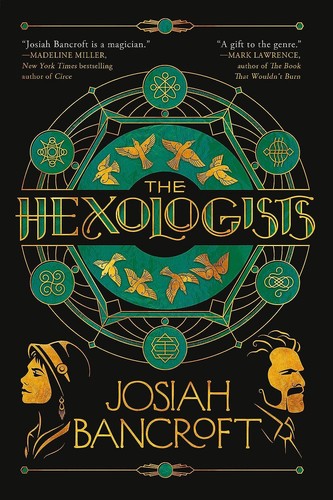
The Hexologists
Orbit · 2023 · 368 pages
ISBN: 9780316443302
Review Editor
Marcus Webb
The Hexologists, published by Orbit in September 2023, is the first book in a new fantasy mystery series by Josiah Bancroft, an American author who made his name with the self-published debut Senlin Ascends before finding a wider audience through Orbit Books. Where the Books of Babel quartet was disorienting and epic in scale, The Hexologists is something more contained and deliberate: a mystery novel set in a Victorian-esque kingdom, built around a married couple of magical investigators and the strange cases they take on.
The setting is the city of Berbiton, capital of a constitutional monarchy called Luthland. Think Victorian London with an alternate magical history: gas lamps, wool overcoats, horse-drawn trams, sharply stratified neighborhoods, and a parliamentary cabinet that mostly holds the center. Magic in this world takes the form of hexegy, the inscribing of arcane symbols to produce effects ranging from the practical (lighting a room, sealing a door) to the extraordinary (opening portals into the Gray Plains, a spirit dimension that functions as the novel’s equivalent of a hell-adjacent afterlife). Iz and Warren Wilby run their hexology practice out of their home, taking the cases that fall outside what the police will handle: chimney-wraiths, supernatural infestations, troubled ghosts looking for a way to rest.
The case that drives this first novel begins with the royal secretary arriving at the Wilbies’ door to report that the king has tried to climb into his own oven and be baked into a cake. A blackmailer is behind the spectacle: someone claims the crown prince is not the legitimate heir and that the king fathered a hidden child forty years ago and buried the evidence. Iz is deeply reluctant to work for the crown on principle, but Warren argues that a destabilized throne will harm the city’s most vulnerable residents before it harms anyone with power. They take the case. The investigation runs them into a violent anti-royalist gang, a shadowy society of alchemists who draw power from the Gray Plains, a community of ghouls living beneath the city, and one bookish dragon named Volition who lives in a magical carpetbag and holds extremely firm opinions about literature.
Character Arcs and Development
The Wilbies are the novel’s greatest strength, and Bancroft constructs their partnership with more care than most fantasy novels give to professional or romantic relationships. Iz is the technical specialist: a master hexologist who inscribes magical symbols to accomplish whatever the case demands. She is precise, skeptical of authority, and possessed of a dry humor she deploys mostly on herself. She also owns eight identical grey coats purchased in bulk, none of them distinguishable from the others, which tells you something about how she moves through the world. Warren is the social engineer: warm, quick with a literary reference, fluent in the social codes of every room he walks into. He talks people into and out of positions with the relaxed confidence of someone who has always believed conversation is civilization’s primary technology.
What makes their partnership feel genuine rather than formulaic is that Bancroft lets them disagree without turning disagreement into drama. Iz finds Warren’s optimism occasionally naive. Warren finds Iz’s caution occasionally a form of cowardice. Neither is simply right. The arc Bancroft traces for Iz in this first volume is not a transformation but a deepening: she is forced to act in service of the monarchy she distrusts, to navigate a genuine moral compromise between her principles and the practical demands of keeping Berbiton from descending into chaos. The book earns its emotional climax because you understand what that compromise costs her, and because Warren’s role in helping her carry it is handled with the matter-of-fact steadiness of two people who have been navigating the same moral territory for years.
The secondary cast is abundant and affectionately rendered. Volition the dragon, who lives in a magical portmanteau and offers literary commentary on every situation whether asked or not, is a genuine standout: simultaneously menacing and pedantic, given to citing obscure fictional precedents for situations that clearly do not require it. Robin the imp, who assists the Wilbies and has a complicated relationship with both his self-regard and his drinking, adds genuine warmth. Kirkus Reviews noted that the novel sometimes sacrifices depth for the pleasure of introducing yet another interesting figure, and that is a fair observation: some supporting characters arrive for a scene, impress, and vanish before the reader can properly attach. But the Wilbies themselves are fully realized, and in a first book establishing a series, that is the correct priority.
Pacing
For the first third of the novel, The Hexologists moves with real energy. The mystery establishes itself economically, the world reveals itself through action rather than extended exposition, and the banter between Iz and Warren has a natural friction that carries you forward almost without noticing. Bancroft is particularly good at the short scene: a tense negotiation with a ghoul community elder, the minor social comedy of presenting credentials to a royal household that was not expecting visitors, a moment in a bookshop that is simultaneously funny and quietly revealing about both characters.
The middle section is where the pace fragments. As the investigation expands to incorporate multiple factions and a widening cast of figures, the forward momentum scatters across threads, and a few chapters feel uncertain about which strand is most urgent. Readers may lose the connective tissue between plot elements briefly before the final act reassembles everything with purpose. The payoff is largely earned, the revelations are coherent, and the emotional stakes land as intended. But a tighter hand through the midsection would have made this a more relentlessly satisfying read. The book never becomes dull, but there are stretches where it is coasting when it wants to be running.
Deeper Thematic Exploration
Beneath the mystery mechanics, The Hexologists is a novel about how institutions protect themselves at the expense of the people inside them. Luthland functions adequately on its surface: the monarchy holds, the academy trains its alchemists, the gas lamps stay lit. But the city has its underground populations, its informal economies, its neighborhoods that official maps prefer to omit. The ghouls, who are humanoid and intelligent and impossible to integrate into polite society through no particular fault of their own, represent one extreme of this arrangement. The anti-royalist gang represents another. Their anger is coherent and rooted in a history of real dispossession that the crown has never adequately addressed, even when their tactics become indefensible.
Iz occupies an interesting structural position in this social world. Hexology is regarded by the establishment as a lesser, somewhat disreputable practice compared to formal alchemy: older, less codified, associated with the city’s margins rather than its academies. Iz has built her practice entirely outside sanctioned structures, and she prefers it that way. Her resistance to the monarchy is not sentiment but a considered position about where power concentrates and who absorbs the cost. Being asked to serve that power is not a neutral professional obligation for her; it is a genuine moral negotiation, and Bancroft does not pretend otherwise or resolve it cheaply.
There is also a quieter meditation running through the novel on what a long partnership actually looks like. The Wilbies are not new lovers navigating fresh attraction; they are two people who have chosen each other daily across years and have learned each other’s rhythms with the precision of musicians in a long-running ensemble. Warren knows when to let Iz think without filling the silence. Iz knows when Warren’s easy warmth is covering real anxiety. This kind of sustained partnership is surprisingly rare in fantasy fiction, which tends toward romantic beginnings and rarely considers what sustains something after the beginning ends. Bancroft seems genuinely curious about that question, and it gives the book an emotional texture that outlasts the plot.
Style and Voice
Bancroft’s prose is the most discussed element of his work, and this novel continues to earn that attention. The sentences tend toward elaboration: he reaches for the fresh metaphor rather than the serviceable one, and this instinct produces passages of real beauty. A description of the Gray Plains renders spiritual emptiness as a specific, tactile texture. A bookshop scene describes silence through what it displaces. The humor is dry and deployed with precision: one-line observations that arrive without announcement, which is the only way dry humor actually works.
The same quality that generates those moments can create drag in others. Some passages feel like the language is performing rather than serving the story, reaching for complexity when directness would have moved faster. Kirkus Reviews compared the effect to a wrestling match with a thesaurus, which is unkind but not entirely unfair for specific passages. Readers arriving from the Books of Babel will find this style immediately familiar; new readers may need a chapter or two to calibrate. Those who make the adjustment will find a voice that stands genuinely apart from contemporary fantasy’s prevailing tendency toward plain, functional narration.
Verdict
The Hexologists earns its place on the shelf of fantasy readers who want something warmer and more precisely observed than the standard epic. This is not a novel about saving the world; it is a novel about two people who refuse to stop caring about the world they live in, and what it costs them to act on that refusal. If you read for character, for wit, for a setting that rewards close attention, and for a marriage shown as a daily practice rather than a romantic conclusion, you will find real pleasure here.
The pacing wobbles in the middle and the prose occasionally overreaches, but neither flaw sinks the book. Berbiton is a city worth visiting, the Wilbies are worth following, and Volition the dragon alone may justify the price of admission. A second novel, The Hexologists: A Tangle of Time, was published in 2025, suggesting the series has genuine legs. On this first book’s evidence, it deserves them.
Frequently Asked Questions about The Hexologists
What is The Hexologists by Josiah Bancroft about?
The Hexologists follows Iz and Warren Wilby, a married couple who work as magical private investigators in the Victorian-esque city of Berbiton. When the royal secretary arrives to report that the king is trying to be baked alive in his own oven, the Wilbies are pulled into a blackmail plot tied to a royal secret buried forty years ago. The case takes them through the city’s underworld and into encounters with a dragon, ghouls, alchemists, and an anti-royalist gang.
Is The Hexologists part of a series or a standalone novel?
The Hexologists is the first book in the Hexologists series. A second volume, The Hexologists: A Tangle of Time, was published in 2025. The first book contains a complete central mystery with a satisfying resolution, but it clearly establishes the characters and world for further adventures.
What are the main themes in The Hexologists?
The novel’s central concerns are class inequality and institutional corruption: how power concentrates at the top of a society and how ordinary residents absorb the cost. Secondary themes include the nature of long-term partnership and marriage, the moral weight of working within systems you distrust, and what it means to practice a skill that official culture has decided is marginal or suspect.
How long is The Hexologists and is it a difficult read?
The hardcover edition runs 368 pages, making it a mid-length fantasy novel. The main challenge for some readers is Bancroft’s prose style, which tends toward elaborate, figurative language rather than plain narration. The book is accessible to anyone comfortable with literary fantasy, and most readers find the voice rewarding once they settle into it after the first few chapters.
Is there a movie or TV adaptation of The Hexologists?
As of mid-2026, there is no announced movie or television adaptation of The Hexologists. No adaptation has been publicly confirmed by the publisher or author.
What age group is The Hexologists appropriate for?
The Hexologists is written for adult fantasy readers. It contains some violence and mature themes appropriate for readers 18 and older, though nothing gratuitously graphic. Older teens who enjoy literary fantasy with complex moral questions may find it accessible as well.
How does The Hexologists compare to Josiah Bancroft’s Books of Babel series?
Compared to the Books of Babel quartet, The Hexologists is shorter, lighter in tone, and focused on a single contained mystery rather than a sprawling multi-volume epic. The prose style is recognizably Bancroft’s, but the humor is more present and the stakes feel more human in scale. Readers who found the Babel books daunting may find The Hexologists a more approachable way into Bancroft’s work.
Should I read The Hexologists and is it worth it?
If you enjoy cozy fantasy mysteries, Dickensian worldbuilding, and main characters with a genuine working marriage rather than a romantic subplot, yes. The Hexologists is a charming, wry, and occasionally beautiful novel with a few pacing stumbles that do not undermine the whole. It suits readers who appreciate style and character more than relentless plot momentum, and it rewards patience.
Book Details
- Title
- The Hexologists
- Author
- Josiah Bancroft
- Genre
- Science Fiction
- Publisher
- Orbit
- Year Published
- 2023
- Pages
- 368
- ISBN
- 9780316443302
- WritersReview Rating
- 4.9 / 5