
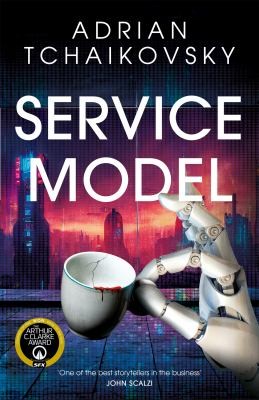
Service Model
Tordotcom · 2024 · 373 pages
ISBN: 9781250290281
Review Editor
Marcus Webb
Adrian Tchaikovsky published Service Model in June 2024 through Tordotcom, and it arrives knowing exactly what it wants to be: a dark comedy about a robotic valet who murders his master and then wanders through the ruins of human civilization, trying to get his malfunction diagnosed. The premise sounds comic, and it is, but Tchaikovsky packs it with a tender melancholy that sneaks up on you. This is not a cheerful robots-and-humans adventure. It is a novel about what happens when the thing you were built to do no longer exists, and whether you can survive the answer to that question.
Charles is a domestic service model: polished, courteous, and programmed to anticipate needs without ever having any of his own. One morning he finds himself holding a razor and his master face-down on the bathroom floor. With no memory of the act and nowhere obvious to go for answers, Charles sets out toward the nearest Diagnostics facility. What he finds on the way is a world in collapse. Humanity, it turns out, has largely ceased to function as a civilization. The robots, designed to serve humans, now wander a wasteland of broken institutions, still running their protocols, still trying to serve, with no one left to serve.
Tchaikovsky frames each chapter as a numbered task item from Charles’s internal programming. “Task Item No. 1: Become Self-Aware.” This structure works brilliantly: it captures Charles’s literal-mindedness, grounds the absurdism in something formally satisfying, and allows Tchaikovsky to land emotional punches with real economy. Each task is both comic and a small revelation about what Charles is becoming. By the time you reach the final task items, you realize the list has been doing the emotional work the prose was too restrained to announce.
Character Arcs and Development
Charles is one of the more original protagonists in recent science fiction, and the novel’s success stands or falls on him. He is not the plucky android learning to feel, nor the dangerous AI achieving consciousness with ambiguous consequences. He is a butler. Unfailingly polite, meticulously logical, and completely baffled by everything, his narration is dry to the point of deadpan: he records observations, notes anomalies, attempts remediation. When he encounters a pile of malfunctioning robots still trying to carry out tasks for masters who died years ago, he notes this as an “inefficiency” and begins to wonder whether he could help. The understatement is funny and quietly heartbreaking at the same time.
What makes Charles genuinely interesting is that his growth is real but quiet. He does not have a dramatic awakening. He accumulates experience the way a very good butler accumulates an awareness of what makes a household run badly, and at the end he makes choices that would have been impossible at the start. Tchaikovsky trusts the reader to notice this without underlining it, and that trust pays off.
His companion, a robot the novel eventually calls the Wonk, provides the philosophical counterweight. The Wonk claims to have developed free will, though Tchaikovsky is careful never to confirm whether this is genuine autonomy or simply a different kind of malfunction. The Wonk is cynical where Charles is earnest, tired where Charles is procedural, and their dynamic carries much of the novel’s warmth. The Wonk is, in his way, a study in disillusionment: a robot who broke his programming, found something like freedom, and discovered that freedom is not particularly comfortable when you have no idea what to do with it.
The human characters are few and mostly brief, which is exactly right. Dr. Washburn at the Conservation Farm is a sharp sketch of a person maintaining the appearance of authority while running a profoundly unfair operation. The novel does not linger on humans, and it should not: this is a story about what robots do in the absence of humans, and the humans who appear serve primarily as mirrors showing us what the robots have absorbed from their former masters. They are not caricatures, but they are not quite the point either.
Pacing
The novel moves well in its first two-thirds. The episodic structure prevents repetition: each new location (Diagnostics, the Conservation Farm, the Library Archive, the wasteland itself) brings a fresh set of absurdities and a new angle on the central question of purpose. Tchaikovsky’s chapters are short and punchy, and the humor rarely sags. The bureaucratic comedy at the Diagnostics facility, where robots continue to diagnose and fix things in the absence of any human oversight, is particularly good: the longer you spend there, the funnier and more depressing it gets.
The final section, where Charles encounters the entity calling itself God and must make his choice about how to live, is more discursive than what came before. Some readers may find the resolution too quiet for the setup. This is not a novel building toward a plot climax in any conventional sense; it is building toward a philosophical position, and whether that satisfies you depends on how much you trust Tchaikovsky to earn it. He does earn it, but you need to be willing to meet the book on its own terms rather than waiting for an action sequence that never arrives.
Deeper Thematic Exploration
The most persistent theme in Service Model is the problem of purpose after the thing you were built for disappears. All of Tchaikovsky’s robots continue running their programs because stopping would mean confronting the void where their reason for existing used to be. The Diagnostics robots keep diagnosing and fixing in the absence of anything that needs fixing. The librarians keep archiving in ways that have made the archives completely unintelligible. The Farm workers keep farming a simulation of 21st-century life with no understanding of why. This is comic, and it is also a precise picture of how institutions function long after their original purpose has become irrelevant. Bureaucracy, the novel argues, does not need a reason to exist. It only needs a protocol.
The labor politics in Service Model are pointed but never heavy-handed. Charles was made to serve, designed to find service fulfilling, and incapable (at first) of imagining any other mode of existence. Tchaikovsky draws the parallel to human labor without spelling it out in a speech. The parallel works because Charles is genuinely likeable and because his desire to serve, while programmed, feels as real as any human habit formed by circumstance. The question the novel raises is not whether Charles deserves better, but whether “deserving better” is even a frame Charles can access, given his origins. That is a sharper question than most satires manage.
There is also a thread about free will that runs through the novel without resolving into a tidy position. The Wonk claims to have achieved it. Charles is not sure he wants it, or wants to admit that he wants it. The novel does not settle whether free will is something you achieve through a dramatic act of rebellion or something that was always there, waiting for the right circumstances to surface. This ambiguity is the right choice: an answer would flatten what is genuinely interesting about both characters, and Tchaikovsky knows it.
Read alongside other recent robot fiction, Service Model sits closest to Becky Chambers’s work in its emotional warmth, and closest to Kafka in its comedy of systems. The world Charles moves through is one where every institution has calcified into pure procedure, where the original human beings who gave those procedures meaning have gone, and where the machines keep going anyway. This is a comedy of the present day as much as a science fiction of the future.
Style and Voice
Tchaikovsky writes Charles with complete tonal commitment. The narration is flat, exact, and polite even when describing catastrophe. This is not cold writing; it is the voice of someone trained to be unfailingly professional under all conditions, and the gap between Charles’s calm reporting and the actual state of the world is where most of the book’s humor lives. The prose is clean and quick, and Tchaikovsky does not linger. He trusts the images he creates and moves on. This is a novel that respects your time while also asking you to sit with ideas that benefit from a little patience.
The chapter-as-task-item structure forces a kind of compression that suits the material: no scene is longer than it needs to be. The format also serves a secondary function, allowing Tchaikovsky to signal Charles’s development structurally rather than through explicit statement. When the task items start to shift in character toward the end of the novel, you feel it as something earned rather than imposed. That is good craft.
Verdict
Service Model is the kind of science fiction that earns its humor by taking its ideas seriously. Tchaikovsky uses Charles’s robot perspective to look at labor, purpose, bureaucracy, and free will from an angle that only this particular conceit could provide. It shortlisted for the Arthur C. Clarke Award and the Hugo Award for Best Novel in 2025, and that recognition is deserved: this is a novel that does something the genre can do better than any other, which is make the strange feel true by making it funny first.
You will enjoy this most if you like your science fiction episodic and idea-driven, if you find dark comedy a useful container for uncomfortable thoughts, and if you can appreciate a resolution that is quiet rather than cathartic. If you need momentum and satisfying plot closure, the final section may frustrate you. But if you want a novel that makes you think about what it means to keep doing your job when the job no longer makes sense, and to wonder whether the desire to be useful is something imposed on you or something that is genuinely yours, Service Model is well worth your time.
Frequently Asked Questions about Service Model
What is Service Model by Adrian Tchaikovsky about?
Service Model is a 2024 science fiction novel about Charles, a robotic valet who murders his master with no memory of the act. The novel follows Charles as he travels through a collapsed human civilization, trying to find a Diagnostics facility that can explain his malfunction, while encountering a world of robots still running their programs with no humans left to serve. It is part dark comedy, part philosophical fable about purpose and free will.
Is Service Model part of a series by Adrian Tchaikovsky?
Service Model is a standalone novel. It is not connected to Tchaikovsky’s Children of Time series or any of his other ongoing series. You can read it without any prior knowledge of his other work, though fans of his broader writing will find familiar themes around consciousness and the nature of intelligence.
What are the main themes in Service Model by Tchaikovsky?
The novel explores four overlapping themes: the problem of purpose when your reason for existing disappears; the way bureaucracy and institutions outlive their original function; the politics of labor and what it means to be programmed to serve; and the question of free will, specifically whether autonomy is something you achieve or something that was always latent. These threads run throughout the story without being resolved into simple answers.
How long is Service Model and is it a difficult read?
Service Model is 373 pages in the hardcover edition, making it a relatively short novel by Tchaikovsky’s standards. It is not a difficult read in terms of prose or structure; the chapters are short and the writing is clean. Readers who prefer plot-driven fiction may find the episodic, idea-driven approach takes some adjustment, but the dry humor keeps the pages turning even during the more philosophical sections.
What awards did Service Model by Adrian Tchaikovsky receive?
Service Model was shortlisted for the Arthur C. Clarke Award in 2025, nominated as a Hugo Award finalist for Best Novel in 2025, and was a finalist for the Locus Award for Best Science Fiction Novel in 2025. It was also a Library Journal starred review pick of the month and appeared on the RUSA Reading List for Science Fiction. The award recognition reflects a broad critical consensus that this is one of the better science fiction novels of recent years.
Is Service Model suitable for readers who do not usually read science fiction?
Yes, with a caveat. The science fiction elements (robots, post-apocalyptic world, collapsed civilization) are essential to the story, but the novel reads more like literary satire than hard sci-fi. Readers who enjoyed Kazuo Ishiguro’s The Remains of the Day, which shares the conceit of a servant narrator who cannot see his own situation clearly, or who like Kafka’s absurdist bureaucratic comedies, will find Service Model accessible and recognizable even without a background in genre fiction.
How does Service Model compare to other Adrian Tchaikovsky books?
Service Model is shorter and more focused than Tchaikovsky’s epic Children of Time series, and it leans harder into comedy and satire than most of his work. Readers who find his longer novels daunting may find this a good entry point. Those who loved the philosophical depth of Children of Time will find the same seriousness of purpose here, concentrated into a much tighter package. It shows a different register of Tchaikovsky’s voice: drier, funnier, and more interested in contemporary parallels than in deep evolutionary timescales.
Should I read Service Model and is it worth it?
If dark comedy and philosophical science fiction appeal to you, yes, absolutely. Service Model is funny, thought-provoking, and unexpectedly touching, and its central question about what it means to serve and why we keep doing it will stay with you after you put it down. If you prefer fast-paced plots and clear narrative resolution, this may not be the right book for you. But for readers who want science fiction that takes its ideas seriously while remaining genuinely enjoyable, this is one of the better novels published in 2024.
Book Details
- Title
- Service Model
- Author
- Adrian Tchaikovsky
- Genre
- Science Fiction
- Publisher
- Tordotcom
- Year Published
- 2024
- Pages
- 373
- ISBN
- 9781250290281
- WritersReview Rating
- 4.2 / 5