
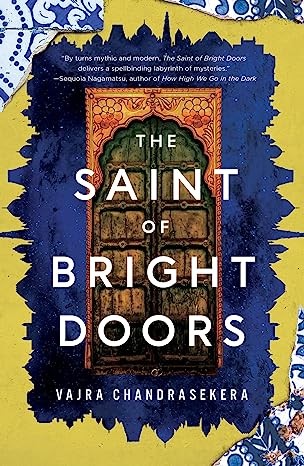
The Saint of Bright Doors
Tordotcom · 2023 · 384 pages
ISBN: 9781250847386
Review Editor
Marcus Webb
When Vajra Chandrasekera’s debut novel arrived from Tordotcom in July 2023, it carried the unmistakable weight of a writer working at full capacity, someone who had spent years thinking hard about what a fantasy novel could do with the materials of religion, power, and inherited fate. “The Saint of Bright Doors” is set in the fictional city of Luriat, a place inspired by South Asian cosmologies and the grinding administrative texture of modern urban life. It follows a man called Fetter, who was built, from infancy, to be a weapon.
Fetter’s mother, Heron, a woman of fearsome dedication, prepared him for a single purpose: to kill his estranged father, a charismatic spiritual leader known as the Perfect and Infinite. As a child, Fetter trained until he could walk without casting a shadow, move with preternatural precision, and detach himself from the ordinary rhythms of human connection. His entire childhood was a curriculum, and its subject was murder. But when Fetter finally cuts himself loose from Heron’s influence and travels to Luriat, he does something his mother never accounted for. He makes friends. He discovers a support group of other “failed saints,” people who were marked at birth for miraculous purpose but, for one reason or another, never delivered on their promise. He falls into their company, and for the first time in his life, begins to learn what it means to belong somewhere.
The bright doors of the title are real: inexplicable portals that flicker open across Luriat’s streets and alleys, visible to all, approachable by none, and officially catalogued by the city’s bureaucrats. Citizens file forms when a door appears near their homes. Office workers take note of them in incident logs. The city’s various religious and political movements interpret them as signs, each claiming them for their own symbolic purposes. Chandrasekera uses the doors as a recurring image rather than a puzzle to be solved, and this choice tells you a great deal about the kind of novel this is. “The Saint of Bright Doors” is less interested in resolving its mysteries than in watching how a city and its people absorb the inexplicable and keep moving.
Character Arcs and Development
Fetter is a fascinating protagonist because his arc runs directly against genre expectation. He was made for violence and glory, but what he actually wants, with a longing he barely knows how to name, is ordinary life. He wants to sit in cafes, hold a job, build slow friendships, exist somewhere without always scanning the room for threats. Chandrasekera tracks this desire with attention and quiet wit. Fetter’s growing attachment to the community of failed saints feels genuinely earned, and the warmth the novel generates in those sections is more affecting than any action sequence could be.
The failed saints themselves form a loose ensemble, and Chandrasekera handles them with restraint. He doesn’t overload you with backstory; instead, he lets these figures emerge through behavior and conversation. Koel and Pipra, two members of the group who become Fetter’s closest companions, feel like complete people rather than supporting functions. Their exchanges crackle with the kind of dry, sideways intelligence that threads through the entire book. Secondary characters, including city officials, neighborhood figures, and members of competing religious movements, are drawn economically but never feel thin. Luriat itself functions almost as a character: a bureaucratic organism with its own habits, its own ways of absorbing disruption, its own particular brand of violence.
The shadow of Fetter’s mother runs through the entire narrative. Heron never fully disappears as a presence, and the damage she did to her son reads as a sustained meditation on the way love, when wielded as a tool, warps the person it touches. The Perfect and Infinite, Fetter’s father, is handled differently: he remains more symbol than person, more force than individual. Whether this satisfies will depend on the reader, but it is consistent with the novel’s larger argument that the systems of belief and power that shape people are often too large and diffuse to be reduced to individual villains.
Pacing
This is where the book will divide its readers, and it’s worth being direct about it. Chandrasekera writes with an unusual relationship to time. Events accumulate rather than escalate. The novel moves through years of Fetter’s life in Luriat in a way that resembles the rhythm of a life actually being lived, not the rhythm of a plot being executed. The middle section spreads wide, full of political developments, philosophical conversations, bureaucratic texture, and the daily routines of people who are, in various ways, waiting. For readers accustomed to forward-momentum fantasy, this will feel slow, and in places it is slow.
But the slowness is purposeful. The tension in “The Saint of Bright Doors” is less about what will happen next and more about how long a person can avoid the shape of their own destiny, how long a city can absorb mounting pressures before something gives, how long the gap between private life and public catastrophe can hold. When the novel’s later sections arrive with their accumulation of consequence, the weight they carry comes from everything that built quietly beneath them.
Deeper Thematic Exploration
The novel’s deepest concern is the violence built into belief systems, particularly belief systems that have fused with political power. Luriat is a city where religious movements and state apparatus have grown into each other over decades, producing something bureaucratic and terrible, a machine for categorizing, controlling, and sometimes eliminating the people who don’t fit its categories. Chandrasekera is Sri Lankan, and the novel’s treatment of ethnic nationalism, colonial legacy, and the instrumentalization of religion draws on that history without ever flattening itself into allegory. The parallels are legible, and they’re meant to be, but the world he builds has its own internal logic and its own particular strangeness.
Fetter’s shadowlessness is the novel’s central metaphor made literal. His shadow was removed as part of his childhood training, the most visible mark of how thoroughly his selfhood was given over to someone else’s project. The question of whether a person so shaped can become fully their own is one the novel returns to again and again, without offering easy comfort. Fetter tries to build a life, and the novel refuses to pretend that trying is enough, that good intentions can fully undo what has been done to a person. This gives the book an emotional honesty that distinguishes it from more reassuring fantasy.
The bright doors themselves operate as the novel’s most resonant image. They appear without warning, their origin unexplained, their destination unknown. No one who enters returns to describe what they found. The city builds forms around them. Files are opened, dates noted, locations recorded. Life continues at their edges. Chandrasekera uses them to evoke something precise: the way societies domesticate horror through process, the way the genuinely inexplicable gets absorbed into routine so that no one has to stop and reckon with what it means. It’s a political observation rendered in pure image, and it lands harder than any explicit argument could.
Style and Voice
Chandrasekera’s prose works through a distinctive kind of flatness. The narrative voice shifts register without warning, moving from lyric to dry to clinical within a paragraph, and the effect is disorienting in a way that feels intentional. Violence and wonder receive the same level documentation. The understatement generates its own unease. You feel the weight of events through what isn’t said, through gaps and absences that pile up quietly until you register them all at once.
The world-building operates on similar principles. Chandrasekera doesn’t explain Luriat so much as deposit you in it, assuming you’ll orient yourself the same way a newcomer would, by paying attention, asking questions the novel may or may not answer directly, building a picture over time. This takes something from the reader, a willingness to stay with confusion longer than is comfortable. But it produces a setting that feels genuinely inhabited rather than constructed, a place that has been going on before you arrived and will continue after you leave.
Verdict
“The Saint of Bright Doors” is a novel for readers who are willing to work. It asks you to sit with uncertainty, to keep reading through passages where the payoff isn’t immediately visible, to trust a writer who is doing something more oblique and more durable than delivering a satisfying plot. That trust is rewarded, though not in the way genre fiction typically rewards patience. The ending doesn’t resolve so much as cohere, pulling together the novel’s long accumulation of images and ideas into something that feels, in retrospect, inevitable.
If you care about fiction that thinks about what power does to people, about the way inherited purpose shapes and sometimes destroys a life, about the forms political horror takes when it has had enough time to become ordinary, this is essential reading. Readers looking for propulsive plotting or clean moral clarity will struggle. But if you’ve ever wanted a fantasy novel that takes religion and politics seriously, that builds a world with genuine historical texture, and that trusts you to keep up, few recent debuts offer anything close to what Chandrasekera delivers here. Read it slowly. It will stay with you.
Frequently Asked Questions about The Saint of Bright Doors
What is The Saint of Bright Doors by Vajra Chandrasekera about?
The Saint of Bright Doors follows Fetter, a man raised from birth by his mother to assassinate his father, a mythic spiritual leader known as the Perfect and Infinite. After breaking from his mother’s control, Fetter moves to the city of Luriat, joins a support group of “failed saints,” and tries to build an ordinary life, even as the city’s political and religious tensions press in from every direction. The novel is set in a world inspired by South Asian culture and mythology.
What are the bright doors in The Saint of Bright Doors?
The bright doors are mysterious portals that appear and disappear across the city of Luriat. No one can open them or control where they appear, and no one who enters ever returns to describe what they found. The city’s bureaucracy catalogues them on official forms. Chandrasekera uses them less as a plot device and more as a recurring image for the inexplicable, and for the way societies absorb horror through routine and documentation.
What awards did The Saint of Bright Doors win?
The novel won the Nebula Award for Best Novel in 2024, the Locus Award for Best First Novel in 2024, the Ignyte Award for Best Adult Novel in 2024, and the IAFA William L. Crawford Fantasy Award in 2024. It was also shortlisted for the Hugo Award for Best Novel and nominated for the Ursula K. Le Guin Prize for Fiction.
What are the main themes in The Saint of Bright Doors?
The novel explores the violence embedded in religious and political belief systems, the lasting damage of being raised to serve someone else’s purpose, and the question of whether a person shaped by an oppressive upbringing can ever fully become their own. It also engages with colonialism, ethnic nationalism, and the way bureaucracy serves as a vehicle for systemic harm. These themes are drawn from South Asian history without reducing the novel to allegory.
How long is The Saint of Bright Doors and is it a difficult read?
The novel is 384 pages, but it reads longer than that suggests because of its deliberately slow, accumulative pacing. It is a genuinely challenging read, with an unusual narrative voice, a world that doesn’t explain itself, and a plot that builds through weight rather than momentum. Readers who prefer clear forward drive and resolved mysteries will find it demanding. Readers comfortable with literary fiction and patient storytelling will find the difficulty rewarding.
Is The Saint of Bright Doors part of a series?
No. The Saint of Bright Doors is a standalone novel. Chandrasekera has published short fiction across various magazines and anthologies, but this is his debut novel and it was written to be complete in itself. There is no sequel announced as of the time of this review.
How does The Saint of Bright Doors compare to other literary fantasy novels?
The novel sits in the tradition of literary fantasy that uses the genre’s tools to examine real-world power structures, similar in ambition to work by authors like N.K. Jemisin, Sofia Samatar, or Silvia Moreno-Garcia. Its prose style and structural approach are distinctive, with a debt to experimental literary fiction that some readers have compared to Kafka or Samuel Delany. It shares DNA with postcolonial literary fiction as much as with any fantasy tradition.
Should I read The Saint of Bright Doors, and is it worth it?
If you want an inventive, politically serious fantasy novel with a distinctive voice and real emotional depth, yes. It rewards patience and close reading. If you want a fast-paced story with a satisfying resolution, this isn’t your book. The novel’s Goodreads rating reflects a genuine split: readers who wanted propulsive fiction found it slow, while readers who came in knowing its ambitions often ranked it among the best novels they’d read. Know which kind of reader you are before you start.
Book Details
- Title
- The Saint of Bright Doors
- Author
- Vajra Chandrasekera
- Genre
- Science Fiction
- Publisher
- Tordotcom
- Year Published
- 2023
- Pages
- 384
- ISBN
- 9781250847386
- WritersReview Rating
- 4.3 / 5