Vajra Chandrasekera
Vajra Chandrasekera is a Sri Lankan author of science fiction and fantasy whose debut novel established him as one of the most formally ambitious and culturally distinctive voices in contemporary speculative fiction. He is based in Colombo, Sri Lanka, and his work draws deeply on South Asian history, mythology, and political experience in ways that feel genuinely new in the English-language science fiction field. He has been publishing short fiction since around 2012, appearing in venues including Clarkesworld, Strange Horizons, Beneath Ceaseless Skies, and The Magazine of Fantasy & Science Fiction, building a reputation for dense, luminous, and formally inventive work before publishing his first novel.
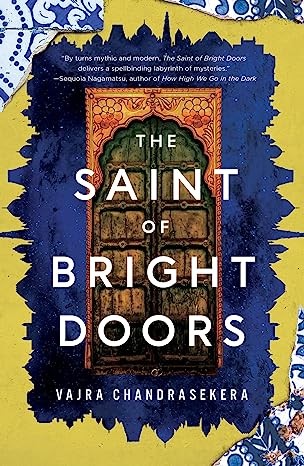
The Saint of Bright Doors (2023), available on WritersReview, was published by Tor Books and won the Astounding Award for Best New Writer (given to Chandrasekera himself rather than to the book) as well as the Locus Award for Best Fantasy Novel. The novel is set in a secondary world city and follows Fetter, the abandoned child of a messianic figure who was literally trained from childhood to become a weapon — a destiny he has quietly refused. The novel’s “bright doors” are literal portals that hover inches above the ground throughout the city, which only the living can pass through, and which serve as a sustained metaphor for liminality, the afterlife, and the borders between states of being. Chandrasekera’s worldbuilding draws on Buddhist cosmology, South Asian political history, and the particular textures of postcolonial urbanism.
Chandrasekera’s prose style is one of his most distinctive qualities: dense, allusive, and accumulative, it builds worlds through implication and lateral suggestion rather than direct exposition. His work requires and rewards active readership, offering layers of meaning that become more apparent on re-reading. He is particularly interested in how power structures — religious, political, bureaucratic — shape individual lives and constrain individual choice, and in the small, stubborn acts of resistance by which people preserve something of themselves within systems designed to absorb or destroy them.
His second novel, Rakesfall (2024), further develops his distinctive approach, working at an even larger temporal scale to explore how civilisations rise, fall, and transform over centuries. Chandrasekera represents a genuinely new direction for Anglophone science fiction and fantasy: not the importation of South Asian surface detail into Western genre structures, but a fundamental rethinking of what speculative fiction can do when built from different cosmological and political foundations. He is a writer of considerable importance, and his career is only just beginning.