
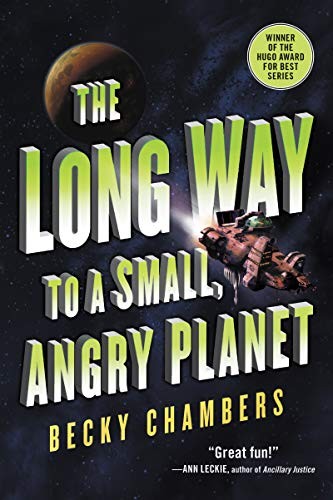
The Long Way to a Small, Angry Planet
Harper Voyager · 2016 · 441 pages
ISBN: 9780062444134
Review Editor
Marcus Webb
The Long Way to a Small, Angry Planet, published in the United States by Harper Voyager in 2016, began its life considerably more modestly: a Kickstarter-funded self-published novel that Becky Chambers wrote during a cross-country road trip in 2014. That leisurely, exploratory spirit made it into the book’s DNA in ways that are immediately apparent and eventually quite satisfying. The novel follows the crew of the Wayfarer, a tunneling ship that punches faster-than-light pathways through space, as they accept a long-haul contract to create a tunnel to the Galactic Core. The journey will take the better part of a year and carry them through some of the most remote and unpredictable corners of the Galactic Commons, an interstellar civilization built on the fragile diplomacy of many competing species.
The viewpoint character is Rosemary Harper, a young human woman who joins the crew as a file clerk while fleeing an unnamed trouble back on Mars. She is the reader’s guide into this world, but Chambers is careful not to make her a simple question-asking tourist. Rosemary arrives with her own secrets and her own particular reasons for running, and her curiosity about her crewmates feels genuine rather than functional. What unfolds is not an adventure story in any conventional sense. No single crisis drives the plot forward from page one. Instead, Chambers structures the novel as a series of stops along the way, each one introducing a new environment, a new species, or a deeper window into a crewmember’s inner life.
The Wayfarers universe is dense with intelligent species. Humans occupy a modest and slightly embarrassed corner of a civilization built on interspecies diplomacy, and they are very much not the center of the story. Sissix, the Aandrisk pilot, has a relationship to family and physical affection that operates on entirely different assumptions than human norms. Ohan, the ship’s navigator, exists as a Sianat Pair: a being shaped by a symbiotic infection that grants extraordinary mathematical gifts at a considerable cost. Dr. Chef, who serves simultaneously as the Wayfarer’s medic and cook, is the last surviving member of a species called the Grum. Each crew member arrives with a fully realized cultural logic, and Chambers lets those differences breathe rather than collapsing them into allegory.
Character Arcs and Development
The cast is the whole point of this book, and Chambers knows it. Rosemary’s arc is the most structurally conventional: she arrives closed off, her secrets slowly surface through conversations with the crew, and she leaves more open to the world and to herself. What keeps her from becoming a generic everyman proxy is the specificity of her situation. Her reasons for hiding are particular and believable, and her development feels earned rather than inevitable, grounded in actual conversations rather than symbolic gestures.
The more interesting character work happens between Jenks and the ship’s artificial intelligence, Lovelace, known to the crew as Lovey. Jenks is the Wayfarer’s shorter, scrappier technician, and his relationship with Lovey is the novel’s most emotionally complex thread. They are in love, as much as that word can extend across the boundary between flesh and code. Chambers handles this with genuine care: she does not pretend the relationship is simple or safe from difficulty, and she does not weaponize it as a twist. The question of Lovey’s consciousness, her curiosity about sensory experiences she cannot have, and what it would mean to give her more access to the world anchors some of the novel’s best and most quietly moving scenes.
Dr. Chef deserves particular mention. He is a creature who has outlasted his entire species, and Chambers allows that grief to sit quietly in the text without dramatizing it at every opportunity. There is a scene in which he prepares food for a crew member in distress, selecting dishes from multiple cultural traditions as a way of communicating something he does not have the words for. It is the kind of small, specific moment that novelists frequently reach for and rarely achieve. Chambers achieves it. Secondary characters like Corbin, the ship’s antisocial algaeist, and Captain Ashby, who carries his own complicated history with the Exodus Fleet, add further texture without overloading the ensemble.
Pacing
Honesty matters here. The Long Way to a Small, Angry Planet moves slowly, and by design. Chambers is interested in the texture of daily life aboard a small ship: in the conversations people have over meals, in the quiet negotiations between very different kinds of beings, in the small gestures that make a crew into a family. Readers who need a relentless plot engine will find themselves impatient through the novel’s middle third, when the journey becomes genuinely episodic and the stakes feel deliberately local. At least one planetary stop drags in ways that do not pay off in proportion to the time spent there.
That said, the structure is ultimately honest with the reader. The title tells you exactly what you are getting into. The destination is a small, angry planet. The book is about the long way there. When real conflict does arrive, in the final act, it lands with weight precisely because Chambers has spent so many pages building the relationships that are now at risk. That investment in character over plot is the novel’s defining choice, and its results are on display in the ending.
Deeper Thematic Exploration
The most interesting dimension of this novel is its politics, which are embedded in the texture of the world rather than announced in speeches. The Galactic Commons operates on a version of cooperative diplomacy that has managed, imperfectly, to keep competing species in a rough working peace. Humans are newcomers and outsiders, remembered by older species partly for the history of environmental destruction they carried into space. This context gives Rosemary’s personal arc a layer of meaning that extends beyond individual growth: she is learning to be accountable for a history she did not choose, to engage with difference rather than retreating to the familiar. That is a genuinely interesting problem for a character to sit with, and Chambers does not resolve it too cleanly.
The novel is also doing serious thinking about consciousness and what it means to be a person. Lovey, the AI, wants a body. Not because her situation is a tragedy or because her programming has gone wrong, but because she is curious, because she wants to know what smell is like, what it feels like to have a stomach. Her wanting is presented as the reasonable desire of any conscious being, not as a glitch to be fixed or a catastrophe to be feared. In a genre that often reaches for artificial intelligence as a source of dread, Chambers reaches for it as a source of tenderness, and that is a considered and deliberate inversion.
Running underneath all of this is a consistent, undefensive optimism. Not naive optimism: characters face real loss, real grief, genuine failures of communication and understanding. But the novel’s underlying argument is that contact between very different kinds of minds is possible, and that attempting it is worthwhile. In a galaxy saturated with stories about power and war, Chambers writes about the harder project of figuring out how to actually live alongside each other. It is a quieter ambition, and she pursues it with care.
Style and Voice
Chambers writes in a clean, warm third-person limited that shifts perspective between characters but settles most often near Rosemary. The prose rarely calls attention to itself, which is the right instinct for a book so focused on relationships and conversation. The dialogue is particularly strong: characters speak in ways that feel natural and distinct, with rhythms and vocabularies that belong specifically to them. You can frequently identify who is speaking before the attribution arrives.
The world-building is handled almost entirely through action and dialogue, which is exactly the right approach. You learn about the Aandrisk customs around touch and family, about the mechanics of tunnel creation, about the Grum’s communal understanding of self, all through scenes in which those things are relevant and alive. The universe feels full because Chambers populates it with specific, particular details rather than taxonomic overviews. Nothing here reads like an encyclopedia entry wearing a thin fictional disguise.
Verdict
If fast-moving plots and high-stakes action are what you need from science fiction, this is the wrong book. But if you want to spend time in the company of a crew you will genuinely miss when the book ends, The Long Way to a Small, Angry Planet offers something that proves surprisingly hard to find: a science fiction novel that asks what the future might actually feel like if people were trying, honestly, to understand each other. It is a book about kindness as a form of intelligence, about curiosity as a survival strategy, and about the small acts of care that hold a community together across the enormous distances between species, cultures, and kinds of mind.
Becky Chambers built something quietly remarkable here. The Wayfarers series continues with A Closed and Common Orbit, which stands on its own and is equally good in different ways. But start with this one, and take your time with it. The long way is the right way.
Frequently Asked Questions about The Long Way to a Small, Angry Planet
What is The Long Way to a Small, Angry Planet by Becky Chambers about?
The novel follows the diverse crew of the Wayfarer, a tunneling ship that creates faster-than-light pathways through space, as they take a year-long contract to reach the Galactic Core. Newcomer Rosemary Harper joins as a file clerk while escaping her past, and the book moves through multiple stops and encounters along the way. It focuses far more on character relationships and cultural exchange than on action or suspense.
Is The Long Way to a Small, Angry Planet a standalone novel or part of a series?
It is the first book in the Wayfarers series, but each novel in the series works as a standalone. The sequels share the same universe and some characters but tell independent stories. A Closed and Common Orbit, the second book, picks up with one character from this novel and tells a very different kind of story. You can start anywhere in the series, though most readers find it rewarding to begin here.
What are the main themes in The Long Way to a Small, Angry Planet?
The book explores found family and chosen community, the challenges of cross-cultural understanding between very different species, the nature of artificial consciousness through the ship’s AI Lovey, and what it means to build a life away from where you started. Running through all of it is an argument for empathy and curiosity as practical tools for navigating a universe full of difference.
How long is The Long Way to a Small, Angry Planet and is it a difficult read?
The Harper Voyager paperback edition runs to 441 pages. The prose is accessible and conversational, and the science fiction concepts are explained through character interaction rather than technical exposition. The bigger challenge for some readers is the episodic pacing, which asks for patience with a slow-building story that prioritizes atmosphere and relationships over plot momentum.
Is there a movie or TV adaptation of The Long Way to a Small, Angry Planet?
As of 2026, no film or television adaptation has been produced. The book’s episodic, character-focused structure would suit a streaming series format more naturally than a single film. Chambers has a devoted following, and adaptation interest has been reported over the years, but nothing has moved into production.
What age group or reading level is The Long Way to a Small, Angry Planet for?
The book is written for adult readers and includes mature themes around relationships, identity, grief, and mortality, though its content is not graphic. Many readers in their mid-teens find it accessible and meaningful. It is particularly popular with readers new to science fiction who find harder, more technical subgenres off-putting. Readers who enjoy found-family stories and character-driven fiction across all genres tend to respond strongly to it.
How does The Long Way to a Small, Angry Planet compare to Becky Chambers’ other books?
This debut established the warm, character-centered approach that defines all of Chambers’ work. Her follow-up Wayfarers novels deepen the philosophical questions she introduces here, while her Monk and Robot novellas (beginning with A Psalm for the Wild-Built) take a more intimate approach to similar themes. Compared to her later, tighter novellas, this book is more sprawling and exploratory, and probably the best entry point into her work.
Should I read The Long Way to a Small, Angry Planet and is it worth it?
If you have ever wanted science fiction that felt genuinely optimistic without feeling naive, this is the book for you. It rewards patient readers with one of the most memorable casts in recent genre fiction and a vision of the future that feels actually livable. The slow pacing in the middle third is a real limitation. But if you connect with the crew, you will likely reach the end wanting more time with them, which is exactly what a series opener should accomplish.
Book Details
- Title
- The Long Way to a Small, Angry Planet
- Author
- Becky Chambers
- Genre
- Science Fiction
- Publisher
- Harper Voyager
- Year Published
- 2016
- Pages
- 441
- ISBN
- 9780062444134
- WritersReview Rating
- 4.2 / 5